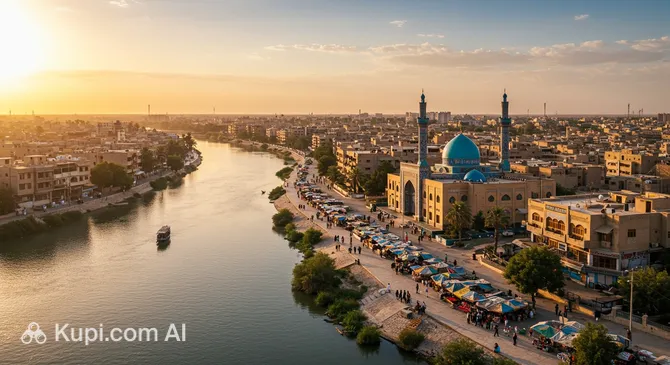
Ramadi is a dynamic administrative center of the Anbar Province, stretching along the scenic banks of the legendary Euphrates River in Iraq. The city possesses a unique atmosphere where the traditions of Arab tribes harmoniously intertwine with the rhythm of a modern commercial hub. Founded in the late 19th century, it quickly transformed into a key point on trade routes connecting Baghdad with the Levant, which left a mark on its architectural appearance and the hospitable character of local residents.
The city's geographic location largely defines its life: its proximity to water has made Ramadi an oasis amidst desert landscapes, contributing to the development of agriculture and trade. With a population of about 874,543, the city remains one of the largest and most significant centers in the region. Travelers can expect an authentic introduction to the heritage of the Dulaim confederation, whose cultural traditions permeate the city's daily life.
Ramadi. Illustration.
Source: Kupi.com AI
The city's rich historical heritage is evident in its preserved Ottoman-era administrative buildings and bustling markets. Strolls along the Euphrates and visits to local bazaars allow you to feel the spirit of the old caravan route. Ramadi invites those seeking genuine Oriental flavor and wanting to see Iraq beyond the usual tourist routes.
Weather Overview
The climate in Ramadi is typical for the desert regions of the Middle East: summers here are extremely hot and dry, while winter brings long-awaited coolness. To plan your trip correctly, it is important to consider that the weather in the city can change abruptly throughout the day, especially during transitional seasons.
In the summer months, particularly July and August, daytime temperatures regularly exceed +43°C, and rain is virtually non-existent during this period. Winter days are much more pleasant—in January, the average maximum is around +16.5°C, although nights can be quite chilly (down to +6°C). Precipitation is rare, occurring mainly between November and April, and even then, it is short-lived.
The Euphrates River has a beneficial effect, slightly softening the heat in coastal areas. Nevertheless, the most comfortable time to visit the city is considered to be spring (March-April) and autumn (October-November), when the air is warmed to pleasant temperatures, and the dry desert air is much easier to tolerate.
Average monthly temperature
Average monthly precipitation
Interesting Facts
The city of Ramadi holds many curious details in its history that help to better understand its character and significance for the region.
The city was officially founded in 1879 by the Ottoman governor Midhat Pasha specifically to strengthen control over nomadic tribes and create a stable trading post.
Ramadi is historically the ancestral home of the powerful Dulaim Arab tribal confederation, which still determines the city's social structure and customs today.
Due to its location, the city served for centuries as a vital transit point for caravans traveling from Baghdad to Syria and Jordan.
Despite the region's arid climate, Ramadi is considered a green city thanks to an extensive irrigation system from the Euphrates.
The city's population has been estimated differently over the years, reaching an impressive 874,543 people, making it one of the key demographic centers of western Iraq.
How to Get There
Ramadi's transport accessibility is due to its advantageous position at the intersection of major road arteries. The city is an important link between the country's capital and the western borders, making road transport the most preferred way to arrive. If you are planning a visit, it is useful to research the options for how to get to this regional center in advance.
The nearest major hub for air travelers is Baghdad International Airport. After landing in the capital, tourists usually continue their journey by intercity buses or taxis. The road from Baghdad to Ramadi follows modern highways and takes a relatively short time, offering views of the Euphrates valley along the way.
Railway communication in the region is currently limited, so most travelers rely on the developed network of bus stations. Regular bus services connect Ramadi with Fallujah and other cities in the Anbar province. For a more comfortable trip, you can use the services of private carriers or rent a car with a driver.
Station
Passenger traffic
Distance
Baghdad railway station
10
104 km
Main Attractions
The main attractions of Ramadi are inextricably linked with its location on the banks of the great Euphrates River. The embankment itself is a favorite place for strolls, where you can observe traditional farming methods that have changed little over the past centuries. The river gives the city a special freshness and serves as a natural center of attraction for residents and guests.
For history buffs, the 19th-century administrative buildings are of particular interest. The city was founded at the initiative of the Ottoman Governor of Baghdad, Midhat Pasha, and architectural traces of that period can still be found in the central districts. These structures reflect the era when Ramadi was just beginning its journey as an important strategic and trade hub of the Ottoman Empire.
No less fascinating is a visit to the local markets, which are themselves a living museum of culture. Here, among the rows of spices and fabrics, you can feel the heritage of the ancient caravan routes. Although there are no large-scale monumental landmarks in the city, its true charm lies in the details: in the traditional masonry of old houses and in the hospitable atmosphere characteristic of the tribal unions of this region.
Local Cuisine
The culinary traditions of Ramadi are deeply rooted in Arab heritage and are largely defined by the bounty of the Euphrates River. The foundation of local cuisine consists of dishes made from fresh fish, lamb, and rice, often prepared according to ancient recipes of the Dulaim tribes. The city's gastronomic scene is permeated with the aromas of spices and smoke from the open fire used to cook most meat delicacies.
You should definitely try the local version of Masgouf—fish grilled over coals in a special way—as well as the hearty Quzi (baked lamb with rice and nuts). Street food at the markets deserves special attention: here you can taste the freshest flatbreads straight from the tandoor, spicy falafel, and various kebabs. Vegetables and fruits grown in the fertile river valley always have a rich flavor.
The drink culture in Ramadi centers around tea and coffee. Traditional Iraqi tea is served very strong and sweet in small glass cups (istican), while Arabic coffee is flavored with cardamom. These drinks are an integral part of any social interaction. For an authentic taste, it's best to head to the central bazaars, where the city's oldest teahouses are located in shady courtyards.
Travel Tips
Preparing for a trip to Ramadi requires attention to details that will make your journey comfortable and safe. These tips will help you quickly adapt to the city's cultural environment and get the most enjoyment from your visit.
Clothing and Dress Code: Choose modest clothing that covers shoulders and knees to show respect for local traditions. In summer, a hat and sunglasses are essential, as temperatures often exceed +40°C.
Transport: The most convenient way to get around is by taxi. Ride-hailing apps may not be available, so it's better to agree on a price with the driver in advance or use services provided by hotels.
Finance: The primary currency is the Iraqi Dinar. Cards are rarely accepted, so always carry cash. Exchange money at banks or official exchange offices in the city center.
Health: Drink only bottled water and always have hand sanitizer with you. Pharmacies are easy to find in central areas, but it's better to bring specific medications with you.
Communication: The main language is Arabic. English is not widely spoken, so learn basic phrases: "Shukran" (thank you) and "As-salamu alaykum" (hello). This will immediately endear you to the locals.
Local Etiquette: Greet people with your right hand. If you are invited for tea, do not refuse immediately—it is an important element of the Dulaim tribes' hospitality.
What to Avoid: Avoid photographing government buildings and military facilities without permission. Also, it is best not to discuss sensitive social topics in public places.
Season for Travel: The best time to visit is the period from November to March, when the weather becomes mild and conducive to long walks by the river.
May your introduction to Ramadi be filled with warm encounters and interesting discoveries!
Entertainment & Nightlife
Entertainment in Ramadi is of a quiet and traditional nature, reflecting the cultural characteristics of the region. You won't find noisy nightclubs or neon bars here; the city's nightlife is concentrated in cozy teahouses and local restaurants. These are places where residents gather for leisurely conversations accompanied by aromatic tea or strong coffee, creating an atmosphere of true Oriental hospitality.
The evening is the ideal time for strolls along the Euphrates embankment. As the heat subsides, the riverbanks come alive: families have picnics, and young people gather in riverside cafes. This is the best time to enjoy the coolness and watch the city sink into twilight. Safety in central areas allows for such strolls without unnecessary worry.
Daytime leisure can be diversified by visiting traditional bazaars, which turn into centers of social life by evening. Travelers are recommended to peek into small establishments in the center, where they can often meet local artisans and hear stories of the city's trading past. This format of relaxation suits those who value cultural immersion and authenticity over standard tourist attractions.
Parks & Museums
Although Ramadi is not a city with a large number of classical museums, its cultural space is shaped by history and nature itself. The role of the main "park" and recreation area here is played by the Euphrates River embankment. Walking areas are set up along the shore, where you can enjoy the silence and the coolness coming from the water amidst the greenery. It is an ideal place for picnics and observing the flow of the river that has fed this land for centuries.
An observant tourist will find interesting objects in the architecture of the administrative center. Some historical buildings constructed during the Ottoman period have retained their original appearance and serve as a kind of open-air museum. In them, you can see traditional decorative elements and layouts typical of Iraqi architecture at the turn of the 19th and 20th centuries.
Local residents are very proud of their heritage, and often private collections or small exhibitions in cultural centers can tell more about the life of the Dulaim tribes than large galleries. We recommend keeping an eye on local announcements, as temporary exhibitions dedicated to traditional crafts and the city's history often open in municipal halls.
Getting Around
The public transport system in Ramadi relies on a network of bus routes and taxis that provide mobility for residents and guests of the city. Since the city historically developed as a trading hub, its road infrastructure is quite well-thought-out, connecting residential neighborhoods with central markets and administrative zones.
The most popular and convenient way for tourists to get around is by shared taxis (minibuses). They run along the main streets and are very inexpensive. They often don't have a strict schedule and depart as they fill up, which is typical for many cities in the region. For door-to-door trips, it's best to call a city taxi—it's safe and allows you to quickly reach any point in the city.
Walking is best for exploring the historical center and the Euphrates embankment, as many interesting details and shops are hidden in narrow alleys. There are no metros or trams in Ramadi, but the compactness of the central part makes this insignificant. When planning trips, keep in mind that traffic can be quite heavy during peak hours and in the market areas.
Accommodation
Accommodation options in Ramadi are primarily geared toward business travelers and those seeking an authentic experience of immersion in local culture. In the central part of the city, especially in areas adjacent to the Euphrates River, one can find small mid-range hotels and guest houses. There are few luxury chain hotels here, but the local service is distinguished by genuine warmth.
For more flexible living, daily rentals of apartments and flats are popular. This is an excellent choice for groups or families wanting to feel like part of the city's rhythm. It is recommended to choose accommodation in the center, closer to the main markets and administrative blocks, as this will provide better walking access to interesting places and cafes.
When planning a trip, it's worth booking accommodation in advance, especially during periods of business forums or regional holidays. Since the online booking market for this region is still developing, it sometimes makes sense to contact owners directly or use local services. The price range remains quite affordable, offering a decent price-to-quality ratio for budget travelers.
Nearby Cities
Due to its location in the Euphrates valley, Ramadi is an excellent starting point for exploring other interesting places in the Anbar province. The city's surroundings are rich in small settlements, each of which holds its share of the region's history and traditions.
A few dozen kilometers away is Habbaniya—a city known for its picturesque lake, which is a popular vacation spot. Also worth noting is Fallujah, a large neighboring center with a rich history and many mosques. For those interested in ancient technologies and daily life, a trip to the city of Hit, famous for its traditional water wheels, will be interesting.
Traveling through these cities allows you to see the diversity of the Iraqi province—from tranquil lake landscapes to bustling commercial districts. Regular communication along the highways by the river makes such trips easy and full of impressions.
Shopping & Souvenirs
Shopping in Ramadi is, above all, a journey through the colorful traditional bazaars that are the heart of the city's economy. The city's central markets are famous for a wide selection of goods reflecting the agricultural wealth of the region. Here you can buy the freshest dates, aromatic spices, and unique varieties of honey collected in the Euphrates valley.
Special attention should be paid to the products of local artisans. Ramadi is known for its fabrics and traditional clothing. In the shops on the old streets, you can find high-quality Arabic headscarves (keffiyehs), hand-embroidered items, and carpets. The purchasing process here often turns into a pleasant ritual of communication, where a cup of tea from the merchant is common practice.
Modern shopping centers are beginning to appear in the new districts, offering the usual range of clothing and electronics; however, for the true spirit of the city, one should head specifically to the bazaar. Most shops are open from morning until late evening, with a break during the hot afternoon hours. Payment is most often made in cash in the local currency, so it's worth taking care of money exchange at official points in advance.