Support

Tajima

About the Airport

Tajima. Source: Kupi.com Binoculars

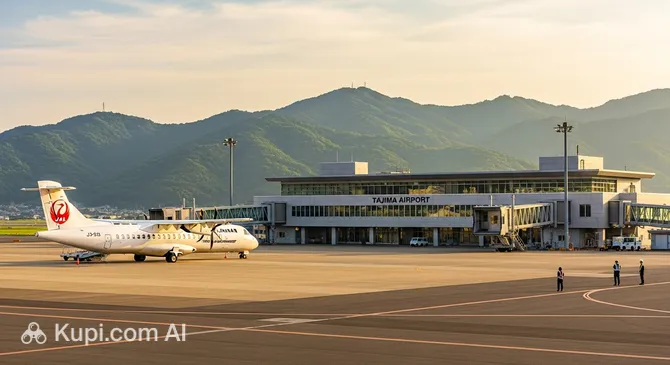
Tajima Airport (TJH), proudly bearing the name "Kounotori" in honour of the rare Oriental white storks, is not merely a transport hub, but a welcoming aerial gateway to the picturesque Hyogo Prefecture. This intimate airport shatters stereotypes of bustle and endless queues: here, the journey begins with sincere Japanese hospitality and absolute tranquillity. Thanks to its compact size, it allows passengers to travel from the aircraft steps to the city exit in literally a matter of minutes, where the legendary hot springs and the authentic atmosphere of old Japan await them.

IATA Code TJH
ICAO Code RJBT
City Toyooka
Distance to Centre About 5 km
Status Domestic
Annual Passengers ~43,700 (based on 2023 data)
Schedule

Features and Advantages of the Airport

The main advantage of Tajima Airport is its incredible ergonomics and speed of service. The terminal is designed so simply and logically that the check-in and security screening process takes minimal time, sparing travellers the stress typical of large hubs.

The airport's location makes it an ideal starting point for tourists: a short bus or taxi ride separates you from the famous Kinosaki onsens (hot springs) and the city centre of Toyooka. For those travelling by car, free parking is provided, which is a rarity for Japanese transport hubs. Furthermore, the flight itself often becomes a small excursion: upon approach, breathtaking views of the mountain ranges and the coast of the Sea of Japan are revealed.

Contact Information

To plan your trip and obtain up-to-date information, you can contact the representatives of Tajima Airport (TJH), also known as Kounotori Tajima. Below are the main contact details:

  • Official Website: The primary source of information is the official airport website, available in Japanese: www.tajima-airport.jp.
  • Information Desk Phone: For enquiries, you can call +81 796-26-1500. Please note that support may be provided in Japanese.
  • Airport Address: 1134 Iwai, Toyooka, Hyogo 668-0065, Japan.
  • Email: A direct email address for general enquiries is not provided. It is recommended to use the telephone or the contact form on the website (if available).
  • Social Media: Tajima Airport is a small regional hub and does not maintain active pages on social networks.
  • Lost Luggage Information: For issues related to lost or damaged luggage, you should primarily contact the representative office of the airline you travelled with.
  • Passenger Support Contacts: All questions related to passenger service within the terminal can be directed to the main airport information desk phone number.

How to Get to the Airport

Tajima Airport (TJH) is the aerial gateway to the northern part of Hyogo Prefecture, serving the city of Toyooka and the famous Kinosaki Onsen hot spring resort. There are several ways to get to the airport from the city centre or key tourist spots, each with its own advantages.

Public Transport

The main and most budget-friendly way to reach the airport is by bus. Zentan Bus operates routes connecting the airport with JR Toyooka Station and Kinosaki Onsen resort. The bus schedule is often synchronised with flight arrivals and departures, making this option very convenient. The journey from Toyooka Station takes about 15-20 minutes. There is no direct rail connection to the airport, so travellers arriving by train need to transfer to a bus or taxi.

Taxi and Transfers

A taxi is the fastest and most comfortable way to reach the airport, especially if you have a lot of luggage or are travelling in a group. A taxi rank is located right outside the terminal exit. A trip from the centre of Toyooka or Kinosaki Onsen will take approximately 15-20 minutes, though the cost will be significantly higher compared to the bus. For greater peace of mind, you can pre-book a private transfer that will meet you at the specified location at the appointed time.

Car Rental and Parking

For those planning to explore the region independently, renting a car is an excellent choice. Representatives of several rental companies operate at the airport and in Toyooka city. Having a car gives you the freedom to move around the picturesque surroundings of Japan. Do not forget that traffic moves on the left in the country, and an International Driving Permit is required for rental. Tajima Airport provides convenient and accessible parking, where you can leave your car for both short and long periods.

Alternative Airports

Although Tajima Airport is convenient for local travel, for a wider choice of flights, including international ones, you may consider larger transport hubs. The nearest alternative is Tottori Airport (TTJ). At a greater distance, but with a vast number of destinations, are the Kansai region airports, such as Itami (ITM), Kobe (UKB), and the main international hub, Kansai International Airport (KIX). You can also consider Okayama Airport (OKJ) as an option.

Terminals and Map

Tajima Airport (TJH), also known as Kounotori Tajima Airport, represents a small and very convenient regional aviation hub. Its main feature is compactness, making navigation intuitively clear even for those visiting for the first time. The airport consists of just one two-storey terminal, serving exclusively domestic flights, primarily to Osaka (Itami Airport).

The terminal structure is extremely simple. On the ground floor, you will find airline check-in counters and the arrivals area with a baggage claim belt. Thanks to the airport's small dimensions, the path from the aircraft exit to retrieving your suitcase takes mere minutes. On the first floor lies the departure zone: here, passengers undergo pre-flight security screening and enter a small but cosy waiting lounge before boarding. Also on the first floor, there is a souvenir shop where you can purchase local delicacies and crafts from the Toyooka region.

Since there is only one terminal, there is no need to worry about transfers between buildings—everything is located under one roof. This eliminates the risk of getting lost or missing a flight due to long transit times. Check-in and screening procedures are very fast, usually without queues. The entire process from entering the airport to the departure lounge rarely takes more than 15-20 minutes. Nevertheless, it is recommended to arrive at the airport about an hour before departure to check in luggage and complete all formalities without rushing. Navigation through the terminal will not cause difficulties: signs are clear, and staff are always ready to assist in this cosy corner of Japan.

Airport History

Tajima Airport (TJH), officially known as Kounotori Tajima Airport, opened its doors to passengers on 18 May 1994. Its creation was a strategically important project for the development of the northern part of Hyogo Prefecture. The main goal was to improve transport accessibility to the mountainous Tajima region, fostering economic growth and tourism development in the city of Toyooka and its scenic surroundings.

An interesting fact from the airport's history is connected to its name. "Kounotori" means "Oriental white stork" in Japanese—a bird that is the symbol of the region. This name was given in honour of the successful programme to reintroduce these rare birds into the wild specifically in this area. Thus, the airport became not only a transport hub but also a symbol of harmony with nature and the pride of the local community.

Since its opening, Tajima Airport has functioned as a classic regional airport, providing mainly flights to major hubs such as Osaka. Throughout its history, it has not undergone massive expansions, which is typical for small airports in Japan. Instead, the main focus has been on constant modernisation and maintaining infrastructure at a high level. Navigation equipment has been regularly updated, and conditions in the passenger terminal improved to ensure safety and comfort.

Despite its modest size and single runway, Tajima Airport has made a significant contribution to the life of the region. It has substantially reduced travel time to the country's major business and cultural centres, making the region more attractive for both business and leisure travellers. Its history is an example of how a local infrastructure project can become a catalyst for development while preserving the unique identity and cultural heritage of the territory.

Services and Amenities

Tajima Airport (TJH) is a compact regional airport that provides all necessary amenities for a comfortable wait before your flight. Despite its small size, the basic needs of travellers have been well considered here.

Within the terminal, there is a café where you can have a snack or a cup of coffee, as well as a souvenir shop. There, you can purchase local delicacies and memorable gifts reflecting the culture of the Tajima region. This is an excellent opportunity to buy something unique before departure.

A general waiting lounge is equipped for passengers. Free Wi-Fi is available throughout the terminal, and there are spots for charging electronic devices. Specialised VIP lounges or business lounges are generally not provided at the airport.

Regarding financial services, ATMs may be installed in the airport building, but currency exchange points are absent here. It is recommended to exchange money in advance in major cities. For passengers with small children, mother and child rooms with changing tables are equipped. The airport is also adapted for passengers with reduced mobility: accessible toilets and ramps are available, and staff are ready to provide assistance during boarding (it is recommended to notify the airline in advance).

There are no hotels or specialised business centres and conference halls within the airport itself. The nearest hotels and accommodation options can be found in Toyooka city and its vicinity, which are easily accessible by public transport or taxi.

Dining

Tajima Airport (TJH) is a small regional air terminal, so the choice of establishments here is quite limited. Nevertheless, passengers have a wonderful opportunity to enjoy local cuisine before departure without leaving the terminal building.

The main place for a full meal is the Tajima Airport Restaurant, located in the main building. Its main pride is dishes made from the famous Tajima-gyu marbled beef, which is considered the progenitor of Kobe beef. Here you can order steak, beef rice bowl (gyudon), or aromatic curry. It is an ideal place for a leisurely lunch and an introduction to the region's main gastronomic symbol. Prices here are moderate for airports in Japan, and portions are quite filling.

For those in a hurry, the airport has a souvenir shop that also sells drinks, packaged snacks, sandwiches, and onigiri (rice balls). This is an excellent option for a quick bite or to grab something light for the road. You can also have coffee or tea here.

It is important to note that all dining establishments are located in the public zone (landside), before passing through pre-flight security. In the sterile departure zone (airside), the selection is practically non-existent, so it is better to eat in advance. The operating hours of the restaurant and shop are directly linked to the flight schedule. As a rule, they open a couple of hours before departure and close shortly after. Specialised vegetarian, vegan, or gluten-free dishes are unlikely to be found on the menu, so passengers with strict dietary requirements are advised to bring food with them.

Travel Tips

Travelling through Tajima Airport, serving the city of Toyooka, can be simple and convenient if you know a few key points. Here are some practical tips that will help you save time, money, and stress during your trip around Japan.

Arrival at the Airport and Check-in. Tajima is a small regional airport, so long queues are rare here. For domestic flights, it is generally sufficient to arrive 1-1.5 hours before departure. To save time, use online check-in if your airline provides such an option. When choosing a seat on the plane, consider that flights from this region often delight with scenic views of the mountains and coast—a window seat may gift you several beautiful shots.

Security Control and Hand Luggage. The screening procedure is standard, but thanks to the airport's compactness, it proceeds quite quickly. Remember the general rules for hand luggage: liquids in containers up to 100 ml must be packed in a transparent bag, and sharp objects are prohibited. Be sure to check your airline's baggage allowance to avoid excess weight fees.

Customs and Transfers. An important point: Tajima Airport serves only domestic flights. This means there is no customs or passport control here. If you are flying on an international flight with a connection, you will go through all customs and immigration formalities at the first or last international airport of your route (for example, in Tokyo or Osaka). If you have a transfer planned, study the layout of the next airport in advance and calculate the time for moving between terminals.

What to Do in Case of Flight Delay? In the event of a schedule change, remain calm. First, contact your airline's counter for current information and instructions. Monitor updates on the information screens. In small airports like Tajima, staff usually help passengers promptly. To save money, consider using public transport to the airport and bring a light snack with you, as the choice of cafés in small airports may be limited.

Reached the end of the page?

That means the route is fully explored