Support

Komatsu Airport

About the Airport

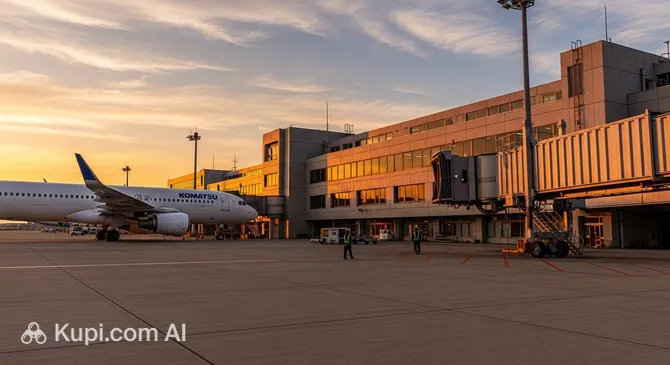
Komatsu Airport. Source: Kupi.com Binoculars

Komatsu Airport (KMQ) is not merely an aerial gateway to the Ishikawa Prefecture, but the largest aviation hub in the entire Hokuriku region of Japan. Located near cultural centres such as Kanazawa and Fukui, it serves as an ideal starting point for exploring the rich heritage and picturesque nature of the country's west coast. A unique feature of the airport is its status as a shared facility: the runway is used by both civil aircraft and fighter jets of the Japan Air Self-Defense Force. This gives travellers a rare opportunity to observe military aviation flights, and once a year, a thrilling aviation festival takes place here.

IATA Code KMQ
ICAO Code RJNK
City Komatsu
Distance to centre About 4 km
Status International
Annual Passengers Over 2.1 million (2022)
Popular Airlines All Nippon Airways, Japan Airlines, EVA Air
Schedule online board "Komatsu Airport"

The main advantage of Komatsu Airport is its strategic location and excellent transport connections. From here, you can easily reach the centre of Komatsu by bus in just 15 minutes, the famous city of Kanazawa in approximately 40 minutes, and the city of Fukui in one hour. The passenger terminal, serving both domestic and international flights, is notable for its compactness and convenient navigation, allowing for quick completion of all pre-flight formalities. For aviation enthusiasts, the airport grounds feature an observation deck offering a wonderful view of the runway. Furthermore, the airport's status as a key logistics hub is highlighted by the presence of a separate international cargo terminal, HIACT.

Contact Information

Official Website: www.komatsuairport.jp

Information Desk Phone: +81-761-21-9803 (for calls from abroad).

Address: Ukiyanagimachi, Komatsu, Ishikawa 923-0993, Japan.

Email: To contact the airport, it is recommended to use the feedback form on the official website.

Social Media: The airport does not maintain active accounts on international social media platforms. The most up-to-date information is published on the official website.

Lost Luggage Information: If items were lost on the plane, please contact your airline directly. For items left within the terminal building, you may enquire at the information desk.

Passenger Support Contacts: For assistance and answers to queries, the information desk phone number may be used.

How to Get to the Airport

Getting to Komatsu Airport is quite simple, thanks to well-organised transport links with key cities in the region. The choice of transport depends on your budget, amount of luggage, and personal preference for comfort. When planning your trip around Japan, you will easily find an option that suits you.

Public Transport is the most popular and economical method. Regular shuttle buses run between the airport and major railway stations. The journey from JR Komatsu Station takes about 15 minutes, and from JR Kanazawa Station, approximately 40-60 minutes. There are also routes connecting the airport with the city of Fukui. This is a reliable and budget-friendly option, with schedules usually coordinated with flight arrivals and departures. There is no direct rail link to the airport, so the nearest station is JR Komatsu, from where you must take a bus or taxi to the terminal.

Taxis and Transfers offer a higher level of comfort. Taxi ranks are located directly outside the arrivals terminal exit. This is an ideal option for those travelling with a large amount of luggage, with family, or who simply value their time. A taxi ride will be significantly more expensive than the bus but ensures maximum convenience and speed. You can also pre-book a private transfer so that a driver meets you with a name sign in the arrival hall.

For those planning to actively explore the Ishikawa Prefecture and neighbouring regions, car rental is an excellent solution. Offices of several major rental companies are located within the airport building. It is recommended to book a car in advance, especially during the peak tourist season. For travellers arriving in their own vehicles, the airport grounds feature a convenient car park with zones for short-term and long-term parking.

When planning your route, it is also worth considering alternative airports in the region. Depending on your destination, Toyama Airport may be convenient, or the more distant but significantly larger Chubu Centrair International Airport, which serves a multitude of international destinations.

Terminals and Map

Komatsu Airport (KMQ) is distinguished by a compact and clear structure, making it very convenient for travellers. You will not have to worry about long walks or confusing layouts — everything is located in one place.

The core of the airport is a single three-storey passenger terminal, which serves both domestic and international flights. The building is clearly divided into two zones: on the left (if facing the building) is the international section, and on the right is the domestic section. This division makes navigation intuitively understandable, and getting lost here is practically impossible.

The terminal layout is logical and simple:

  • 1st Floor: This is the arrival and check-in zone. Here you will find check-in counters for all airlines, the baggage claim area, and customs control for international flights. Information desks and car rental counters are also located on the first floor.
  • 2nd Floor: Departure zone. After checking in on the first floor, you proceed here to pass through security screening. Boarding gates, duty-free shops (in the international zone), souvenir shops, and various cafes and restaurants are also located here.
  • 3rd Floor: The observation deck is located on this floor, offering an excellent view of the runway. This is an interesting feature, as the airport shares the runway with a Japan Air Self-Defense Force base, and occasionally military aircraft can be seen.

Since there is only one terminal, no transfers between terminals are required. The domestic and international zones are connected by a common space on the first and second floors. Completing all formalities at Komatsu usually takes significantly less time than at major airports. For domestic flights, it is recommended to arrive 1-1.5 hours before departure, and for international flights — 2 hours prior. This time is generally more than sufficient for a calm check-in and security screening process.

Airport History

The history of Komatsu Airport (KMQ) is a unique intertwining of Japan's military and civil aviation. Its journey began in 1943, when a runway was created for the needs of the Imperial Navy. After the war ended, the facility came under the control of American forces, and later became one of the key bases for the Japan Air Self-Defense Force (JASDF), which continues to use it today.

The transition to civil use occurred significantly later. In 1961, a decision was made to organise a shared facility, and the first regular domestic flights launched that same year. This allowed Komatsu to be connected with major cities such as Tokyo and Osaka, providing a powerful impetus for the economic development of the entire Hokuriku region.

With the development of tourism and the growth of passenger traffic, the airport began to develop international routes. The first international charter departed for Hong Kong in 1979, and the success of this flight paved the way for the opening of a regular service to Seoul in 1994. For passenger comfort, a new modern terminal was erected in 1981, which has since been modernised multiple times to meet global standards.

Perhaps the most fascinating feature of Komatsu Airport is its dual purpose. The civil terminal is located in immediate proximity to the JASDF military airbase. Thanks to this, passengers and airport guests have a unique opportunity to watch fighter jet training flights. This spectacle, as well as the annual aviation festival, attracts thousands of aviation enthusiasts from all over the country.

Services and Amenities

Komatsu Airport (KMQ) offers its guests a thoughtful range of services to make waiting for a flight comfortable and pleasant. In the terminal, you will find several restaurants where you can experience local cuisine, and cosy cafes for a light snack. Additionally, souvenir shops selling traditional regional products, as well as classic duty-free shops, are at the disposal of passengers.

For those who prefer to wait for their flight in a quieter environment, the airport has premium lounges. Staying connected is effortless: free Wi-Fi is available throughout the terminal, and numerous charging stations for electronic devices allow you not to worry about the battery status of your smartphone or laptop.

At Komatsu Airport, all basic services for travellers are provided. You can use banking services or ATMs, as well as exchange currency at special counters. In case of feeling unwell, a medical point is available in the terminal where first aid can be provided.

Great attention is paid to the convenience of passengers with children and people with reduced mobility. For families, nursing rooms with changing tables are equipped. The terminal is fully adapted for citizens with limited mobility: there are ramps, lifts, and specially equipped restrooms, ensuring unhindered movement.

If you need to rest between flights, several hotels of various price categories are located in the immediate vicinity of the airport. While specialised conference centres may not be present within the terminal, basic conditions for business travellers allowing for work in a quiet environment are generally available. This makes the airport a convenient arrival point for getting acquainted with this region of Japan.

Where to Eat

Komatsu Airport (KMQ) offers passengers a compact but respectable selection of establishments where one can have a snack or a full meal before departure. Most cafes and restaurants are concentrated in the main terminal building, on the second floor, in the general area before security control. This allows well-wishers to also enjoy local cuisine together with travellers.

If you have time for a leisurely lunch, pay attention to restaurants specialising in traditional Japanese cuisine. Ishikawa Prefecture, where the airport is located, is famous for its fresh seafood, so we highly recommend trying dishes made from it. This could be sashimi, sushi, or kaisen-don (a bowl of rice topped with various seafood). Also popular are teishoku sets, which include a main dish (fish or meat), rice, miso soup, and small side dishes. This is an excellent way to familiarise yourself with the gastronomic traditions of Japan. Seafood options are generally a suitable choice for Muslim travellers.

For those looking for a quick bite, there are cafes in the airport where you can have coffee or tea with fresh pastries, sandwiches, or light desserts. Here you can also find popular Japanese noodle dishes — soba and udon, which are served quickly and are relatively inexpensive. This is an ideal option if there is not much time left before departure.

The price range in the airport establishments is average, as in most of the country's air hubs — slightly higher than in the city, but quite acceptable. Most restaurants and cafes operate in accordance with the flight schedule, usually opening in the morning and closing after the departure of the last evening flight. Regarding special dietary needs, finding vegetarian dishes is possible (for example, vegetable tempura or salads), however, the selection may be limited. For stricter diets, or to ensure Halal compliance regarding sauces and ingredients, it is recommended to clarify the composition of dishes directly with the staff.

Tips for Travellers

To ensure your journey through Komatsu Airport goes as smoothly and comfortably as possible, take advantage of these proven tips. A little preparation will help avoid unnecessary stress and make the start or end of your trip to Japan more pleasant.

Arrival Time and Check-in: Japanese airports are famous for their organisation, but it is better to play it safe. We recommend arriving at the airport at least 2 hours before a domestic flight departure and 3 hours before an international one. This will give you enough time for check-in, baggage drop, and passing through security control without haste. To save time in queues, complete online check-in for your flight if your airline provides such an option.

Security Control and Hand Luggage: The screening procedure here is standard but very thorough. Be prepared to remove laptops and other large electronics from your bag in advance. Remember the international rule for carrying liquids: all containers must be no more than 100 ml in volume and packed in a single transparent resealable bag. Please note that strict phytosanitary rules apply in Japan, so refrain from carrying fresh fruit, vegetables, and meat products in your hand luggage when entering the country.

Customs Control and Transfers: When arriving from abroad, you will need to fill out a customs declaration. These are usually distributed on the plane before landing. Honestly declare all goods subject to declaration. If you have nothing of the sort, feel free to proceed through the "Green Channel". Passengers with transfers should clarify in advance whether their luggage will be automatically transferred to the next flight or if it needs to be collected and checked in again.

Economy and Comfort: To avoid spending extra, bring an empty water bottle with you and fill it at a drinking fountain after security screening. Prices in airport cafes and shops can be high, so you can bring permitted snacks with you. When choosing a seat on the plane, consider your priorities: a window seat will offer beautiful views during takeoff and landing, while an aisle seat offers more freedom of movement.

What to Do in Case of Flight Delay: In the event of a flight delay or cancellation, first contact your airline representative. They will provide up-to-date information and explain possible options: provision of food vouchers, drinks, or, in the case of a long delay, accommodation in a hotel. At Komatsu Airport, there are cafes and souvenir shops where you can pass the time while waiting for departure.

Reached the end of the page?

That means the route is fully explored