Support

Shizuoka Airport

About the Airport

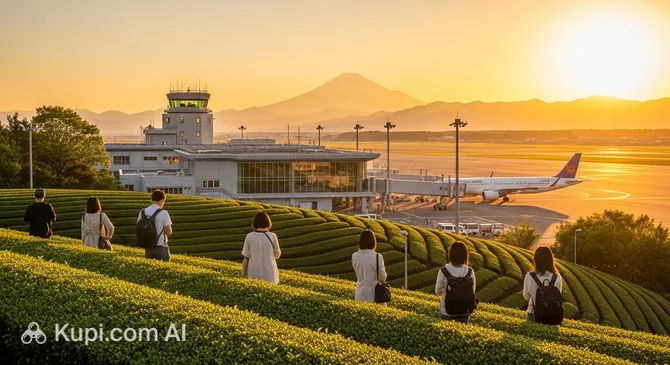
Shizuoka Airport. Source: Kupi.com Binoculars

Shizuoka Airport, also known as "Mount Fuji Airport", is arguably one of the most picturesque air hubs in Japan. It is situated literally in the middle of endless green tea plantations, and in clear weather, the terminal offers a breathtaking view of the majestic Mount Fuji. It is not just a transport hub, but also a popular attraction where locals come to admire colourful aircraft taking off against the backdrop of the country's main symbol.

IATA Code FSZ
ICAO Code RJNS
City Makinohara (serves Shizuoka City)
Distance to City Centre ~27 km (about 40–50 min by bus)
Status International
Annual Passengers approx. 512,000 (2023 data)

Despite its compact size, the airport possesses a unique charm and well-thought-out infrastructure. The main highlight is the observation deck on the third floor of the terminal, offering a panorama of the runway with Mount Fuji in the background (weather permitting). Additionally, the airport is famous for its food court, where you can taste the freshest seafood from Suruga Bay and the famous local tea.

Travellers should also pay attention to the Runway Shop "FSZ", which sells exclusive aviation souvenirs and products related to the locally based Fuji Dream Airlines, known for its fleet of bright, multi-coloured liners.

Contact Information

Below is the essential contact information for Shizuoka Airport, which will help you plan your trip and promptly resolve any issues that may arise.

  • Official Website: www.mtfuji-shizuokaairport.jp. Up-to-date information on flights, services, and transport is available on the site.
  • Information Desk Phone: +81 548-29-2000. Staff are ready to answer your questions regarding airport operations.
  • Address: 3365-1 Sakaguchi, Makinohara, Shizuoka 421-0411, Japan.
  • Email: To contact airport representatives, it is recommended to use the special contact form available on the official website in the "Contact Us" section.
  • Social Media: You can follow news and updates on the airport's official pages on Facebook, X (formerly Twitter), and Instagram.
  • Lost and Found: If you have lost items within the terminal building, please contact the Lost and Found service at +81 548-29-2244. For luggage lost during a flight, you should contact your airline directly.
  • Passenger Support Service: For general information and support, you may use the main airport information desk phone number.

How to Get to the Airport

Getting to Shizuoka Airport, also known as Mt. Fuji Shizuoka Airport, is quite simple thanks to a well-organised transport system. It is located in Shizuoka Prefecture and serves both domestic and international flights, allowing you to choose the most suitable travel method from several available options.

Public Transport is the most popular and economical method. The primary means of transport here are specialised buses that run from key railway stations in the region. For instance, from JR Shizuoka Station, the bus journey takes about 55 minutes, and the cost is approximately 1,000 yen. Buses also depart from Shimada and Kakegawa stations, connecting the airport with the main railway network of Japan.

If you are travelling from other major cities such as Tokyo or Nagoya, the optimal solution would be a combination of train and bus. First, take the Shinkansen bullet train or a local JR line to Shizuoka or Kakegawa station, and then transfer to the aforementioned bus to the airport. This allows for quick access to the destination from major transport hubs, including Haneda Airport in Tokyo.

Taxi or Pre-booked Transfer offers maximum comfort, especially if you are travelling with family or a large amount of luggage. This is the most expensive option: a trip from Shizuoka city centre can cost 8,000–12,000 yen or more, depending on traffic conditions. It is recommended to confirm the cost with the driver before starting the journey.

Car Rental is an excellent choice for those planning to actively explore the prefecture, known for its tea plantations, coastline, and views of Mount Fuji. Counters for several major rental companies are located at the airport. Do not forget that to rent a car in Japan, you will need an International Driving Permit, and traffic in the country flows on the left side of the road.

For travellers with their own vehicle, the airport provides spacious parking. Parking fees are considered quite moderate, making this option convenient for both short and long trips. Before travelling, it is recommended to check current rates on the official airport website.

Thus, the bus is the most balanced option in terms of price and convenience for most tourists. If flexibility of route is a priority, consider renting a car. Important tip: be sure to check the bus schedule in advance, as it is usually coordinated with flight arrivals and departures and may change.

Terminals and Map

Shizuoka Airport (FSZ), also known as Mt. Fuji Shizuoka Airport, is distinguished by its compactness and thoughtful organisation. The airport operates one passenger terminal, which serves both domestic and international flights. Thanks to this, navigation through it is intuitive and causes no difficulties even for those visiting for the first time.

The terminal structure is very logical and divided by floors. On the first floor (1F) is the Arrivals Zone. This is where you enter after your plane lands. Here you will find baggage claim carousels, the customs control area, tourist information desks, as well as exits to taxi stands, bus stops, and car rental offices. Everything necessary to start your journey in Japan is located in one place.

The second floor (2F) is the Departures Zone. Here, travellers check in for flights at airline counters and drop off luggage. After this, passengers proceed to the pre-flight security screening area. In the sterile area, there are boarding gates, as well as the main selection of duty-free shops, souvenir stalls where you can buy famous local tea, and restaurants with cafes.

A special feature of the terminal is the third floor (3F), where the spacious "f-air" observation deck is located. From here, a magnificent view opens up over the runway and, in clear weather, Mount Fuji. It is a wonderful place to pass the time while waiting for a flight and to take impressive photos. Conference rooms and additional services may also be located on this floor.

Due to the airport's small size, completing all formalities usually takes little time. For international flights, it is recommended to arrive 1.5-2 hours before departure, and for domestic flights — approximately 1 hour. Nevertheless, it is always better to check current recommendations with your airline. Navigation through the terminal is extremely simple: follow the signs, which are duplicated in English, and you will find everything you need without difficulty.

Airport History

Shizuoka Airport, officially known as Mt. Fuji Shizuoka Airport, is one of the youngest international airports in Japan. Its history is relatively short but quite eventful. The idea of building an air gateway for Shizuoka Prefecture was discussed for decades, but the active phase of the project began only in the 1990s. After a long period of planning and construction, the airport officially opened for flights on June 4, 2009. Its creation was intended to stimulate the economy and tourism in the region located between two metropolises — Tokyo and Nagoya.

One of the key moments in the airport's history was the issue of the runway length. Initially, a 2,500-metre runway was planned, but due to various construction difficulties, the airport opened with a shortened runway of 2,200 metres. This imposed limitations on the types of aircraft it could accept and flight ranges. However, shortly after opening, extension work began, and in 2011, the runway was extended to the planned length of 2,500 metres. This modernisation became a crucial stage in development, allowing for larger liners and expanding the geography of international flights.

Since its opening, Shizuoka Airport has focused on developing international destinations, primarily to East Asian countries such as China, South Korea, and Taiwan. It quickly became a popular gateway for tourists wishing to visit Mount Fuji, the Izu Peninsula, and other attractions of Shizuoka Prefecture. The airport is not associated with any loud historical records, but its main achievement can be considered the successful attraction of foreign airlines and steady growth in passenger traffic in the pre-pandemic period, proving its demand.

Interesting fact: the airport is built on a plateau in a mountainous area, which required massive earthworks. Thanks to this location, passengers can enjoy stunning views of tea plantations during takeoff and landing, and in clear weather — the majestic Mount Fuji, in whose honour the airport received its full name. This makes it one of the most picturesque airports in Japan.

Services and Amenities

Shizuoka Airport (FSZ), the gateway to the prefecture of the same name in Japan, offers passengers all necessary amenities for a comfortable wait. In the terminal, you will find several restaurants and cafes where you can taste local cuisine, including the famous green tea and fresh seafood for which the region is renowned. For shopping enthusiasts, there are Duty Free shops, souvenir stalls with unique goods, and convenience stores.

For a comfortable rest before departure, passengers can use the premium lounge services, which often offer beautiful views. Free Wi-Fi is available throughout the terminal, and numerous gadget charging stations will allow you to stay connected at all times. These amenities make waiting for a flight pleasant and productive.

The airport provides all basic financial and medical services. You will easily find ATMs and currency exchange points to handle monetary matters. In case of feeling unwell, a first aid station operates in the terminal, where qualified personnel are ready to help.

Particular attention is paid to passengers with children and people with disabilities. For travellers with little ones, special nursing rooms are equipped with changing tables and spaces for feeding. For passengers with reduced mobility, ramps, accessible toilets, and the option to request assistance and wheelchairs are provided, ensuring a barrier-free environment throughout the airport.

Although there is no hotel within the airport building itself, several hotels are located in the immediate vicinity, offering convenient accommodation for those with early departures or long layovers. For business travellers, basic business services are available to help resolve work issues right at the airport. Conference rooms are usually available upon prior request.

Dining

Shizuoka Airport (FSZ) offers passengers a good selection of establishments where you can have a snack before departure or a full meal. Most restaurants and cafes are conveniently located in the main terminal building on the third floor, in the public zone (landside), before security control. This allows those seeing passengers off to also enjoy local cuisine.

The airport's main pride is its restaurants specialising in local delicacies of Shizuoka Prefecture. Be sure to try dishes featuring the freshest seafood caught in Suruga Bay, or the famous eel. Here you can find both traditional Japanese establishments serving sushi, sashimi, and tempura, as well as restaurants offering ramen and other popular dishes. If you want to get acquainted with the region's gastronomy, this is an excellent opportunity to do so without leaving the airport.

For those in a hurry, there are fast food options and cosy cafes. You can grab sandwiches, pastries, or simply drink a cup of coffee. Since Shizuoka is the heart of the tea industry in Japan, do not miss the chance to enjoy a cup of high-quality green tea in one of the local cafes. After passing security control (airside), the choice of establishments is limited, so it is better to plan your main meal in advance.

The price range is generally average, typical for Japanese airports. A full lunch in a restaurant will cost more than a quick snack in a cafe. Regarding dietary restrictions, vegetarian dishes based on vegetables and tofu can be found in Japanese restaurants, but for strict vegans or people with gluten intolerance, the choice may be difficult. It is recommended to check the ingredients with the staff. Opening hours of establishments usually correspond to the flight schedule but may change, so it is worth checking up-to-date information on the airport website.

Travel Tips

To ensure your journey through Shizuoka Airport goes as smoothly as possible, take advantage of these useful tips. This airport, serving Shizuoka Prefecture, is notable for its compactness and convenience, but proper preparation is never superfluous.

Arrival Time and Check-in: To avoid any rush, arrive at the airport in advance. For international flights, it is recommended to allow 2–2.5 hours before departure, and for domestic flights, 1.5–2 hours will be sufficient. Although the airport is known for its efficiency, this buffer will allow you to calmly complete check-in, drop off luggage, and pass security control, especially during peak hours. Keep your passport and boarding pass handy to speed up procedures.

Seat Selection: If your flight is scheduled during clear weather, try to get a window seat — you will have a chance to see the famous Mount Fuji in all its glory. Aisle seats are more convenient if you plan to get up frequently during the flight. Emergency exit rows offer more legroom but are usually provided for an additional fee and have restrictions for certain categories of passengers.

Hand Luggage: Standard international rules apply at the airport. All liquids must be in containers of no more than 100 ml and packed in a single transparent resealable bag. Sharp objects, weapons, and flammable substances are prohibited in hand luggage. Always keep valuables, documents, electronics, and necessary medication with you.

Connecting Passengers: Shizuoka Airport is not a major transit hub. If you have a connecting flight, be sure to check with your airline whether you need to collect and re-check your luggage. Often, when transferring from an international to a domestic flight, re-screening at security is required.

Customs Control: When entering Japan, you will need to fill out a customs declaration. Be attentive: the import of many products, including fresh fruits, vegetables, meat, and dairy products, is strictly prohibited in the country. Honestly declare all imported goods to avoid fines and unpleasant delays at the border.

Saving Time and Money: To save time, complete online check-in if your airline provides such a service. To save money, bring an empty reusable bottle with you — after security, it can be filled with drinking water. Prices for food and drinks at the airport are generally higher, so you may wish to have a snack beforehand.

In Case of Flight Delay: If your flight is delayed, remain calm. Monitor up-to-date information on departure boards and your airline's website. If necessary, contact a carrier representative for clarification. Depending on the length of the delay, you may be provided with vouchers for food or drinks. You can pass the waiting time in one of the airport's several cafes or shops.
Reached the end of the page?

That means the route is fully explored