Support

National Museum of Beirut

About

A journey into the rich past of the Middle East is incomplete without visiting the place where history comes alive. The National Museum of Beirut is Lebanon's main treasury, housing over 100,000 archaeological finds within its walls. Located in the heart of Beirut, this museum is not just a building, but a symbol of the cultural continuity of many civilizations.
\n\n

National Museum of Beirut
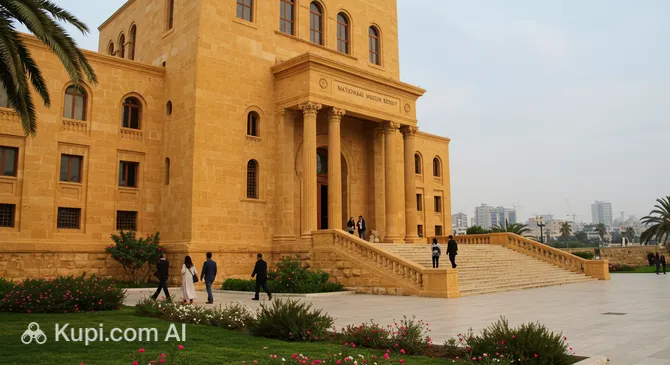
National Museum of Beirut. Иллюстрация. Источник: Kupi.com AI

\n\n

The museum's architecture deserves special mention: the ochre limestone building is designed in a French style with Egyptian Revival elements. Inside, the exhibition is thoughtfully distributed across three floors, covering a vast period—from prehistoric times (6000 BC) to the Ottoman era. Here you can see everything from tiny Phoenician jewelry to monumental Roman sarcophagi and Byzantine mosaics.

\n\n

A particular highlight of the collection are the artifacts found during excavations in Byblos and Tyre. The permanent exhibition features about 1,300 of the most significant items, each accompanied by explanations. Thanks to well-designed lighting and a modern layout, visitors can literally touch the Phoenician heritage and see how the face of these lands has changed over millennia.

Contacts

For more information before your visit or to organize a group tour, you can use the museum's official contact details. The National Museum of Beirut is located in the convenient Mathaf district and is easy to find on the city map.

\n\n
How to contactContact
AddressNational museum of Beirut, Mathaf, Lebanon
Phone+961 1 426 703

What to Do

Inside the museum halls, a fascinating journey through the centuries awaits guests. It is best to start your tour on the ground floor, where massive objects dominate: impressive anthropomorphic sarcophagi from the Phoenician period, giant statues, and intricately detailed floor mosaics are on display here. Each of these works of art tells its own story about the beliefs and daily lives of the ancient peoples of Lebanon.

\n\n

Going up to the top floor, you will find a more intimate setting. Modern display cases with soft lighting showcase collections of ancient coins, delicate ceramics, weapons, and jewelry. For the convenience of visitors, many displays are equipped with magnifying glasses, allowing you to see the finest work of ancient craftsmen, while multimedia screens in several languages help you better understand the context of the finds.

\n\n

Be sure to head down to the basement level, which opened after a major restoration. This is where you will find the unique 13th-century Christian mummies discovered in the caves of the Lebanese mountains, as well as a reconstructed Roman hypogeum with beautifully preserved frescoes. You can conclude your visit at the small souvenir shop, which sells replicas of famous artifacts and books on the history and archaeology of the region.

Getting There

Getting to the country's main repository of antiquities is quite simple, as it is located in the central part of the city in the Mathaf district, near the hippodrome. If you are staying downtown, the walk may take some time, but most tourists prefer to use taxis. Services like Uber operate reliably in the city, as do traditional "yellow" taxis, which know the location well.

\n\n

The journey from Rafic Hariri International Airport takes approximately 20–30 minutes, depending on traffic. If you prefer public transport, look for routes passing through the main arteries toward the Damascus Road, although taxis remain the most comfortable and fastest way for international guests to get around.

\n\n

For those who prefer exploring the city by car, parking is available near the museum. However, it is recommended to check the current route on a navigator before your trip to avoid traffic jams, which often occur on central streets during peak hours.

Ближайший город: Beirut

History & Facts

The history of this collection began back in 1919, when a small exhibition of archaeological finds collected by a French officer formed the basis of the future national treasure. The official decision to construct the building was made in 1923, and in 1930, architects Antoine Nahas and Pierre Leprince-Ringuet began work on a project that is today considered a benchmark of the Neo-Egyptian style.

\n\n

The grand opening of the museum took place on May 27, 1942. Since then, the collection has been continuously enriched with unique objects found during excavations in Byblos, Tyre, and Sidon. A huge contribution to the museum's development was made by the legendary curator Maurice Chehab, who headed the institution for four decades and managed to preserve many priceless exhibits during the city's most challenging periods.

\n\n

The modern era of the museum's life has been marked by extensive restoration. In 2011, new galleries were opened, and in 2016, after painstaking work by international experts, the basement floor with its unique collection of funerary art became accessible to the public. Today, the museum is not just an exhibition but a high-tech center for studying the Phoenician civilization and the ancient heritage of the entire region.

Time Needed

To leisurely explore all three levels of the exhibition, most visitors need between 2 to 3 hours. This is plenty of time to study the massive sarcophagi on the first floor, examine the delicate work of jewelers in the upper galleries, and descend into the basement to see the rarest finds.

\n\n

If you plan to study every information board in detail or use an audio guide, your visit time may increase. It is recommended to arrive in the first half of the day to have enough time before closing and enjoy the atmosphere of this historical site without rushing.

Working Hours

When planning your visit to the National Museum of Beirut, please note the operating hours, as the museum closes quite early. Monday is a day off when the doors are closed to visitors.

\n\n

From Tuesday to Sunday, the museum operates on a single schedule: from 9:30 AM to 3:00 PM. We recommend arriving a couple of hours before closing to have time to see all the main halls without rushing.

DayWorking hours
ПонедельникЗакрыто
Вторник9:30 – 15:00
Среда9:30 – 15:00
Четверг9:30 – 15:00
Пятница9:30 – 15:00
Суббота9:30 – 15:00
Воскресенье9:30 – 15:00

Nearby

After immersing yourself in Lebanon's ancient history, it's worth checking out other interesting locations nearby. Beirut offers many options for relaxation—from quiet parks to entertainment centers that will help diversify your itinerary and provide new experiences.

\n\n
NameDistance
MIM Mineral Museum0.2 km
Achrafieh Mall1.2 km
Nicolas Sursock Museum1.7 km
Mohammad Al-Amin Mosque2 km
Martyrs' Square2.1 km
Downtown Beirut2.3 km
FABRK2.3 km

Reached the end of the page?

That means the route is fully explored