Support

Batu Caves

About

Batu Caves is one of the most iconic and amazing landmarks, located just 13 kilometers from bustling Kuala Lumpur. This unique complex represents an impressive combination of a natural wonder and an important spiritual center of Malaysia. The caves were formed in massive limestone cliffs that are approximately 400 million years old, making them not only a place of pilgrimage but also an object of immense geological interest.
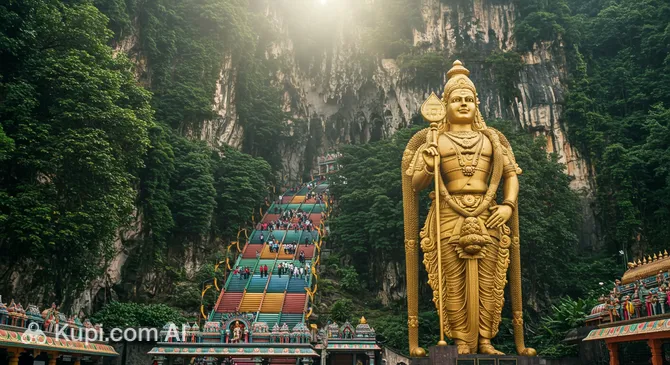
Batu Caves. Illustration.
Source: Kupi.com AI

Traveler photos:

At the foot of the hill, guests are greeted by a grand gilded statue of Lord Murugan standing 42.7 meters tall—the tallest statue of this deity in Malaysia. From here, the famous staircase of 272 colorful steps begins, leading to the entrance of the main Temple Cave. Climbing it is a small adventure in itself, during which you can admire the views and observe the playful macaques that have become an integral part of this location.

Inside the main cave, where the vaulted ceilings reach heights of 100 meters, there is an active Hindu temple, making Batu Caves one of the most important pilgrimage centers for Hindus outside of India. Natural light streaming through openings in the cave ceiling creates a mystical and peaceful atmosphere. In addition to the Temple Cave, the complex includes other grottos, such as the Dark Cave with its unique ecosystem and the Ramayana Cave, decorated with vibrant sculptures and dioramas.

Contacts

While admission to the main Temple Cave is free, other caverns like the Dark Cave or the Ramayana Cave have their own opening hours and entrance fees. To confirm current information, plan your visit, or organize a tour, it is recommended to contact official channels.

The most convenient way to reach the caves from Kuala Lumpur is by the KTM Komuter suburban train, heading to the final stop, "Batu Caves," which is just a few minutes' walk from the entrance of the complex.

How to contactContact
AddressGombak, 68100 Batu Caves, Selangor, Malaysia
Phone number+60 3-6189 6284
Websitewww.tourism.gov.my

What to Do

A visit to Batu Caves is primarily an exploration of a unique temple complex. The highlight for many is climbing the famous staircase of 272 colorful steps leading to the main Temple Cave. At its base, you are greeted by a grand golden statue of the god of war, Murugan, over 42 meters tall, which is considered one of the tallest in the world. Once you reach the top, you will find yourself in a vast cave housing an active Hindu temple dedicated to this deity.

Inside the cave complex, you can spend hours examining the colorful altars, statues, and murals that adorn the walls. Of particular interest is the Ramayana Cave, where the story of Rama from the ancient epic "Ramayana" is detailed on the walls through dioramas and sculptures. This allows you to not just view the sanctuaries but to immerse yourself more deeply in Hindu mythology.

Beyond exploring the temples, you can expect encounters with the complex's numerous and quite enterprising inhabitants—monkeys that roam freely everywhere. If your visit coincides with late January or early February, you might witness the grand Hindu festival of Thaipusam. This incredibly colorful and massive event annually attracts thousands of pilgrims, offering a unique opportunity to see impressive religious rituals.

Getting There

The Batu Caves are located in close proximity to Kuala Lumpur, and reaching them from the city center is quite simple. The most convenient and popular method is the KTM Komuter suburban train. You will need the line heading to the Batu Caves station, which is the terminus and is located right at the entrance to the temple complex. The train journey from the central KL Sentral station takes about 30 minutes, making the trip quick and effortless.

If you prefer more comfort or are traveling in a group, taxis or ride-hailing services are a good alternative. A car ride from central Kuala Lumpur also won't take much time, though possible traffic jams should be considered. Additionally, the caves can be reached by city buses, such as route No. 173 from the city center—this is a more budget-friendly option, though it may require a bit more route planning.

For those who value full organization, there are numerous tourist excursions that include round-trip transfers to the Batu Caves and the services of a guide. This is an excellent option if you want not only to reach the site without any hassle but also to learn more about the history and significance of this unique sanctuary. Regardless of the chosen method, the way to the caves is well-organized, and signs in English will help you easily find your way around.

Nearest city: Kuala Lumpur

History & Facts

The history of the Batu Caves dates back approximately 400 million years, though their role in human life became notable much later. Initially, these majestic caves served as a shelter for the region's indigenous tribes, known as the Temuan (or Besisi). In the 19th century, the situation changed: Chinese settlers began mining guano—a valuable fertilizer made from bird droppings—here. For the Western world, the caves were "discovered" in 1878 by the American naturalist William Hornaday, who was the first to document their existence.

A pivotal turn in the caves' history occurred in the late 19th century. In 1891, the influential Indian merchant K. Thamboosamy Pillay, inspired by the shape of the main cave's entrance which resembled a spear tip, decided to dedicate this site to the god of war, Murugan. It was he who initiated the creation of the first temple here, transforming a natural landmark into one of the key Hindu shrines in Malaysia. Since 1892, the annual Tamil festival of Thaipusam has been held at the caves, cementing its status as an important religious center.

Since then, Batu Caves has transformed into a major pilgrimage site, attracting over 1.5 million believers annually, especially during the Thaipusam festival. The modern look of the complex formed gradually: the famous staircase leading to the Temple Cave was originally wooden and only appeared in 1920, later being replaced by a concrete one. Meanwhile, the grand golden statue of Murugan, which has become the landmark's signature feature, was installed at the base of the stairs as recently as 2006.

Time Needed

When planning a visit to Batu Caves, you should aim for 2–4 hours to fully enjoy this amazing site. This time is generally sufficient for a leisurely climb up the famous 272 steps, a tour of the main Temple Cave, and for taking commemorative photos against the backdrop of the grand Murugan statue and the picturesque surroundings. Even if you are limited on time, you should set aside at least 1.5–2 hours for a quick look at the main part of the complex.

If you want to explore the complex more thoroughly, it is better to allocate about 3-4 hours. This will allow you not only to visit the main sanctuary but also to peek into other, equally interesting grottos like the Dark Cave or the Ramayana Cave, which will require extra time. Such an unhurried pace will give you the opportunity to observe temple life, rest after the climb, and, of course, interact with the local celebrities—the numerous monkeys who are always happy for tourist attention.

Working Hours

The Batu Caves complex is open to visitors year-round, making it accessible at any time. Generally, the temples and main grounds are open daily from early morning until late evening, approximately from 6:00 AM to 9:00 PM. This allows tourists to flexibly plan their visit, arriving either at dawn to avoid the midday heat or closer to evening to enjoy a cooler atmosphere.

Advance ticket booking for the main Temple Cave is usually not required, as entry is free. However, it is worth remembering that during major religious holidays, such as Thaipusam, working hours may change, and the number of visitors increases dramatically. Therefore, before your trip, it is strongly recommended to check current information on official websites or local tourist sources to avoid surprises and plan your visit in the best way possible.

Nearby

A visit to Batu Caves is undoubtedly a vibrant and memorable event, but your journey through the surroundings of Kuala Lumpur doesn't end there. Exploring nearby attractions will help you dive deeper into the multifaceted culture of Malaysia and see the contrast between ancient shrines and the ultra-modern metropolis.

In the immediate vicinity of the caves and within a short drive, there are many interesting places—from world-famous skyscrapers to cozy bars and shopping malls. Exploring these locations will allow you to form a more complete and rich impression of the capital and its surrounding areas.

NameDistance
Tap Room KL5.1 km
Petronas Twin Towers9.4 km
Marini’s on 579.5 km
Suria KLCC9.5 km
MO Bar9.6 km
Samad Al Iraqi Restaurant9.6 km
Kyō Kuala Lumpur9.7 km

Have you reached the end of the page?

So the route has been studied inside and out