Support

Shwedagon Pagoda

About

Shwedagon Pagoda is a majestic 98-meter gilded structure in the heart of Yangon, the primary shrine of Myanmar. Its name comes from the Burmese words "Shwe" (gold) and "Dagon" (the ancient name for Yangon). From afar, it resembles a giant inverted bowl shining in the sun and is one of the country's most recognizable symbols.
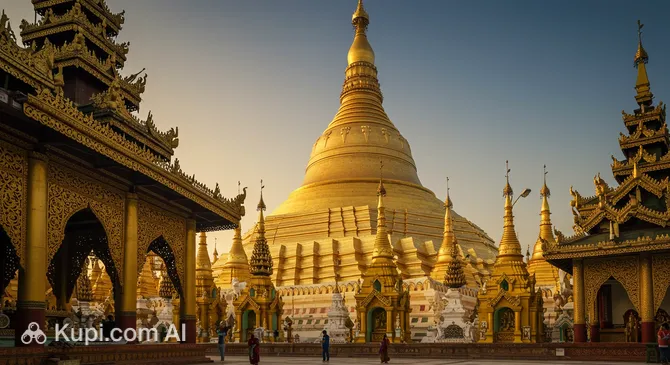
Shwedagon Pagoda. Illustration.
Source: Kupi.com AI

Traveller photos:

The main value and sanctity of the pagoda lie in the tradition that it houses the relics of four Buddhas: the staff of Kakusandha, the water filter of Konagamana, a piece of Kassapa's robe, and eight hairs of Gautama Buddha. These artifacts make Shwedagon one of the most important pilgrimage centers for Buddhists worldwide.

The pagoda is the centerpiece of a vast temple complex located on a hill. Surrounding the main golden stupa are many small pavilions, temples, and statues where you can observe the rituals of believers and immerse yourself in an atmosphere of tranquility. A visit to this place, especially at sunset when the lights are turned on and the gold plating of the stupa begins to shine in a new way, leaves an unforgettable impression.

Contacts

For the most accurate and up-to-date information regarding visits to Shwedagon Pagoda, including opening hours and ticket prices, it is recommended to check official sources. You can contact the complex administration via phone or email.

How to contactContact
AddressYangon, Myanmar (Burma)

What to Do

Visiting Shwedagon Pagoda is much more than just viewing the central golden stupa. Guests are greeted by an entire temple complex where you can wander for hours, exploring numerous small pagodas, pavilions, and shrines. Statues of mythical lions and elephants are placed throughout the territory, and in the shade of trees, you can find secluded spots for meditation and rest. The most important rule for all visitors is that you can only move around the complex barefoot, so shoes must be left at the entrance. This allows you to fully experience the special energy of this sacred place.

One of the most interesting traditions that even tourists can join is the ritual of offering. Around the main stupa, there are 8 small shrines and sacred posts corresponding to the eight days of the week in the Burmese calendar (Wednesday is divided into two days). Believers and pilgrims bring gifts to the post that corresponds to their day of birth. Flowers or thin sheets of gold leaf, which are applied to the pagoda walls as a sign of respect, can be used as offerings. This is a unique opportunity to touch the local culture and participate in an ancient ritual.

Don't forget to pay attention to the details that amaze with their magnificence. At the very top of the pagoda, a weather vane is installed, its orb encrusted with 4,351 diamonds. Above it flies a flag decorated with another 1,100 diamonds and more than 1,300 other precious stones. Although it is impossible to see these treasures up close, their sparkle in the sun creates a truly unforgettable sight and emphasizes Shwedagon's status as one of the world's greatest shrines.

Getting There

Shwedagon Pagoda is located on Singuttara Hill, almost in the center of Yangon, making it easily accessible from anywhere in the city. The most convenient and popular way for tourists to reach this shrine is by taxi. A ride from central districts, such as the colonial center, will take about 15–25 minutes depending on traffic. Taxis in Yangon are relatively inexpensive, but it is recommended to agree on the fare with the driver in advance to avoid any misunderstandings.

For a more budget-friendly and authentic journey, you can use public buses. Many routes pass in close proximity to the pagoda, and there is a stop named after it. Although this method may seem challenging due to the language barrier, it allows for a deeper immersion into the daily life of Myanmar locals. It is best to ask your hotel staff for the correct bus number.

If you are staying in one of the nearby neighborhoods, walking to the pagoda can be a pleasant experience, though one should consider Yangon's hot and humid climate. The temple complex has four entrances facing different cardinal directions, each consisting of a covered staircase leading up. The Southern Entrance is considered the main one and is equipped with escalators and an elevator, which can be particularly convenient for elderly visitors or those with limited mobility. Regardless of the chosen method, be prepared to remove your shoes at any of the entrances—walking on the sacred grounds of the pagoda is strictly barefoot.

Nearest city: Yangon

History & Facts

The history of Shwedagon Pagoda is shrouded in legends that date its founding to events 2,500 years ago. According to lore, its original height was only about 20 meters. While the exact construction date is difficult to confirm, reliable written sources indicate that renovation work was already being carried out here at the end of the 14th century. This fact proves irrefutably that the shrine in Yangon was already a significant center of spiritual life in Myanmar at that time.

The fate of Shwedagon, like many other ancient stupas in Burma, is full of trials. Over the centuries, the pagoda has repeatedly suffered from earthquakes and fires, but every instance of destruction only became a reason for a new, even more grand restoration. After each such repair, the structure was not just brought back to life but also increased in size, making the pagoda a symbol of the resilience of spirit and faith.

One of the most serious incidents occurred in 1931, when a major fire destroyed two dozen buildings within the temple complex. However, thanks to the efforts of the faithful, all of them were completely restored. Today, Shwedagon Pagoda is not just a national treasure but one of the world's most famous monuments of Buddhist architecture. It is under international protection, and the country's authorities strictly monitor the preservation of this unique cultural and spiritual treasure.

Time Needed

For a brief introduction to Shwedagon Pagoda and its main grounds, allocating about 2–3 hours is sufficient. This time is enough to leisurely walk around the central golden stupa, admire its grandeur from different angles, inspect several small temples and pavilions, and take memorable photos. The complex is quite extensive, and even a simple walk around its perimeter takes time, allowing you to feel the peaceful atmosphere of this sacred place.

If you want to delve deeper into the spiritual life of the pagoda and explore it in more detail, you should plan for half a day or even more. This will allow you to study the numerous shrines without rushing, observe the rituals and prayers of pilgrims, and visit the small museum on site. Many travelers recommend coming here closer to evening to see the pagoda in daylight, in the rays of the setting sun, and in the glow of the night illumination—it is a truly unforgettable sight that is well worth staying longer for.

Working Hours

Shwedagon Pagoda is open to visitors year-round, allowing you to plan a visit at any convenient time. Standard opening hours are daily from 04:00 AM to 10:00 PM. Last entry to the grounds is permitted at 09:45 PM. It is worth noting that twice a year, on the days before the full moon of the months of Tabaung (around March) and Waso (around June-July), the pagoda is open 24 hours a day, coinciding with important Buddhist festivals.

Special ticket booking for visiting Shwedagon Pagoda is usually not required—they can be purchased directly at the entrance. The ticket is valid for the entire day of purchase, providing a great opportunity to see the shrine at different times of the day. Many travelers recommend coming here closer to evening, around 04:00–05:00 PM. This way, you can enjoy the view of the golden stupa in daylight, see a stunning sunset, and then admire its majestic glow in the night lighting.

4:00 – 22:00

Nearby

A visit to the majestic Shwedagon Pagoda is undoubtedly the central event for many travelers in Yangon. However, to make your introduction to this amazing city in Myanmar even more complete and rewarding, it is worth paying attention to its surroundings. Exploring nearby attractions will allow you to dive deeper into the culture and daily life of Yangon, revealing new facets of this colorful place.

Near the world-famous shrine, you will find many interesting sites, from quiet parks to important cultural centers and leisure spots, each capable of offering unique experiences and complementing the overall picture of your trip. A stroll around the area after visiting the pagoda is a great opportunity to see the city's contrasts and better understand its multifaceted character.

NameDistance
Pyi Thu Yin Pyin Park0.8 km
Pioneer1 km
People's Park1.1 km
The Beer Factory Yangon1.2 km
THAI 47 Nightclub (Helpin Branch)1.3 km
National Museum of Myanmar1.3 km
Shan Yoe Yar Restaurant (Manaw Hari)1.5 km

Things to see in nearby cities

Reached the bottom of the page?

Looks like you know this route inside out