Support

Delft

About

Delft is a charming city, often called the jewel of South Holland, nestled comfortably between The Hague and Rotterdam. This city in the Netherlands literally breathes history, offering its guests a unique atmosphere of a leisurely Dutch fairy tale. Its picturesque canals, ancient bridges, and majestic churches create a unique landscape.

Despite its relatively small size and a population of just over 100,000, Delft retains the intimacy and charm of an old European town. At the same time, it is an important administrative and educational center. It is home to the famous Delft University of Technology, which fills the city with the youthful energy of students and researchers from all over the world, giving it a modern rhythm that blends harmoniously into the historical context.
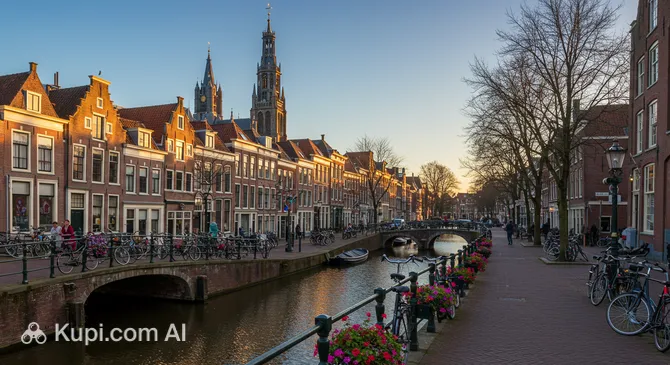
Delft. Illustration.
Source: Kupi.com AI

Delft is world-famous for its unique blue and white porcelain (Delftware), which has decorated the homes of European nobility for centuries and remains a symbol of the city. Beyond porcelain, Delft attracts tourists with its picturesque canals, where you can walk endlessly admiring the reflections of Gothic spires in the water, and its numerous historical buildings. A visit to the New Church (Nieuwe Kerk), featuring the burial vault of the Dutch royal family, the House of Orange-Nassau, and the Old Church (Oude Kerk), famous for its leaning tower, is a must.

Delft is an ideal destination for those who want to immerse themselves in the authentic atmosphere of old Holland, enjoying beauty, tranquility, and a rich cultural heritage. Every street here holds its own story, and every corner is ready to surprise you with something new, making a visit to Delft truly unforgettable.

You can find more interesting facts on the Delft city history page.
Weather Overview

When planning a trip to Delft, be prepared for typical Dutch weather: mild summers with average temperatures hovering around 17-19°C (June-August) and maximums reaching about 21°C. While summer is considered relatively dry in terms of total precipitation (2-3 mm per month), short rain showers are common, with an average of 11-14 rainy days per month. Winters in Delft are cool, with average temperatures (December-February) staying at 5-6°C, and frequent rainy days (13-18 per month), sometimes with sleet. The highest number of rainy days (16-18 per month) occurs from October to January, and overall, precipitation is frequent throughout the year. For more detailed information, we recommend exploring the climate of Delft.

Average monthly temperature

Average monthly precipitation

Interesting Facts

Beyond its world-famous canals and porcelain, Delft hides many surprising stories and little-known details that make it even more attractive. Ready to learn some secrets of this charming city in the Netherlands?

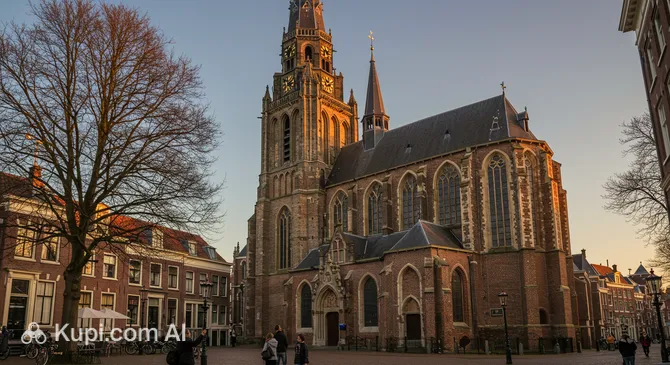
Old Church. Illustration.
Source: Kupi.com AI

Traveler photos:

  • Did you know that the famous Old Church (Oude Kerk) in Delft has a tower that is noticeably tilted? This lean is not a mistake by medieval builders, but a result of the local soil conditions, which is why it is sometimes jokingly called the "Leaning Tower of Delft." By the way, the famous painter Johannes Vermeer is buried inside this church.

  • Within the walls of the Prinsenhof Museum, which was once a monastery and then the residence of William I of Orange, you can see real bullet holes! They date back to 1584, when the founder of Dutch independence was assassinated here, remaining silent witnesses to dramatic historical events.

  • One of the modern symbols of Delft, paying tribute to the world-famous Delft blue-and-white porcelain, is the "Blue Heart" (Delfts Blauwe Hart). This unusual glass sculpture, located in one of the squares, symbolizes the city's openness and its unbreakable link to centuries-old traditions of ceramic art.

  • Although Johannes Vermeer, author of "Girl with a Pearl Earring," is one of Delft's most famous residents, there is not a single original painting by the artist in the city. However, there is the Vermeer Centrum Delft, where you can immerse yourself in his life and work and see full-scale reproductions of all his masterpieces.

How to Get There

Reaching the charming city of Delft in the Netherlands is easy thanks to several convenient options provided by the country's well-developed transport network. The main arrival points for international travelers are nearby airports and major railway hubs, ensuring easy access to this historical center.

The closest airport to Delft is Rotterdam The Hague Airport (RTM), located just 8.3 km away. This is a convenient regional airport from which you can reach the center of Delft by taxi in about 30-35 minutes. You can also use public transport: a bus will take you to the railway station in Rotterdam or The Hague, from where the train to Delft takes only a few minutes; the entire journey takes about 45-60 minutes.

The main international hub for travelers heading to Delft is often Schiphol (AMS) in Amsterdam. This very large airport is about 43 km from Delft. From Schiphol to Delft, the most convenient way is by train: direct trains or those with one transfer take about 35-45 minutes. A taxi ride will take approximately 1-1.5 hours, depending on traffic.

Another option is Eindhoven Airport (EIN), located about 94 km from Delft. From Eindhoven Airport, you first need to take a bus to Eindhoven Central Station and then a train to Delft (usually with a transfer), which takes about 1.5-2 hours in total.

For convenience, here is a summary of the main airports:

AirportPassenger trafficDistance
Rotterdam The Hague Airport2.1 mln8 km
Amsterdam Airport Schiphol66.8 mln43 km
Antwerp International Airport239 51792 km
Eindhoven Airport6.8 mln94 km
Brussels Airport23.6 mln124 km

Delft has excellent rail connections. The city itself has its own station (Delft Station), where trains from all over the country arrive, including direct routes from major cities. Additionally, major transfer hubs in neighboring cities play an important role.

The nearest large railway hub is Rotterdam Centraal station, located in Rotterdam, about 12 km from Delft. Trains run regularly from here to Delft, with a travel time of just 10-15 minutes. This is a very convenient option if you arrive in Rotterdam on an international train or from another region of the Netherlands.

Amsterdam Centraal is the main railway station of the capital of the Netherlands, located in Amsterdam, about 55 km from Delft. Direct trains to Delft or trains with one transfer run very frequently, with a travel time of about 50-60 minutes.

Below is information about some major railway stations through which you can reach Delft:

StationPassenger trafficDistance
Rotterdam Centraal Station40.9 mln12 km
Breda Station13.2 mln55 km
Amsterdam Centraal Station70.1 mln55 km
Hilversum Railway Station8.5 mln60 km
Antwerp Central Station13.5 mln89 km

In addition, Delft is easily accessible by car thanks to the excellent network of highways in the Netherlands, connecting it with other cities in the country and Europe.

Main Attractions

Delft, a charming city in the Netherlands, is famous for its rich history, picturesque canals, and, of course, the world-renowned Delftware. However, beyond porcelain, the city offers many unique attractions that immerse visitors in the atmosphere of past centuries and a modern student spirit.

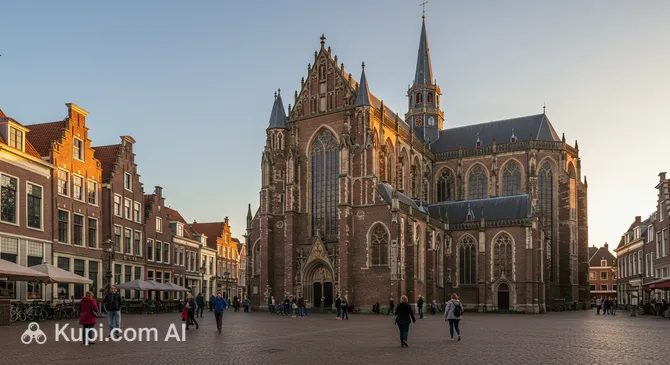
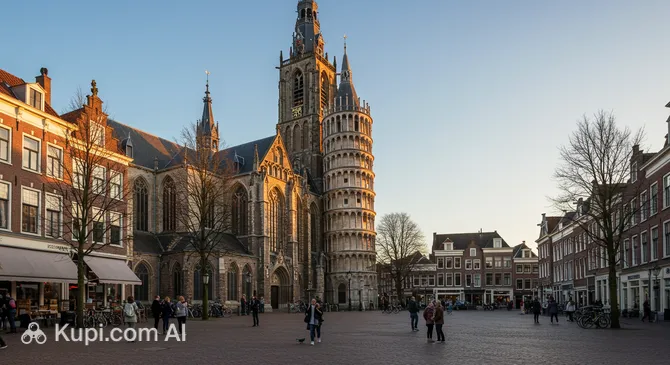
One of the main gems of Delft is the New Church (Nieuwe Kerk). This majestic structure on the Market Square impresses with its Gothic architecture and tall tower, which offers breathtaking views of the city. The church is of great historical importance to the Netherlands, as it houses the crypt of the members of the House of Orange-Nassau, including William the Silent, the "Father of the Fatherland." Visiting the New Church is an opportunity to touch the country's history and enjoy a magnificent panorama.

New Church. Illustration.
Source: Kupi.com AI

Traveler photos:

Equally interesting is the Old Church (Oude Kerk), known for its characteristic leaning tower, affectionately called "Crooked Jan" (Scheve Jan). This oldest parish church in Delft, founded in the 13th century, houses the graves of many famous citizens, including the renowned painter Johannes Vermeer. Inside, you can see impressive stained glass windows and an ancient organ, while the atmosphere of the church itself is permeated with peace and history.

Old Church. Illustration.
Source: Kupi.com AI

Traveler photos:

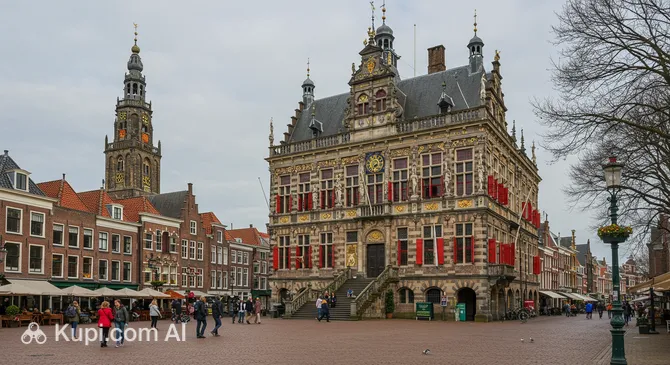
Directly opposite the New Church, on the same Market Square, stands the Delft City Hall (Stadhuis Delft). This magnificent Renaissance building with Gothic elements is one of the city's symbols. Rebuilt after a city fire in 1618 around an old Gothic tower, the city hall is still used today for official ceremonies and weddings. Its facade, decorated with sculptures and coats of arms, catches the attention of tourists and serves as a beautiful backdrop for photographs.

Delft City Hall. Illustration.
Source: Kupi.com AI

Traveler photos:

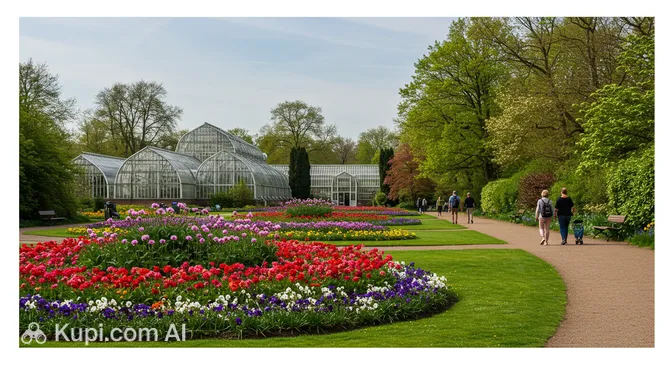
For those seeking tranquility and a love for nature, the Botanical Garden of Delft University of Technology (Botanische Tuin TU Delft) is a must-visit. Founded in 1917, this garden covers about 2.5 hectares and features a collection of more than 7,000 plant species from all over the world. Here you can walk through thematic zones, including tropical greenhouses, an apothecary garden, and a rock garden. It is a wonderful place to relax and discover a diversity of flora.

Delft University Botanical Garden. Illustration.
Source: Kupi.com AI

Traveler photos:

Local Cuisine

The cuisine of Delft is a delightful combination of classic Dutch flavors and unique local traditions that will surely please any gourmet. The gastronomic hallmark of the city is, without a doubt, the famous Delft cheese. It can be found at bustling farmers' markets and in specialized cheese shops, where you will be offered a taste of various types of this aromatic delicacy.

During your visit to Delft, be sure to try traditional Dutch pancakes – pannenkoeken. They are served here with a wide variety of toppings, from sweet apples with cinnamon to savory options with bacon or smoked fish. Don't miss the chance to taste fresh "haring" herring, which locals and tourists often eat right on the street, holding it by the tail and dipping it in finely chopped onions. During cooler times of the year, a hearty Dutch pea soup – erwtensoep – is particularly popular as a filling and warming dish.

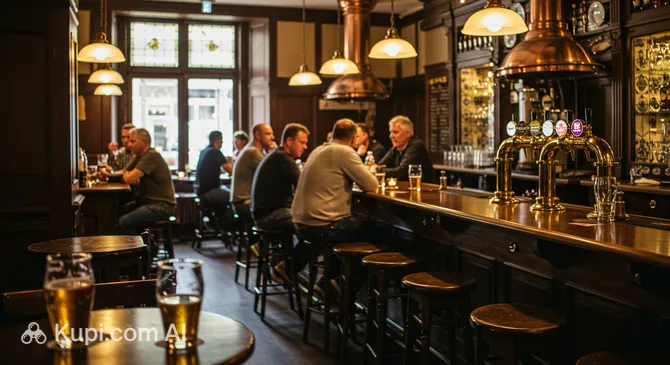
Those with a sweet tooth will certainly enjoy stroopwafels – thin round waffles joined together with a layer of caramel syrup. It's the perfect treat with a cup of aromatic coffee or tea. As for drinks, Delft, like many cities in the Netherlands, is proud of its local beer, which is often brewed in small breweries. To get acquainted with local brews, you can visit places like Delfts Brouwhuis, which has an authentic atmosphere.

Delfts Brouwhuis. Illustration.
Source: Kupi.com AI

Traveler photos:

The dining culture in Delft is very diverse. Locals and tourists love to buy fresh products at markets, stop by street stalls for quick snacks, or spend time in many cozy cafes, enjoying fresh pastries, soups, and, of course, conversation. For a more substantial meal, there are many restaurants in the city offering both traditional Dutch dishes and international cuisine.

The gastronomic scene in Delft is characterized by its friendly and relaxed atmosphere, with an emphasis on quality local products. The city periodically hosts food festivals, providing a great opportunity to get acquainted with culinary innovations and dive deeper into the world of Dutch flavors. This is a great chance to discover authentic Dutch cuisine in all its diversity and enjoy the leisurely pace of life in this charming city.

Travel Tips

Planning a trip to charming Delft? These practical tips will help make your journey as comfortable and rewarding as possible.

  1. Clothing for the weather and essentials: The climate in Delft is temperate and maritime, so layering is your best friend. Summers can be warm, but evening chills or sudden rain are not uncommon, so a light jacket or sweater and an umbrella will come in handy. In autumn and spring, waterproof clothing is a must. Be sure to bring comfortable shoes for walking on the old town's cobblestone streets. Don't forget an adapter for European sockets (type F). When visiting churches like the New Church (Nieuwe Kerk) or the Old Church (Oude Kerk), choose modest clothing that covers shoulders and knees.
  2. Getting around the city: Delft is a small and very cozy city, so the best way to explore it is on foot or by bicycle. Bike rental is very popular and accessible here. Public transport includes buses and trams that connect different parts of the city and suburbs. To travel to nearby major cities like The Hague or Rotterdam, it's convenient to use trains—the rail connection in the Netherlands is excellent. Renting a car for travel within Delft itself is generally impractical due to narrow streets and limited parking.
  3. Financial matters: The local currency is the Euro (EUR). You can exchange money at banks or exchange offices, but bank rates are usually more favorable. Credit and debit cards (Visa, Mastercard) are accepted almost everywhere, especially in shops, restaurants, and hotels. However, it's always useful to carry a small amount of cash for minor purchases or at markets. ATMs (geldautomaat) are easy to find throughout the city. Tipping in restaurants is not strictly mandatory, but if you enjoyed the service, it's customary to leave 5-10% of the bill or simply round up the total.
  4. Health and safety: Pharmacies (Apotheek) in Delft are easy to find and marked with a green cross. Some may operate on a duty schedule at night and on weekends; information about this can usually be found on the door of the nearest pharmacy. If medical assistance is needed, tourists should contact local hospitals or general practitioners (huisarts). For emergencies, the universal number is 112. Delft is considered a very safe city. Nonetheless, take usual precautions: watch your belongings in crowded places and don't leave values unattended.
  5. Language and connectivity: The official language is Dutch. However, the vast majority of Delft's residents, especially young people and tourism workers, speak English fluently, so you should have no communication problems. Learning a few basic phrases in Dutch (e.g., "Hallo" – hello, "Dank u wel" – thank you, "Ja/Nee" – yes/no) is a nice gesture. Wi-Fi is widely available in hotels, cafes, and many public places. Local SIM cards can be purchased at mobile phone shops or supermarkets.
  6. Local etiquette: The Dutch are generally friendly, direct, and value politeness. It's customary to say hello when entering small shops or cafes. A handshake is the standard form of greeting. In public places, try not to be noisy and respect others' personal space. Punctuality is also highly valued.
  7. What to avoid: It is strictly recommended not to walk or stand on cycle paths (fietspad), which are usually painted red. Cyclists have priority, and it can be dangerous. Also, avoid comparing the Netherlands to Holland in conversation with locals, as Holland is only two of the country's twelve provinces (though Delft is in South Holland, it's better to use "Netherlands" for the general context).
  8. The Delft specialty: Don't miss the chance to get up close with the famous Delft blue-and-white porcelain (Delfts Blauw). Visit one of the factories, like Royal Delft, to see how it's created. Delft is also a city of rich history, closely linked to the artist Johannes Vermeer and the royal House of Orange-Nassau. Walking along its picturesque canals and historic center is a true delight. On Thursdays and Saturdays, a lively market opens in the central Markt square—a great place to buy local products and souvenirs.

We hope these tips help you better prepare for your trip and fully enjoy every moment spent in beautiful and unique Delft. We wish you an unforgettable journey!

Entertainment & Nightlife

Delft, known for its rich history and famous blue-and-white pottery, reveals another side as evening falls – a cozy and lively nightlife. Largely thanks to the Delft University of Technology and its large student population, the atmosphere in the city during the evening becomes particularly friendly and informal. While Delft cannot boast the scale of nightlife found in Amsterdam or Rotterdam, it charms with its authentic bars, pubs, and several clubs where you can have a great time.

The main concentration of evening and night venues is located in the historical city center. The heart of Delft's nightlife is undoubtedly the Beestenmarkt square. Once a cattle market, today it is a bustling spot with numerous cafe and bar terraces that fill up with visitors as dusk falls. Venues around the Markt (Market Square) are also popular. Here, you can find bars for every taste: from traditional Dutch "brown cafes" (bruine kroegen) with their unique atmosphere to more modern bars with trendy music and cocktails. The crowd is mostly young and student-oriented, but you will also find locals of all ages and tourists. The dress code in most places is quite casual, with a relaxed style being preferred. Most bars stay open until 1-2 AM on weekdays and may extend their hours until 3-4 AM on Fridays and Saturdays.

Among the many venues in Delft, there are several particularly popular spots. For example, Delfts Brouwhuis attracts beer lovers with its wide selection and lively atmosphere. If you are looking for a place for a heartfelt gathering with friends, check out De Botanie, known for its cozy interior. Many residents and visitors also appreciate LEF Restaurant & Bar for its stylish design, good cuisine, and diverse cocktail menu.

Delfts Brouwhuis. Illustration.
Source: Kupi.com AI

Traveler photos:

When planning your evening in Delft, keep in mind that things are liveliest on Friday and Saturday nights. Average drink prices are comparable to other cities in the Netherlands: a glass of beer costs about 3-6 euros, wine starts from 4-5 euros per glass, and cocktails from 8-10 euros. Getting around the compact center of Delft at night is most convenient on foot or by bicycle, which is the traditional Dutch way. Taxis are also available; they can be called by phone, through mobile apps, or found at designated stands, such as at the railway station.

Delft is generally considered a very safe city, and nighttime walks along the well-lit central streets usually cause no concern. Nevertheless, as in any other place, standard precautions should be taken: keep an eye on personal belongings and avoid poorly lit or deserted alleys, especially if you are returning late alone. You can call a taxi by asking the staff at a bar or restaurant or by using one of the taxi apps.

While Delft's nightlife has its charm, the city also offers many interesting activities during the day. It is definitely worth exploring its rich cultural heritage by visiting iconic sites like the majestic New Church (Nieuwe Kerk) with the royal burial vault or the ancient Old Church (Oude Kerk) with its leaning tower. Nature lovers can stroll through the picturesque Botanical Garden of Delft University, and for active leisure, Franky's Bowling in Delft is a great option. Museums like the Prinsenhof will tell you about the history of the city and the country.

Parks & Museums

Delft is not only a city with a rich history and charming canals but also a place where you can enjoy nature in cozy parks and immerse yourself in the world of art and science in its many museums and historical landmarks.

For nature lovers, Delft offers several wonderful green spaces. One such place is the Botanical Garden of Delft University of Technology. This is not just a beautiful garden for walks, but also an important scientific center with a rich collection of plants from all over the world, including thematic gardens and greenhouses where you can spend several hours enjoying the silence and the diversity of flora. Another popular place for outdoor recreation is the nearby Rijswijk Forest. This extensive forest park is ideal for walking and cycling, offering peace and connection with nature away from the city bustle.

Rijswijkse Forest. Illustration.
Source: Kupi.com AI

Traveler photos:

Delft's cultural life is equally rich. The city is proud of its museums, which tell the story of its glorious past and artistic traditions. Museum Prinsenhof Delft is a must-visit; it was here that key events in the history of the Netherlands involving William of Orange, the "father of the fatherland," took place. Fans of the art of Johannes Vermeer, a famous native of Delft, can get to know his work more deeply at the Vermeer Centrum Delft, which features reproductions of all his works and tells the story of the life and techniques of the great artist. It is impossible to imagine Delft without its famous blue-and-white ceramics. The Royal Delft factory (Koninklijke Porceleyne Fles), founded in 1653, is the last remaining original 17th-century factory where products are still hand-painted in the traditional technique. Here, you can not only see the production process and a rich collection of historical items but also purchase unique souvenirs. For those interested in science and technology, Race Planet Delft might be interesting, offering interactive exhibits that will be fascinating for both children and adults.

Delft's architectural heritage is impressive at every turn. The central Markt square is adorned with the majestic Renaissance-style Delft City Hall, which is one of the city's symbols. Opposite it rises the New Church (Nieuwe Kerk) with its famous 85-meter belfry, which offers a stunning view of the city and houses the burial vault of members of the House of Orange-Nassau. Nearby is the Old Church (Oude Kerk), known for its characteristic leaning tower and magnificent stained glass windows. Also worth noting is the Maria van Jesse Church (Maria van Jessekerk), an impressive Neo-Gothic basilica with rich interior decoration.

Maria van Jesse Church. Illustration.
Source: Kupi.com AI

Traveler photos:

To feel the authentic atmosphere of Delft, turn off the main tourist routes and stroll through the quiet streets along the picturesque canals, looking into hidden courtyards called "hofjes" – oases of calm in the city center. Also, take note of the small antique shops and art studios where you can find unique items by local artisans and take home a piece of the soul of this amazing city.

Getting Around

Public transport in Delft is well-developed, making it easy to get around the city and its surroundings. The main modes of transport here are buses and trams, which connect various city districts and link Delft with neighboring cities like The Hague and Rotterdam. There is no metro in Delft, but its role is partly filled by tram lines and suburban trains.

The payment system for travel in the Netherlands, and Delft in particular, is based on the use of the contactless OV-chipkaart. This is a universal card that can be topped up and used for all types of public transport across the country. For tourists, there are anonymous OV-chipkaarts that can be purchased at railway stations, some supermarkets, and tobacco shops. You can also buy single-use tickets for one or more journeys, or day passes, which can be cost-effective for intensive travel. The cost of the trip depends on the distance. Payment is also possible with a bank card directly on the transport (the OVpay system), but check for this possibility before your journey.

You can purchase tickets and top up your OV-chipkaart at machines at railway stations, in transport company service centers, or online. It is important to remember that when entering and exiting a bus or tram, you must tap your card against the special validator (check-in and check-out). If you forget to check out, the maximum fare for the trip may be deducted from your card. Public transport in Delft usually runs from early morning until late evening, but schedules can change on weekends and holidays. It is recommended to check the current schedule on the websites of transport companies or in mobile apps like 9292.nl.

In addition to public transport, the bicycle is extremely popular in Delft. This is perhaps the most convenient and authentic way to move around the compact historical city center. Bicycle rental shops can be found everywhere, especially near the railway station. Taxi services are also available, though they are a more expensive option. Car sharing in Delft is represented by several operators, but for short tourist trips, it may be less convenient than a bicycle or public transport.

Accommodation

In Delft, travelers will find a variety of accommodation options to suit different preferences and budgets. The city offers a wide choice: from cozy bed and breakfasts (B&Bs) and budget hostels to comfortable mid-range hotels, stylish boutique hotels, and short-term rental apartments.

The most popular area for tourists to stay is undoubtedly the historic city center. Staying here provides easy access to major attractions such as the New Church, the Old Church, and the Delft City Hall, as well as numerous cafes, restaurants, and shops. Many hotels and apartments are located in charming historic buildings, which adds a special flavor to the stay. The areas adjacent to the central station are also convenient, making it easy to travel to other cities in the Netherlands.

While specific famous hotels are not listed in the provided data, you can find many options to suit every taste in Delft. The price range varies from budget-friendly options to more expensive offerings. It is recommended to book accommodation in advance, especially if your trip coincides with the peak tourist season (for example, in the spring during tulip blooming or in the summer months) or during major events in the city. To find and book accommodation, it is convenient to use popular online platforms or contact the chosen hotel directly.

Nearby Cities

For those who want to explore the surrounding area, Delft serves as an excellent starting point for day trips to several interesting nearby locations. Among them, the following stand out:

The Hague, located just 8 kilometers away, is not only the official residence of the royal family but also the political heart of the Netherlands. Here you can visit the Binnenhof (the parliament building complex), the Peace Palace, where the International Court of Justice sits, and the famous Mauritshuis art gallery with masterpieces by Dutch masters, including Vermeer's "Girl with a Pearl Earring."

Rotterdam is a dynamic city known for its bold modern architecture, which contrasts sharply with the historical look of Delft. It is definitely worth seeing the innovative Cube Houses, the impressive Erasmus Bridge, and visiting one of the largest ports in the world. Rotterdam also offers many museums, lively markets, and excellent restaurants.

Below is information about other nearby cities that may also be of interest for short trips:

CityPopulationDistance
Rijswijk55 2204 km
Nootdorp19 0004 km
Pijnacker27 1305 km
Leidschendam10 4828 km
The Hague548 3208 km

These nearby destinations allow for a more complete understanding of the diverse culture, history, and modern life of the South Holland region, complementing the experience of visiting Delft itself.

Shopping & Souvenirs

Delft is not only a city of rich history and picturesque canals but also a wonderful place for leisurely shopping. Here, you won't find massive shopping malls, but instead, you can enjoy the atmosphere of cozy streets filled with numerous independent shops, boutiques, and, of course, stores selling the world-famous Delftware. The city is renowned for its craft products and unique souvenirs.

The main shopping arteries of Delft are concentrated in its historical center. Take a stroll along streets like Voldersgracht, Choorstraat, Oude Delft, and Hippolytusbuurt. Here you will find plenty of clothing stores, designer goods, antiques, and local delicacies. The central Markt square, located between the New Church and the Delft City Hall, is also teeming with shops and cafes where you can relax after your shopping spree.

New Church. Illustration.
Source: Kupi.com AI

Traveler photos:

There are no large modern shopping centers in the traditional sense within Delft. The emphasis here is on small specialized shops and boutiques that give the city a special charm. If you are looking for a wider selection of chain stores, the nearest large shopping malls can be found in neighboring cities like The Hague or Rotterdam.

Market life in Delft is quite active. The main weekly market takes place on the Markt square on Thursdays. Here you can buy fresh food, cheeses, flowers, clothing, and much more. On Saturdays, a large antique and flea market unfolds on the same square and adjacent streets (such as Brabantse Turfmarkt and Burgwal), where you can find real treasures. Additionally, along the Voldersgracht canal on Saturdays (from April to October), a picturesque flower market is open.

The main souvenir from Delft is undoubtedly Delft blue-and-white porcelain (Delfts Blauw). You will find it in numerous shops and workshops, ranging from small trinkets to exquisite vases and dinnerware sets. It is also worth looking for local cheeses, traditional Dutch caramel-filled waffles (stroopwafels), and perhaps reproductions of paintings by Johannes Vermeer, Delft's famous native. Souvenir shops also sell items featuring windmills and tulips.

Shops in Delft are usually open from 10:00 AM to 6:00 PM from Tuesday to Saturday. Many shops are closed on Monday mornings or open later. Thursdays often feature a "shopping evening" (koopavond), when shops stay open until 9:00 PM. On Sundays, some shops in the city center may also be open, especially during the tourist season. Bank cards (Maestro, VPay, Visa, and Mastercard credit cards) are accepted almost everywhere, but it's always useful to have some cash for small purchases or at the market.

Tourists from non-EU countries may be eligible for a VAT refund (Tax Free) when making purchases over a certain amount in participating shops. Look for "Tax Free Shopping" stickers in windows and remember to ask the shop for the special tax refund form, which must be presented to customs when leaving the EU.

Reached the end of the page?

That means the route is fully explored