Support

Pohutu Geyser

About

The majestic Pohutu Geyser is perhaps the most breathtaking natural spectacle New Zealand has to offer. Located in the famous Whakarewarewa thermal valley in the city of Rotorua, this giant is the largest active geyser in the Southern Hemisphere. Its Māori name symbolically means "explosion" or "big splash," perfectly capturing its power.
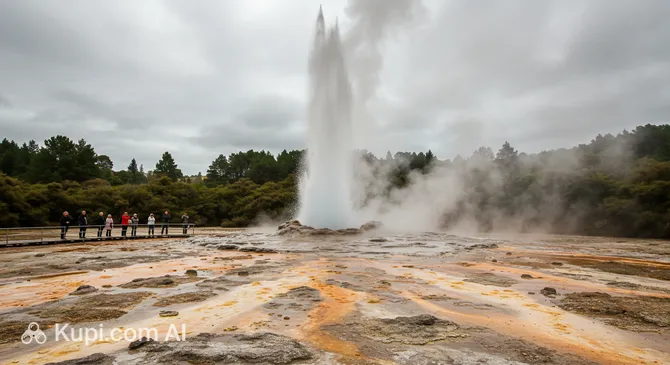
Pohutu Geyser
Pohutu Geyser. Иллюстрация. Источник: Kupi.com AI

The uniqueness of Pohutu lies in its impressive regularity: every 20–60 minutes, fountains of boiling water and steam erupt from a vent about half a meter wide, reaching heights of up to 30 meters. The show unfolds against a backdrop of surreal geothermal landscapes, adorned with silica terraces and bubbling mud pools.

The geyser is located within the Te Puia cultural and educational center. Here, the earth's natural energy is closely intertwined with the rich traditions of the Māori people, making a visit a deep dive into the history and geology of the Taupō Volcanic Zone.

Contacts

To plan your visit to Pohutu Geyser, it is worth checking the official information from the Te Puia cultural center in advance. Below are the current contact details to help you easily find your way and clarify tour details. Please note that the site is located on protected land with well-developed tourist infrastructure.

How to contactContact
Address20 Hemo Road, Rotorua 3010, New Zealand
Websitewww.tepuia.com

What to Do

The main reason travelers from all over the world come to Rotorua is the chance to witness the awakening of Pohutu firsthand. The mesmerizing show is often preceded by a smaller neighboring geyser known as the "Prince of Wales Feathers." The best place to watch the water column rise is from the special viewing platforms, where the characteristic smell of sulfur fills the air and steam envelops everything in a mystical haze.

In addition to watching the geyser, it is worth walking along the thermal trails within Te Puia. You will see amazing "champagne pools," boiling mud basins, and picturesque silica terraces. The journey is complemented by an introduction to living Māori culture: here you can see traditional wood carving, hear ritual chants, and even witness the famous haka dance.

Don't miss the chance to try dishes prepared in the traditional hangi style (in an earth oven using steam from geothermal springs) or relax in nearby thermal baths. This location is ideal for photography and videography, especially at moments when several vents activate simultaneously, creating a rare natural spectacle.

Getting There

This natural wonder is located just 3 kilometers from Rotorua city center at 20 Hemo Road. The easiest way to get here is by car; the drive from the local airport takes about 15–20 minutes via State Highway 30. There is a large free parking lot for visitors on-site.

If you prefer public transport, use the city buses on lines 5 or 20. The trip from the central station takes only 10–15 minutes, and the stop is located directly opposite the park entrance. Many hotels also offer organized shuttles to the Te Puia cultural center.

Walking enthusiasts can reach the geyser in about 40 minutes by following the scenic trails through the Whakarewarewa forest. However, keep in mind the specific smell of sulfur and high humidity, so a taxi or bus ride is often a more comfortable option.

Ближайший город: Rotorua

History & Facts

The history of this place is steeped in the legends of the indigenous people for which New Zealand is famous. According to Māori lore, the geysers were created by the fire sisters Te Hoata and Te Pupu, who burst from the earth's depths to warm the freezing chief Ngatoroirangi. Geologically, Pohutu sits above an active fault where underground steam pressure periodically breaks through a water plug, causing a massive eruption.

Interestingly, the neighboring "Prince of Wales Feathers" geyser gained its current activity level after the catastrophic eruption of Mount Tarawera in 1886. Since then, these two springs have worked in close synchronization: the activity of the smaller one often serves as a reliable sign that the great Pohutu is about to begin its grand performance.

In the early 20th century, the region was famous for the Waimangu Geyser, which shot water an incredible 450 meters into the air, but it eventually subsided, leaving Pohutu with the status of the most stable and powerful giant. Today, Te Puia carefully preserves this natural heritage, combining scientific facts with the Māori cultural code.

Time Needed

To fully experience the power of Pohutu and explore the surrounding park, it is recommended to allow 2–3 hours. This is enough time to wait for at least one full eruption (which happens quite frequently) and take impressive photos without rushing.

If you plan to attend a Māori cultural show, visit the craft workshops, and take a leisurely stroll along all the Te Puia geothermal trails, it is better to set aside half a day for your visit. Keep in mind that nature doesn't always work on a strict schedule, so a little extra time will ensure you see the geyser at its peak strength.

Working Hours

You can visit the geyser valley daily: the Te Puia complex is open to guests from 9:00 AM to 4:00 PM. This schedule applies seven days a week, including weekends and public holidays. While the geyser's natural activity doesn't stop at night, access to the viewing platforms is limited to daylight hours for safety reasons.

It is recommended to arrive at opening time or in the first half of the day to have enough time to see all the exhibits and wait for an eruption before the complex closes. Note that Pohutu is active regardless of operating hours, but the most impressive views are revealed in bright daylight.

9:00 – 16:00

Nearby

Exploring the area around Pohutu Geyser can significantly enrich your trip to Rotorua. The region is packed with unique sites—from authentic Māori villages to modern adrenaline parks—allowing you to create a diverse itinerary for every taste.

Thanks to the high concentration of geothermal zones and historical monuments, you can go from contemplating boiling lakes to studying traditional arts almost immediately after leaving the main complex.

NameDistance
Te Puia0.3 km
Whakarewarewa – The Living Maori Village0.3 km
Regal Palms Resort0.8 km
Secret Spot Hot Tubs1.4 km
Redwoods – Whakarewarewa Forest1.8 km
Redwoods Treewalk1.8 km
Bold Flavours Bistro2.6 km

Reached the end of the page?

That means the route is fully explored