Support

Wagah

About

Wagah is a small but surprisingly colorful town located in eastern Pakistan, literally on the border with India. It occupies a strategic position between Lahore, the cultural heart of the region, and the Indian city of Amritsar, stretching across the picturesque plains of Punjab. The air here is often filled with the aromas of spices and freshly cut grass, creating a special atmosphere.
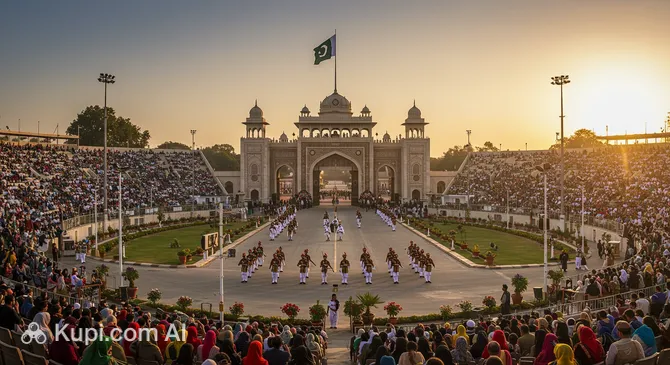
Wagah. Illustration.
Source: Kupi.com AI

With a population of about 27,000 people, Wagah maintains the coziness and measured pace characteristic of small border towns. There is no metropolitan hustle and bustle; instead, there is a special sense of unity and hospitality that is felt in every greeting from the local residents.

The main attraction of Wagah, drawing travelers from all over the world, is its border crossing — the only official land route between Pakistan and India in this region. Every day at sunset, a spectacular flag-lowering ceremony takes place here. This vibrant and patriotic show, known as the "Wagah Border Ceremony," gathers huge crowds of spectators on both sides of the border, turning an ordinary border ritual into an unforgettable performance.

Wagah is a place where you can touch history, enjoy authentic culture, and witness unique traditions carefully preserved through the centuries. The town seems to invite you to dive into the world of Eastern hospitality and get to know the real Pakistan. A visit to Wagah will give you vivid impressions and allow you to see a unique aspect of life on the border of two states.

More interesting facts can be found on the history of the city of Wagah page

Weather Overview

The weather in Wagah is characterized by significant seasonal variations. Summer, especially from May to September, is hot, with average temperatures often exceeding 30°C, peaking in June at around 32.9°C (maximum values can approach 39°C). Winters, from December to February, are significantly cooler, with average temperatures around 11-15°C, while night minimums can drop to 6-9°C.

As for precipitation, the highest amount falls in July (about 7 mm, 23 rainy days) and August (about 4 mm, 18 rainy days), coinciding with the monsoon season. Winter months, conversely, are very dry, especially December, when there is practically no precipitation. Overall, expect a hot summer with occasional but sometimes intense rain, and cool, dry winters. For a more detailed forecast and climate information, you can visit the Wagah Climate page.

Average monthly temperature

Average monthly precipitation

Interesting Facts

Beyond its well-known role as a border point, Wagah holds many fascinating secrets and surprising stories that make it a truly unique place on the map of Pakistan. Here are just a few of them:

  • The daily flag-lowering ceremony at the border is not just a formality, but a real theatrical performance. The military forces of Pakistan and India turn the ritual into a colorful show with synchronized marches and music, gathering enthusiastic spectators on both sides.

  • Despite the strict border control, the crossing at Wagah is often called a place of unique friendly rivalry. The soldiers of the two countries seem to compete in the precision of their movements and their military bearing, while the atmosphere resembles a sporting festival more than a stern checkpoint.

  • Wagah is not just a geographical point, but a place that has witnessed millions of human destinies. After the Partition of British India, it was through this point that countless streams of people passed, and the town still preserves the memory of these meetings and partings.

  • This region is historically home to representatives of various peoples and religions. In Wagah and its surroundings, traditions and holidays of Muslims, Sikhs, and Hindus are treated with great respect, creating a unique atmosphere of cultural diversity.

How to Get There

When planning a trip, it is important to think through your route in advance. Since Wagah is a small border town, the main flow of tourists arrives here via neighboring major transport hubs. You can find all ways to get to the city on a separate page, and below we will look at the main arrival options through airports and train stations.

There is no airport in the town of Wagah itself, but thanks to its proximity to large cities, getting here by air is quite simple. The most convenient option is Allama Iqbal International Airport (LHE), located in Lahore. It is only 17.3 km from Wagah. This is a major aviation hub that handles many international flights. A taxi or bus ride from the airport to the town takes about 45-50 minutes, making it an ideal point of arrival.

Another possible option is Sialkot Airport (SKT), located in Sialkot. It is significantly further away — approximately 105 km from Wagah. This airport has international status, but the passenger traffic here is smaller than in Lahore. The travel time by car from here will be about 3 hours. This route might be convenient if you plan to visit other cities in the Punjab province as well.

For convenience, here is a summary of the main airports located in the region:

AirportPassenger trafficDistance
Allama Iqbal International Airport5.4 mln17 km
Sri Guru Ram Dass Jee International Airport3.5 mln26 km
Sialkot Airport800 000105 km
Satwari Airport1.6 mln123 km
Ludhiana (Halwara)139 km

Regarding rail connections, there is no railway station in Wagah itself that accepts long-distance passenger trains. Travelers usually use the railway networks of neighboring major cities. In the available list of stations, Rawalpindi Railway Station (RWP), located in Rawalpindi, can be highlighted. However, it should be noted that it is a significant distance away — approximately 263 km from Wagah. A trip from there would require a bus or taxi transfer and would take a long time, so this option is more suitable for those on a large journey across the country.

Below is information about the closest significant railway station from the available data:

StationPassenger trafficDistance
Rawalpindi Railway Station5.5 mln263 km

Main Attractions

The town of Wagah, located on the border of Pakistan and India in the Punjab province, is world-famous for one unique and exciting spectacle. Although the settlement itself is small, its name is firmly associated with a vibrant daily event that attracts many tourists and locals.

The main and undoubtedly most famous attraction of Wagah is the Wagah-Attari border closing ceremony. This carefully choreographed daily military performance, also known as the "Beating Retreat ceremony," is held before sunset. It features the Pakistan Rangers and the Indian Border Security Force, each group on its own side of the border.

During the ceremony, soldiers from both countries demonstrate impressive drill maneuvers, including high leg kicks, energetic marches, and demonstrative gestures full of showy militancy. All this happens to loud music and shouts of support from the stands. The culmination is the rapid and synchronized lowering of the national flags of Pakistan and India, after which the border gates are ceremoniously closed until the next morning. This spectacle symbolizes both rivalry and strict discipline.

Attending the ceremony in Wagah is not just watching a military ritual, but a real immersion into an incredibly charged and patriotic atmosphere. The stands on the Pakistani side are always full of enthusiasm: spectators actively support their Rangers with songs, dances, and loud cheers. This is a bright and memorable show that leaves a strong impression due to its uniqueness and energy.

In addition to the ceremony itself, the border infrastructure is also of interest to tourists. Specially built monumental gates, amphitheatres for spectators, and flagpoles are an integral part of this impressive complex. Observing the preparations for the ceremony and the opportunity to feel this special atmosphere at the border of two states make a visit to Wagah truly special.

Local Cuisine

The cuisine of Wagah, located in the heart of Punjab, is a true feast of flavors and aromas that gourmets will surely appreciate. Local residents masterfully prepare dishes over an open fire, generously using spices, which gives the food a unique character. Be sure to try the juicy meat skewers known as tikka and the tender tandoori chicken cooked in a special clay oven. Thick vegetable curries with chickpeas or lentils, served with fragrant rice or freshly baked flatbreads, are also popular.

Among the local drinks, lassi – a refreshing yogurt-based drink – holds a special place. It is prepared in various versions: sweet, salted, with spices, rose water, or fresh fruit. It is the perfect way to quench your thirst on a hot day and complement any meal. Among non-alcoholic beverages, tea is also popular and drunk everywhere here.

The food culture in Wagah is closely linked to street food and bustling markets. This is where you can feel the true spirit of the city and try many authentic dishes. Look for crispy samosas with spicy filling, fragrant chana chaat (a chickpea salad with vegetables and spices), and pakoras – vegetables deep-fried to a golden crust. In the evening, the markets turn into real gastronomic festivals where chefs compete in the art of cooking, creating a unique atmosphere. Of course, the town also has restaurants offering both traditional Punjabi dishes and more modern interpretations of local cuisine.

Travel Tips

Planning a trip to Wagah to witness the famous border ceremony? These practical tips will help you prepare for your journey and get the most out of this unique location on the border of Pakistan.

  1. Clothing and Essentials: In Wagah, as in the Punjab province, the climate can be hot, especially during the summer months. Choose light, breathable clothing made from natural fabrics. Considering the cultural aspects of Pakistan, a modest style of clothing is recommended, especially for women (shoulders and knees covered). Be sure to bring comfortable shoes, as you may have to stand or walk a lot, especially during the ceremony. Don't forget sunscreen, a hat, and sunglasses. For electronics, you may need a Type D or G adapter.
  2. Transport: Wagah is primarily a border crossing, not a large city. The best way to get here is by taxi or a rented car with a driver from Lahore. Public transport directly to the checkpoint itself can be irregular. In the vicinity, you can use local rickshaws for short trips, but for a trip to the ceremony, it's better to organize transport in advance.
  3. Finance: The local currency is the Pakistani Rupee (PKR). It is recommended to carry sufficient cash, as cashless payment options, especially in small shops or with street vendors, may be limited. ATMs may be available in Lahore, but they are harder to find directly in Wagah. International cards are accepted in large hotels and some shops in big cities, but you shouldn't rely on this heavily in Wagah. Tipping is appreciated for good service in restaurants and for drivers.
  4. Health and Safety: In Lahore, the nearest major city, there are pharmacies and medical facilities. In Wagah itself, medical assistance is limited. Bring a small first-aid kit with basic medications. Drink only bottled water. The border zone is well-guarded during the ceremony, but always keep an eye on your personal belongings due to the large crowds. Avoid walking in deserted and unlit areas after dark outside the main ceremony zone.
  5. Communication: The official languages are Urdu and English. Punjabi is also widely spoken in Punjab. English is understood by many in the tourism sector and in cities, but knowing a few phrases in Urdu (e.g., "Assalamu Alaikum" – hello, "Shukriya" – thank you) will be appreciated by locals. For stable connectivity, it's better to purchase a local SIM card in Lahore. Wi-Fi may be available in hotels but is not ubiquitous.
  6. Local Etiquette: Show respect for local traditions and customs. The greeting "Assalamu Alaikum" is standard. During the border ceremony, behave respectfully and follow the instructions of officials. Ask permission before taking photos of people, especially women. In public places, try not to attract excessive attention with loud behavior.
  7. What to Avoid: Categorically avoid discussing sensitive political topics, especially those concerning Indo-Pakistani relations, unless a local person initiates the conversation and does so in a very cautious manner. Do not photograph military installations, personnel, or equipment without special permission.
  8. Wagah's Highlight – The Border Closing Ceremony: The main reason people go to Wagah is the daily flag-lowering ceremony. Try to arrive early (1-2 hours before the start) to get good seats, as many spectators gather. The atmosphere is very patriotic and energetic – be prepared for loud shouting and music. It is truly a unique sight!

We hope these tips make your trip to Wagah comfortable and unforgettable. Enjoy this vibrant and emotional spectacle that will leave you with strong impressions!

Entertainment & Nightlife

The town of Wagah is primarily known for its unique daily border closing ceremony, which in itself is the main evening event and attracts many spectators. This colorful and patriotic ceremony takes place at sunset and sets the tone for the evening in this border area.

Regarding nightlife in the traditional sense — with noisy clubs, bars, and dedicated entertainment districts — Wagah, being a small border settlement, offers more relaxed evening leisure. You won't find a large selection of nightclubs or specialized bars here. Evening activity is mainly centered around restaurants and cafes serving both locals and tourists visiting for the ceremony.

The atmosphere in Wagah in the evening is quite lively near the border crossing, especially right after the ceremony. The crowd here is mixed — local residents, tourists from all over Pakistan, and international visitors. Establishments are typically restaurants with local cuisine or small snack bars. The dress code is usually casual, but it is recommended to be respectful of local traditions in clothing. Most such places close relatively early, following the flow of visitors after the ceremony.

While there are no widely known nightlife spots with big names in Wagah, you can find places for dinner or evening tea. For example, you might look at places like "Border View Restaurant" or "Wagah Sunset Cafe," offering local dishes and a chance to relax after an eventful day. Specific establishments are best found on the spot by checking reviews or recommendations. It is best to visit such places right after the border closing ceremony. Prices are generally moderate. For a more active and diverse nightlife, consider a trip to nearby Lahore, where the choice of clubs, bars, and restaurants is significantly wider.

For getting around in the evening, especially after the ceremony, it is recommended to use a taxi or pre-arranged transport. Make sure to agree on the fare in advance. Wagah itself is considered relatively safe, especially in the areas adjacent to the border complex during the ceremony. However, as elsewhere, it is wise to observe common safety precautions after dark and avoid poorly lit or deserted areas.

Daytime entertainment in Wagah is quite limited due to its nature and small size. Beyond observing the preparations for the ceremony or visiting small local shops, there are no major museums, theaters, or amusement parks here. The main focus for visitors is the border crossing and its associated events, as well as the opportunity to experience the unique atmosphere of this location.

Parks & Museums

The town of Wagah offers travelers a completely unique experience, where its main attraction – the famous border ceremony – is in itself a captivating open-air performance and a living reflection of the local culture. While traditional parks and large museum complexes like those in major cities are few here, Wagah makes up for it with its unique atmosphere and spectacle.

When it comes to green spaces and leisure areas, Wagah does not have vast classic parks. However, the area around the Wagah-Attari border crossing, where the daily border closing ceremony takes place, can be considered the main public and performance space. This vast, specially equipped territory with stands for spectators becomes a center of attraction for thousands of people. Here, you can not only witness a unique ritual but also feel an incredible surge of patriotic emotions and unity, which makes this place remarkable in its own way.

Instead of traditional museums with display cases and artifacts, Wagah offers its guests a "living museum" – the daily flag-lowering ceremony itself. This colorful, perfectly synchronized performance involving the border guards of both countries is the town's main cultural event. The ritual, full of military bearing, energy, and national character, tells the traditions and history of the region much more vividly than many exhibits. Sometimes, small information boards or temporary exhibitions dedicated to the history of this border point can be found in the immediate vicinity of the ceremony site, complementing the overall impression.

The border itself and the monumental gates that serve as the arena for the ceremony are important historical and architectural sites. They symbolize significant events of the past and are an integral part of Wagah's unique identity. The entire atmosphere here is steeped in history, and every building or structure bears its mark.

To ensure your visit to Wagah leaves the brightest impressions, try to arrive for the ceremony early – this will allow you to get the best seats and fully feel the growing excitement. Also, don't miss the chance to observe the life around you: you can often see colorful locals, souvenir vendors, and snack sellers, which will add authenticity to your journey. For those seeking more traditional parks and museums, consider visiting nearby Lahore, which offers a greater variety of such attractions.

Getting Around

The public transport system in Wagah, considering its size and status as a border town, is quite simple and oriented toward the basic needs of residents and tourists. The main types of public transport here are buses and route taxis (minivans) that run along key routes, connecting different parts of the town and providing links to larger settlements like Lahore. However, the most popular and flexible means of transportation for short distances remains auto-rickshaws (tuk-tuks), which can be easily found in almost any part of town.

The payment system in Wagah is predominantly cash-based. On buses, tickets are usually purchased directly from the conductor or driver upon entry. The fare for an auto-rickshaw should always be negotiated with the driver before starting the journey, as there may be no fixed rates or meters. Universal transport cards or mobile apps for paying fares in local transport are generally not common. Fares are usually low but can vary depending on the distance and type of transport.

Tourists planning to use public transport in Wagah are recommended to carry small bills of local currency for convenience. Bus tickets, if issued, usually do not require special validation. Public transport operating hours may be limited, especially in the evening, so it's better to plan major trips for the daytime. Information about routes and approximate fares can be checked with local residents or directly with drivers.

As an alternative to public transport, taxi services are always available in Wagah. This is a more expensive but also more comfortable way to get around, especially if you are traveling with luggage or a group. As with auto-rickshaws, it's better to agree on the taxi fare in advance. For very short distances, especially in the central part or around the border crossing, you can walk. Car-sharing services or developed bike-rental networks are usually absent in the town.

There are no unique or specific types of transport, such as metro systems, trams, or cable cars, in Wagah. The town's transport system is functional and aimed at meeting basic mobility needs. The main flow of passengers is often related to attending the famous border closing ceremony, and transport logistics are largely oriented toward serving this event.

Accommodation

In Wagah, known primarily for its border crossing and the daily flag-lowering ceremony, the choice of accommodation is focused on short-term travelers. Here you will find options to suit different budgets, from modest guest houses to small hotels offering basic comfort.

Most accommodation options in Wagah are strategically located to provide easy access to the main attraction – the border crossing where the famous ceremony takes place. These can be small local hotels or guest houses. By choosing accommodation nearby, you can immerse yourself in the atmosphere of this unique event without unnecessary hassle. In some cases, travelers also consider accommodation options in larger nearby cities if they plan a longer stay in the region.

When planning a trip to Wagah, especially during periods of high demand or national holidays, it is worth taking care of booking accommodation in advance. The main tools for searching and booking are popular online platforms and travel aggregators. They allow you not only to compare prices and conditions but also to read up-to-date reviews from other tourists, which will help you make the right choice.

In Wagah, you can find accommodation options for various budgets, from more economical to the mid-price segment. It is recommended to check offers on several online resources to get the most complete picture of available options and choose the optimal price-quality ratio for your trip. Direct booking at small hotels is also possible, but online platforms usually offer a wider choice and the ability to compare.

Nearby Cities

For those who want to explore the surrounding area, Wagah serves as an excellent starting point for day trips to several interesting nearby locations:

For example, Lahore, located just 21 km away, is the cultural heart of Pakistan. This ancient city beckons travelers with its magnificent Mughal-era monuments, such as the famous Lahore Fort and the Badshahi Mosque, as well as its bustling bazaars and rich culinary heritage, offering an unforgettable day trip experience.

Another interesting option for a short journey is Sheikhupura, located about 56 km from Wagah. The town's main gem is the Hiran Minar – a unique historical complex with a minaret and a large artificial pool built by Emperor Jahangir, making it an attractive destination for history and architecture lovers.

Below is a table with information about some of these and other nearby cities:

CityPopulationDistance
Attari9 5234 km
Kaonke14 6467 km
Dara8 86717 km
Lahore Cantonment374 87219 km
Lahore12 306 00021 km

These nearby destinations offer a glimpse into the diverse culture and landscapes of the region.

Shopping & Souvenirs

Shopping in Wagah has its own specifics due to its status as a border town, known primarily for its daily border closing ceremony. Although Wagah is not a major trading hub, you can find interesting souvenirs and goods here that reflect the culture of Pakistan and the atmosphere of this unique place. The town is not famous for any special types of shops, but it offers a good selection of memorabilia for tourists.

The main shopping points in Wagah are concentrated mostly along the main road leading to the Wagah-Attari border crossing, as well as in the immediate vicinity of the border itself. Here you will find many small shops and kiosks offering a variety of goods. These are not the classic shopping streets of big cities, but rather lively areas oriented toward visitors of the ceremony.

There are no large modern shopping centers in the usual sense in Wagah. If you are looking for shopping in big malls with international brands, you should consider a trip to larger cities in Pakistan, such as Lahore, which is relatively close by.

The markets in Wagah are more like traditional bazaars and individual trading rows than large organized market complexes. Here you can find local products, clothing, textiles, and, of course, souvenirs. This is a great place to feel the local flavor and perhaps bargain for an item you like. The atmosphere in such markets is usually lively, especially on the days of the border ceremony.

As souvenirs from Wagah, tourists often choose items related to Pakistan and the border ceremony. These can be Pakistani flags of various sizes, keychains, magnets with images of border guards or the ceremony itself. Textile products like shawls, scarves with traditional embroidery, and small rugs are also popular. You can also find products from local artisans, such as carved wooden boxes or ceramics. Don't forget to look at traditional headwear and inexpensive jewelry.

Shops and souvenir stalls in Wagah usually operate daily, tailoring their schedule to the time of the border ceremony, when the largest influx of tourists is observed. Standard opening hours may vary, but most outlets are open during the day and early evening. The main method of payment in small shops and markets is cash – Pakistani rupees (PKR). The ability to pay by bank card is extremely rare, so it is recommended to carry a sufficient amount of cash. ATMs in Wagah itself may be few and far between.

The possibility of Tax Free (VAT refund) for tourists on goods purchased in Wagah is generally absent. This system usually applies to large purchases in specialized stores in big cities and international airports. For souvenir products and goods purchased at local markets, this option is not provided.

Reached the end of the page?

That means the route is fully explored