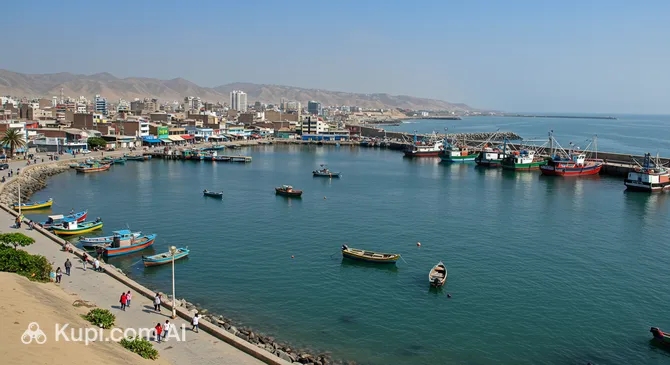
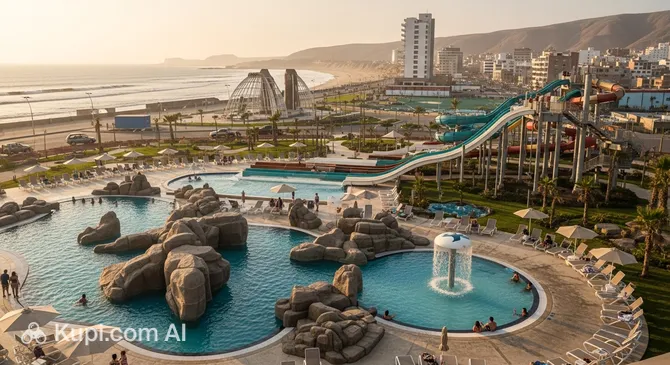
Chimbote is a dynamic port city on the Pacific coast, located in the northern part of Peru. Known as the "fishing capital of the world," it possesses a unique industrial atmosphere where the scent of the sea blends with the energy of the country's largest fishing hub. The city stretches along the shores of a picturesque bay 420 kilometers from Lima, serving as an important administrative and economic center of the Ancash region.
Chimbote. Illustration.
Source: Kupi.com AI
The city's geographic position on the Pan-American Highway has made it a strategic hub. The population of Chimbote is approximately 497,875 people, making it one of the largest settlements on the coast. The climate here is mild, typical of the coastal desert, allowing tourists to comfortably move between city blocks and industrial docks to witness the scale of the fishing fleet, which accounts for 75% of the country's total catch.
The city's modern development is closely tied to the industrial boom of the mid-20th century, though the heritage history of this place dates back to 1835, when a small fishing settlement first emerged here. Today, the city attracts those who want to see the real, unfiltered Peru: from bustling markets to metallurgical giants and massive port terminals.
A visit to Chimbote will be a discovery for travelers who appreciate industrial aesthetics and an authentic way of life. Here, you can feel the rhythm of a massive machine driving global exports and enjoy the freshest treasures of the ocean right in the heart of Peruvian fishing.
Weather Overview
The climate in Chimbote is classified as subtropical coastal, which results in stable and moderate temperatures throughout the year. Two distinct periods can be identified in the city. The warm season lasts from January to April: during this time, the average temperature is about 22–23°C, and daytime highs in February and March can reach 25–28°C. This time is often overcast and humid despite the low amount of precipitation.
From May to December, a cooler and drier period arrives. The "coldest" months are considered to be August and September, when the average temperature drops to 17°C, and minimum nighttime values can be around 15°C. Precipitation in Chimbote is extremely low—the annual norm rarely exceeds 100 mm, so you are unlikely to need an umbrella. Typical weather here consists of a mild sea breeze and the cloudiness characteristic of the Peruvian coast.
It is worth considering that industrial activity and dense construction in the center can influence the city's climate, creating a heat-retention effect. Furthermore, due to its location in the bay, air humidity always remains high, which should be considered when planning walks. The best time to visit in terms of sunny days is the Peruvian summer (December–March).
Average monthly temperature
Average monthly precipitation
Interesting Facts
"Fishing Capital of the World": Chimbote earned this title in the mid-20th century due to the colossal volumes of fishmeal production from Peruvian anchoveta.
Fleet Concentration: Approximately 75% of Peru's entire fishing fleet is concentrated in the city's port, making it a key link in the global food industry.
Rapid Growth: In the 1940s, a small fishing settlement experienced an industrial boom, resulting in the population growing tenfold in just a few years.
Unique Aroma: Due to the abundance of fish processing plants, a characteristic smell of fish and the sea is often felt in the city air, becoming a kind of calling card for Chimbote.
Industrial Pioneer: Beyond fishing, the city is a center for the country's steel industry, housing the largest metallurgical plant, SIDERPERU.
How to Get There
Chimbote is an important transport hub in the north of the country, so getting to the city is quite simple, especially if you are traveling by land. The main artery is the Pan-American Highway, which connects the city with the capital and other regions.
Intercity buses remain the primary way for most tourists to arrive. The journey from Lima takes between 6 to 8 hours (a distance of about 420 km), and modern bus companies like Cruz del Sur offer comfortable conditions. From the city of Trujillo, Chimbote can be reached in just 2–3 hours. It is worth noting that traffic jams often occur at the city entrance due to heavy truck traffic heading to the port.
For those who prefer air travel, there is Chimbote Airport (IATA: CHM). It handles domestic flights, predominantly from Lima. The flight time is about an hour, but schedules can be irregular, so it is recommended to check flights in advance.
Railway communication in the region is poorly developed and oriented mainly toward cargo transport of coal and agricultural products. This type of transport is practically unavailable for passengers. Most travelers prefer the reliable road network.
Main Attractions
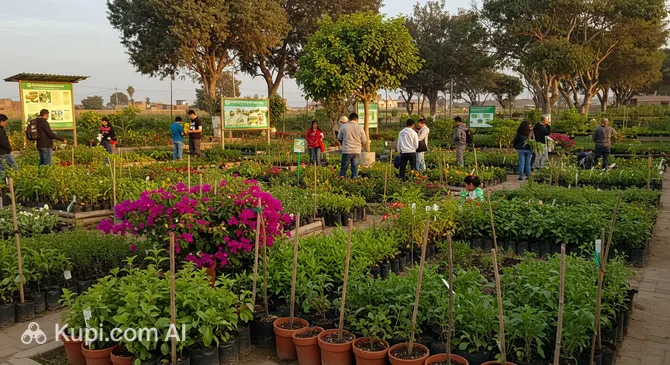
Despite its predominantly industrial status, Chimbote offers several interesting locations for tourists to get a feel for city life. The primary spot for relaxation and walks is the Vivero Forestal (Chimbote Tree Nursery). This is a true green oasis amidst the industrial landscape, where residents and guests find refuge from the city bustle under the shade of sprawling trees.
Tree Nursery. Illustration.
Source: Kupi.com AI
Traveler photos:
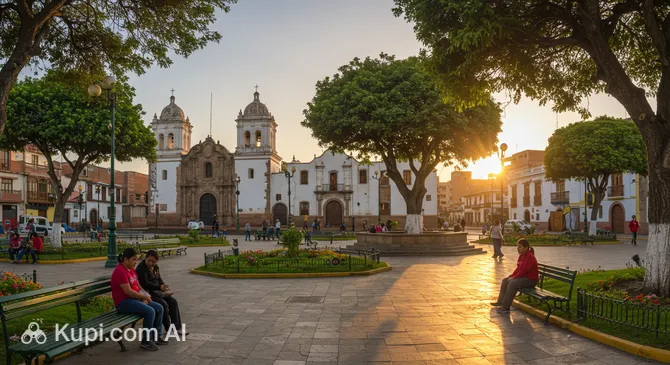
The center of social life is the Chimbote Main Square. This spacious open area, surrounded by important administrative buildings, reflects the city's rapid growth in the 20th century. Public events are often held here, and the architectural ensemble of the square provides insight into the urban planning style of this significant port.
Chimbote Main Square. Illustration.
Source: Kupi.com AI
Traveler photos:
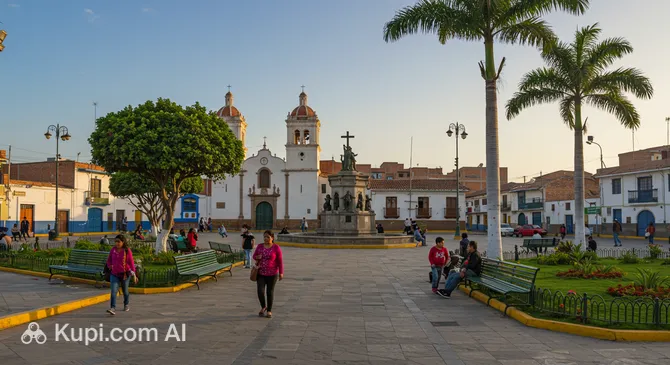
Another important landmark is the Admiral Miguel Grau Square, named after a national hero of Peru. Located near the shoreline, it serves as a reminder of the city's close connection to the sea and the country's naval history. It is a great place for those who want to experience the city's maritime character and see monuments dedicated to its defenders.
Admiral Miguel Grau Square. Illustration.
Source: Kupi.com AI
Traveler photos:
Tourists should also take note of the Port of Chimbote—the largest fishing terminal in the world. Watching the loading of vessels and the work in the docks gives an understanding of why the city is called the "fishing capital." While it is an industrial site, the scale of activity here is truly impressive.
Local Cuisine
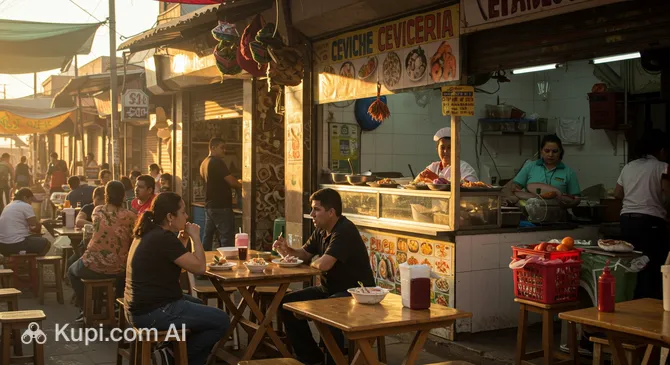
Chimbote's gastronomy is inextricably linked to the Pacific Ocean, so the crowning glory of the local cuisine is the freshest seafood. You must try the local ceviche, which is often made here from anchovy or the catch of the day. Also popular are arroz con mariscos (seafood rice) and fried fish served with crispy yuca and onion sauce.
To experience authentic flavors, Cevichería Taipa is an excellent choice, where chefs masterfully work with the bounty of the sea. If you are looking for a place with a more traditional country atmosphere, it's worth visiting La Fontana Campestre. Local dining culture favors lunch as the main meal, so it is during the daytime that restaurants (cevicherías) are most full of life.
Taypa Cevicheria. Illustration.
Source: Kupi.com AI
Traveler photos:
Among drinks, the classics remain Chicha de Jora (a fermented corn drink) and the ubiquitous Inca Kola. On hot days, tropical fruit juices, such as passion fruit, are popular at markets and street cafes. The city's markets, such as the Central Market, are great places to taste street food, including empanadas and fresh fish grilled right in front of you.
Travel Tips
Preparing for a trip to Chimbote will help you better understand this rugged but honest industrial city. These tips are collected to ensure your visit goes smoothly and safely.
Clothing and Protection: Bring light clothing made of natural fabrics, as it is humid and warm here. Be sure to use sunscreen and wear a hat, even if the sky is overcast.
Getting Around Town: Use official taxis or ride-hailing apps for travel. If you decide to take a colectivo, be prepared for crowds during peak hours.
Finances: The main currency is the Peruvian Sol. Cards are accepted in hotels and large restaurants, but in markets and taxis, you will need cash. ATMs are available in the center.
Health: Drink only bottled water. Due to the proximity of the port and industrial zones, tap water may be unsuitable for drinking.
Safety: Stick to central areas and the Malecón during the daytime. Avoid walking in the outskirts and port docks after dark. Do not display valuables openly.
Language: Knowing basic phrases in Spanish will be a huge plus, as English is not widely spoken here. Download an offline translator.
Local Etiquette: The city's residents are hardworking and straightforward. Greet people with a polite "Buenos días" and always ask for permission before taking a photo of someone at the market.
What to Avoid: Do not plan long walks near fish processing plants if you are sensitive to strong odors. Also, it is not recommended to swim in the bay directly within the city limits due to industrial traffic.
May your introduction to Peru's main port be a bright adventure full of authentic discoveries and fresh flavors of the ocean!
Entertainment & Nightlife
The entertainment scene in Chimbote is largely defined by its status as a working-class city, so nightlife is mostly concentrated in the central part and near the port areas. You can start your evening with a stroll along Malecón Grau, where the fresh sea breeze combines with views of the bay. Along the promenade and on adjacent streets, you will find bars and restaurants where live music—most often rhythmic cumbia or passionate salsa—can be heard on weekends.
Malecón Grau. Illustration.
Source: Kupi.com AI
Traveler photos:
The crowd in local venues consists mainly of residents and port workers, creating an atmosphere of sincere and simple fun. Popular spots for dinner and drinks include restaurants like "Mar & Luna" or "La Piettra," which transform into social hubs in the evening. Nightclubs (discos) stay open late, and the dress code is usually casual, though a smart casual style is recommended for more upscale venues.
Daytime leisure in the city includes visiting local markets and walking in park areas. For those seeking larger-scale cultural events or modern shopping malls, trips to neighboring Trujillo are often recommended. It is best to get around the city at night using taxis booked through official apps to ensure safety and a fixed fare.
Parks & Museums
Due to its industrial character, Chimbote may not boast an abundance of traditional art galleries, but it does have green spaces that are vital to the city's ecosystem. The primary natural site is the Vivero Forestal (Tree Nursery). This vast space with dense vegetation serves as the main spot for walks, family picnics, and outdoor sports.
Tree Nursery. Illustration.
Source: Kupi.com AI
Traveler photos:
For a cultural promenade, residents often choose the Malecón Grau area. This coastal embankment functions as an open-air museum of maritime history and key city symbols. Monuments are installed here, and relaxation areas with views of Chimbote Bay are provided, making this an ideal place to understand the city's identity.
There is a shortage of organized museum spaces within the city itself, so history buffs are often recommended to visit nearby archaeological zones in Casma or head to Trujillo. Nevertheless, public spaces such as the Chimbote Main Square and Admiral Miguel Grau Square carefully preserve the memory of the region's key development stages and its heroes.
Getting Around
The transport system in Chimbote is primarily represented by buses and shared taxis, known here as colectivos. This is the most popular way for locals to get around. Minibuses run along fixed routes, connecting the city center with port zones and residential outskirts. It is worth noting that during rush hours—morning and evening, when port and factory workers travel for their shifts—transport can be very crowded.
For more comfortable trips, tourists often choose taxis. Three-wheeled moto-taxis are also popular in Chimbote and are convenient for short trips over small distances. Taxi prices within the city are generally low (around 5–10 Peruvian soles), but it is better to agree on the fare with the driver in advance, as meters are rarely used.
There is no metro or dedicated lines for high-speed buses in the city. Since Chimbote stretches along the bay for about 20 kilometers, a trip from one end to the other can take up to 40 minutes, especially given the traffic on the city's main arteries, which are dominated by freight transport. Bicycles are not very popular due to the heavy traffic and the lack of dedicated lanes.
Accommodation
The hotel stock in Chimbote is primarily geared toward business travelers, industrial workers, and transit tourists. You won't find massive luxury resorts here, but the city offers a decent selection of mid-range hotels and budget guesthouses that are practical and clean.
The most convenient area to stay is the city center. Popular options here include Hotel Real Chimbote or the cozy Hotel Brillia. These locations provide quick access to the main squares, banks, and restaurants. Accommodation prices in Chimbote remain very affordable compared to more popular tourist cities in Peru.
For those planning an extended stay, perhaps for work, apartment rentals are a popular choice. It is recommended to book accommodation in advance, especially during peak port activity or during regional holidays. International online services are best for searching and booking, as they offer verified reviews from real guests.
Nearby Cities
Chimbote serves as an excellent starting point for exploring the northern coast and the foothills of the Andes. The region is rich in historical monuments and natural beauties that can be easily reached as part of a day trip.
Just 55 kilometers to the south lies the city of Casma, known for its archaeological complexes such as Sechín. The trip there takes less than an hour. Also worth noting is Virú (74 km), where you can learn about the agricultural traditions of the valley. For those interested in the history of pre-Columbian civilizations, a must-visit is Moche, located 109 kilometers away, home to the famous Temples of the Sun and the Moon.
Longer but impressive routes lead to Trujillo, about 130 km away, or to the mountain region of Huaraz, famous for its glaciers and canyons. Although the mountain road can be challenging, the views of the Cordillera Blanca are well worth the effort.
City
Population
Distance
Casma
30 000
55 km
Viru
36 029
74 km
Salaverry
13 892
103 km
Moche
30 671
109 km
Santiago de Chuco
25 000
111 km
Exploring the surroundings of Chimbote will allow you to see the contrast between the industrial coast and the ancient heritage of Peru's ancient cultures, making your journey truly multifaceted.
Shopping & Souvenirs
Shopping in Chimbote is primarily about experiencing local life and finding basic necessities. You won't find massive shopping malls with global brands here, but the city offers the unique experience of visiting bustling markets where the life of the "fishing capital" pulses.
The main shopping destination is the Central Market. This is the perfect location to see an incredible variety of fresh fish and seafood, as well as to buy tropical fruits and vegetables. Besides food, you can find everyday clothing and household goods here. For those looking for souvenirs, look for products from local artisans, including textiles and small crafts made of shells or wood that reflect the maritime theme.
Main shopping stalls are concentrated along the primary streets crossing the center. If you require modern supermarkets or specialized clothing stores, they are usually located along the Pan-American Highway. Shops operate from early morning until evening, and payment in most small stalls and at markets is accepted only in local soles in cash, so it is always worth having some on hand.