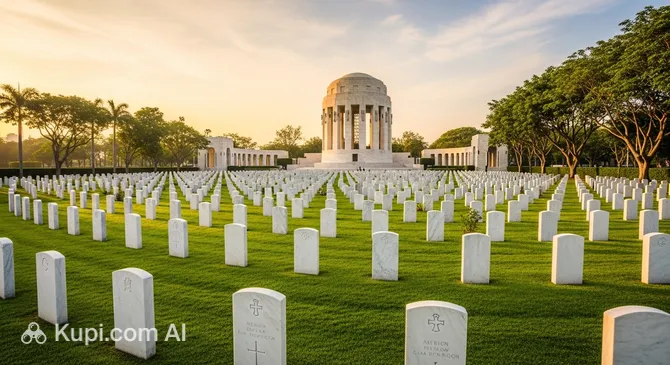
Spanning a picturesque 152-acre plateau, the Manila American Cemetery and Memorial is the largest U.S. military cemetery outside the United States. It is a place where the serenity of tropical gardens meets majestic architecture, creating an atmosphere of deep respect and remembrance. Located in the city of Manila, the complex serves as a vital historical landmark telling the story of events in the Pacific.
Manila American Cemetery and Memorial. Illustration.
Source: Kupi.com AI
Traveler photos:
Approximately 17,200 military personnel have found their final resting place here, most of whom died during operations in New Guinea and in the defense of the Philippines during World War II. At the center of the memorial stands a white stone chapel adorned with exquisite mosaics and sculptures, while two monumental structures curve out in front of it, forming a harmonious ensemble amidst the exotic greenery.
This site is carefully managed by the American Battle Monuments Commission (ABMC). Thousands of symmetrically arranged marble crosses and Stars of David set against perfectly manicured lawns leave a powerful impression on every visitor, making this memorial one of the most visited and significant sites in the capital.
Contacts
For more information about visiting or searching for specific burials, you can use the following contact details:
Begin your visit with a walk to the central chapel. Be sure to step inside to see the magnificent blue glass mosaic behind the altar, which depicts the Madonna, and view the seals of all the American states skillfully carved into the floor. The building's facade is decorated with an impressive sculpture of Saint George slaying the dragon.
Special attention should be given to the four galleries featuring 25 mosaic maps. These detailed panels vividly demonstrate the progress of military campaigns in the Southwest Pacific, as well as in China, India, and Burma. It is an excellent opportunity to literally follow history step-by-step. On the wide terraces in front of the chapel are limestone walls where the names of more than 36,000 missing in action are engraved.
Be sure to visit the Interpretive Center, which opened in 2019. This modern museum space features interactive exhibits and unique artifacts that tell the personal stories of American and Filipino soldiers. This helps to better understand the human side of historical events and the scale of the sacrifices made in the struggle for peace in the region.
Getting There
This memorial complex is located approximately 10 kilometers (about 6 miles) southeast of the central district of modern-day Manila, within the city of Taguig. The exact address is 1634 McKinley Road, Taguig. Thanks to its location on an elevated plateau, it offers panoramic views of the surrounding area and Laguna de Bay.
The most comfortable way to get here is by taxi or using ride-hailing apps like Grab. The trip from central tourist areas or nearby metro stations (such as Guadalupe or Ayala) takes between 20 to 40 minutes, depending on the traffic density, which can be quite high in the capital.
If you prefer public transport, you can use buses or jeepneys heading towards the Bonifacio Global City (BGC) area. However, keep in mind that you may need to walk from the public transport stops to the main gate of the memorial. A private car is also a convenient option, as there are usually parking spaces for visitors at the entrance.
Nearest city: Manila
History & Facts
The history of this site is inextricably linked to the former American military base, Fort William McKinley. It was on its grounds that the decision was made to establish a memorial following the end of major battles. The official right to use this land was granted free of charge by the government of the Philippines to the United States back in April 1948—with the condition of perpetual and tax-free use.
Buried here are those who gave their lives during the fierce fighting in New Guinea and during the operations to liberate the Philippine archipelago between 1941 and 1945. The architecture of the cemetery is meticulously planned: the snow-white marble headstones form eleven plots, which together create a giant circular composition that harmonizes with the tropical landscape.
Among the thousands of names on the memorial plaques, one can find stories of incredible courage and family devotion. Notably, the graves of 29 Medal of Honor recipients—the highest U.S. military decoration—are located here. Furthermore, in 20 instances, brothers lie here side by side, and more than 500 burials belong to Philippine Scouts who fought shoulder to shoulder with American soldiers.
Time Needed
To explore the entire memorial grounds at a leisurely pace, visit the chapel, and thoughtfully study the historical displays, it is recommended to allow 2 to 3 hours for your visit. This will be enough time to walk through the memorial paths and examine the maps in the galleries.
If you plan to delve into the information at the new Interpretive Center or are searching for a specific name on the memorial walls, your visit may take a bit longer. The complex is quite extensive (152 acres / 61 hectares), so factor in walking time between the different sites.
Working Hours
The memorial complex is open to the public daily from 9:00 AM to 4:45 PM local time. The cemetery welcomes visitors even on Philippine national holidays, which is convenient for tourists with tight travel schedules. However, please note that the site is closed on December 25 and January 1.
While the complex is open, an ABMC staff member is always on duty at the visitor building. They can answer historical questions, help with navigation around the grounds, or escort relatives of the deceased to specific burial sites. Before planning your visit, it is recommended to double-check the current schedule on the official website.
09:00–16:45
Nearby
A visit to the memorial can be combined with exploring other interesting locations in the Taguig area and adjacent parts of the metropolis. The variety of nearby sites allows you to switch from a contemplative mood to active recreation or family entertainment.