Support

Elblag

About

Elbląg is a cozy and picturesque city that looks like it stepped right off a festive postcard. Located in northern Poland, in the Warmian-Masurian Voivodeship, it attracts travelers with its warm atmosphere and a harmonious blend of ancient architecture and natural beauty. If you are planning a trip to Poland, this city is definitely worth your attention thanks to its unique location at the junction of two natural zones—the Vistula Fens (Żuławy Wiślane) and the Elbląg Upland.

With a population of about 119,000 people, Elbląg is an important administrative and cultural center of the region. Here, quiet water canals, scenic embankments, and spacious green zones coexist in a wonderful way. The city is famous for its Old Town, which is considered one of the largest archaeological sites in Europe. New buildings here are often constructed directly on the foundations of medieval structures, allowing you to feel a living connection across time. The rich history of Elbląg can be traced in every cobblestone and in the majestic silhouettes of Gothic cathedrals.
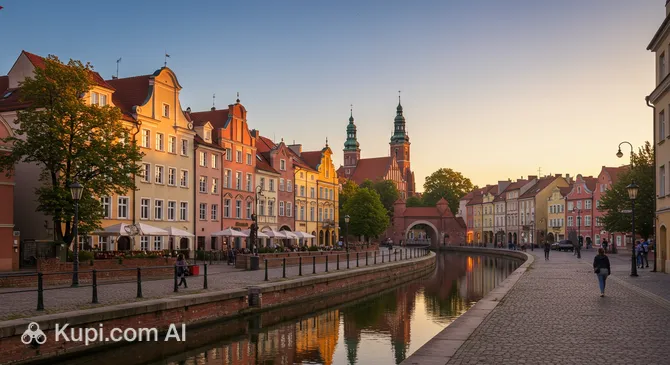
Elbląg. Illustration.
Source: Kupi.com AI

For tourists, the city offers many interesting routes. One of the main attractions is the famous Elbląg Canal—a unique monument of hydro-engineering known for its boat lifts. Nature and outdoor enthusiasts should definitely visit the Bażantarnia forest park, which locals call "Little Bieszczady" for its hilly terrain and beautiful landscapes. After a walk, you can relax in cozy cafes, enjoying the local hospitality.

Elbląg is a city where the past and present weave into an amazing kaleidoscope of impressions. Here, everyone will find something to their liking: from exploring museum collections to quiet contemplation of nature. Come and see the charm of this corner for yourself and discover its hidden treasures.
Weather Overview

The climate in this region can be described as temperate, with a noticeable influence of maritime air masses. Winters here are usually mild but humid: the average temperature in January and February stays around 1°C, occasionally dropping slightly below zero at night. January is the cloudiest month, with up to 17 days of precipitation. Spring arrives gradually: while in March the air warms up to an average of 3.6°C, by May the city blooms at a comfortable 12.7°C.

Summer brings long-awaited warmth, making this season ideal for long walks. August is considered the hottest month with an average temperature of 19.5°C and daytime highs around 23°C. However, even in the middle of the season, an umbrella can be useful: July is often rainy (about 16 days with precipitation). To choose the best days for excursions, we recommend checking current information provided by detailed weather in Elbląg. In autumn, the warmth gradually fades: in September, the temperature still stays at a pleasant 15°C, but by November it drops to 5°C.

Overall, the city is characterized by a moderate climatic pattern: expect a warm summer with periodic rain and cool winters with temperatures close to freezing.

Average monthly temperature

Average monthly precipitation

Interesting Facts

In addition to its main attractions, Elbląg holds many fascinating secrets and unique features that make it one of a kind. Here are a few facts that reveal the city's character from an unexpected side:

  • The local waterway is considered a true engineering marvel of the 19th century. The famous Elbląg Canal cruise is unique because part of the route is traversed by ships not on water, but on land—on special platforms moving on rails. This system of boat lifts operates purely on water power and still amazes with its originality.

  • The Elbląg Old Town is often called an archaeological treasure trove of Europe. After extensive destruction, it is being restored using the "retroversion" method: new buildings are erected on authentic medieval foundations, preserving the historical street grid. This creates an amazing time-travel effect where modern architecture intertwines with ancient history.

  • The city has preserved a unique Church Path (Ścieżka Kościelna)—a narrow old passage between houses connecting the city's main churches. This atmospheric alley closes at night, which gives walks through it a special charm and a slight touch of mystery.

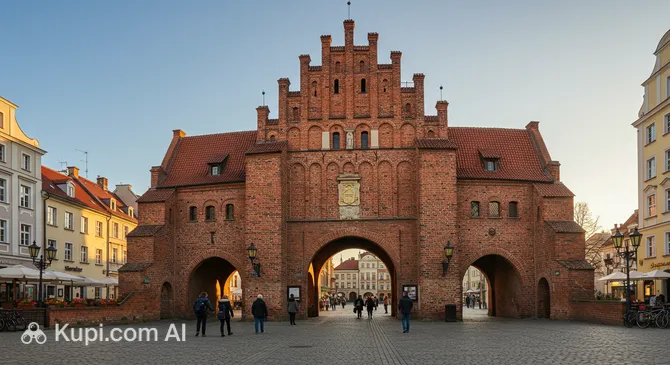
  • The Market Gate serves as a witness to the city's medieval power. It is the only surviving part of the ancient defensive walls and is now one of the most recognizable symbols of Elbląg.

  • The city's main spiritual symbol, St. Nicholas Cathedral, is one of the most beautiful Gothic churches in the region. Interestingly, St. Nicholas is considered the patron saint of the cathedral (and the city), highlighting Elbląg's historical connection to trade and seafaring.

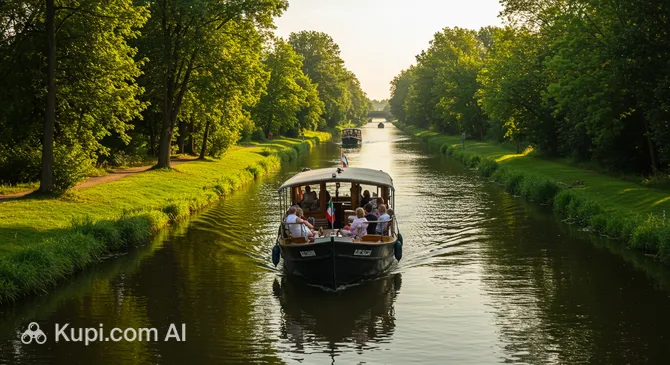
Elbląg Canal Cruise. Illustration.
Source: Kupi.com AI

Traveler photos:

How to Get There

When planning a trip to this picturesque corner of northern Poland, it is worth thinking through the route in advance. Elbląg is conveniently located relative to major transport hubs, making the trip comfortable regardless of the mode of transport you choose. You can find all the ways to get to the city in more detail on a separate page, while below we look at the most popular options.

Elbląg does not have its own airport, so most tourists fly into neighboring major cities. The most convenient option is Gdańsk Lech Wałęsa Airport (IATA: GDN). It is located in the city of Gdańsk, just 65.8 km from Elbląg. It is a large international hub accepting flights from all over Europe. The journey from there by taxi or rental car takes about an hour, and there is also a regular bus service.

An alternative option is Olsztyn-Mazury Airport (IATA: SZY), located in Szczytno. It is a bit further away, about 125 km from Elbląg. This is a regional airport that is great for those planning to travel through the Warmian-Masurian Voivodeship. The journey from here by car will take about 2 hours.

For clarity, here is a summary of the main airports located in relative proximity:

AirportPassenger trafficDistance
Gdansk Lech Walesa Airport6.7 mln66 km
Khrabrovo4.8 mln112 km
Olsztyn-Mazury Airport142 587125 km
Bydgoszcz Airport366 355151 km
Warsaw-Modlin Airport2.7 mln207 km

Traveling by rail is also a popular way to reach the region. Although Elbląg has its own railway station, many tourists use larger hub stations nearby for transfers. One of the main transport hubs is Gdańsk Główny station in Gdańsk, located about 54 km away. High-speed trains from Warsaw and other major cities arrive here, and from there you can quickly reach Elbląg by regional train or bus.

Another significant point is Olsztyn Główny station in the city of Olsztyn (about 83 km from Elbląg). This is a key railway hub for the voivodeship, convenient for those coming from the south or east of Poland.

Below is a table with the nearest major railway stations:

StationPassenger trafficDistance
Gdańsk Główny Railway Station14.5 mln54 km
Olsztyn Główny Station3.5 mln83 km
Kaliningrad South Railway Station4.5 mln93 km
Gurevsk-Novyy Station75 000103 km
Zelenogradsk-Novy Railway Station750 000112 km

Main Attractions

Elbląg is a city with a rich past where every stone breathes history, and modern solutions are harmoniously woven into the ancient landscape. A walk through local attractions will allow you not only to enjoy the architecture but also to immerse yourself in the atmosphere of the Hanseatic League and the Teutonic Order.

The best place to start getting to know the city is its heart—the Elbląg Old Town. This area is unique because it was restored using the principle of "retroversion": buildings were erected on preserved medieval foundations that replicate historical volumes but are executed in a modern style. It is a pleasure to simply wander the paved streets here, looking at house facades that recall the former greatness of the port city, and popping into cozy souvenir shops.

The main architectural landmark rising above the rooftops is St. Nicholas Cathedral. This monumental 13th-century Gothic building is striking in its grandeur. The cathedral's tower, 97 meters high, is considered one of the tallest sacred structures in Poland. Tourists come here not only for the spiritual atmosphere and beautiful interiors but also for the observation deck, which offers a breathtaking panorama of the city and its surroundings.

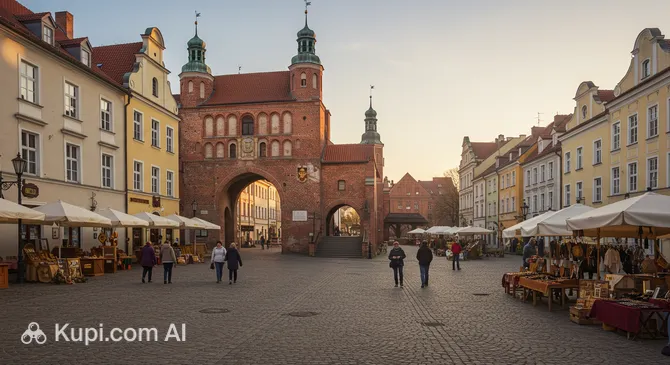
Market Gate. Illustration.
Source: Kupi.com AI

Traveler photos:

A must-see is the Market Gate (Brama Targowa)—one of the most recognizable symbols of Elbląg. Built in the 14th century, it was once part of the city's powerful defense system. Today, it is not just an architectural monument but also an excellent viewpoint. According to legend, it was thanks to the courage of a local baker, who cut the gate's ropes with a shovel, that the city was saved from invaders; a monument to this hero can be found nearby.

For those who want to understand the region's history more deeply, the Museum of Archaeology and History in Elbląg opens its doors. The museum's exhibition is located in the buildings of the former Outer Castle (Podzamcze) and offers unique collections telling the story of the legendary Truso trading settlement and Viking life. Interactive exhibitions and rich archaeological finds make the visit interesting for both adults and children.

Art lovers and those who enjoy unusual spaces should visit the Art Center – Gallery EL. It is located within the walls of a former 13th-century Dominican church, which lay partially in ruins after the war. The combination of austere Gothic walls and bold works of contemporary art creates a unique atmosphere, making this gallery one of the most original exhibition spaces in the country.

Local Cuisine

Elbląg's culinary scene is a real feast for lovers of hearty and varied food. The local cuisine harmoniously combines classic Polish traditions with a "northern" accent due to its proximity to the water. The menu of many establishments is based on fresh fish caught in the surrounding lakes and rivers. A lunch here should start with the traditional żurek—a slightly sour soup made from rye starter with sausage and egg, which is particularly good in cool weather.

A special point of pride for local chefs are poultry dishes, particularly duck and goose, prepared according to old recipes. If you prefer something more familiar but with a national flavor, be sure to order pierogi (Polish dumplings). Their variety is amazing: from hearty versions with meat, cabbage, or mushrooms to sweet dessert versions with cottage cheese and wild berries. The region is also famous for its homemade sausages and smoked meats, often served as appetizers.

As for drinks, Elbląg has long-standing brewing traditions, so tasting local beer is a must for many tourists. Lovers of stronger and warming drinks will enjoy various infusions (nalewki) made from herbs, berries, and honey. In the warm season, gastronomic life spills out onto the streets: food festivals are held here where you can taste farm products and participate in masterclasses.

The food culture in the city is democratic and diverse. For a quick snack, street food is perfect: fresh donuts, fragrant waffles, and the famous Polish zapiekanki—open-faced toasted baguettes with mushrooms, cheese, and other toppings. If you want to enjoy a leisurely dinner in an atmospheric place, head to the Studnia Smaków restaurant or other cozy venues in the Old Town area, where the hospitality of the owners makes you feel right at home.

Travel Tips

Welcome to Elbląg! To ensure your introduction to this unique city of canals and history is as comfortable as possible, we have prepared a list of practical recommendations to help you plan your trip wisely and avoid minor troubles.

  1. Clothing and shoes. The weather in northern Poland is changeable, so layering is your best friend. Even in summer, a light windbreaker or raincoat won't go amiss, as sudden rain is not uncommon here. For walks on the cobblestones of the Old Town, be sure to choose comfortable flat shoes, and save the heels for an evening out at a restaurant.
  2. Transport. Elbląg's historical center is compact and is best explored on foot. For trips to outlying areas (for example, to the Bażantarnia forest park), it is convenient to use trams and buses; tickets can be bought at kiosks or ticket machines. Taxis are easily called through popular international apps (such as Bolt or Uber), so renting a car within the city is not a necessity.
  3. Finances. The local currency is the Polish złoty (PLN). In Elbląg, bank cards are accepted everywhere, including contactless phone payments, so it is not necessary to change large sums of cash. However, keep some coins with you for paying for public toilets or small souvenirs. Tipping in cafes is welcome; 10% of the bill is considered standard.
  4. Health and safety. Elbląg is a quiet and safe city, but standard precautions are still wise: keep an eye on your belongings in crowded tourist spots. Pharmacies (Apteka) are easily found by the green cross, and the universal emergency number is 112. Tap water is safe to drink and of good quality, but most tourists still prefer bottled water.
  5. Communication and language. The state language is Polish. Young people and hotel staff usually speak English well, but the older generation may not know it. Learn a couple of phrases, such as "Dzień dobry" (Good day) and "Dziękuję" (Thank you)—this always wins over the locals. A SIM card can be bought at any kiosk (Żabka, Ruch), but remember that by law, passport registration is required for activation.
  6. Local etiquette. Poles are very polite. When entering a shop, elevator, or sitting in a train compartment, it is customary to say hello, and when leaving, to say goodbye. Try to keep noise levels down in public places. When visiting St. Nicholas Cathedral, observe silence and an appropriate dress code (covered shoulders and knees), especially during a service.
  7. What to avoid. It is strictly recommended not to cross the road in unauthorized places or at a red light—fines for this can be quite substantial, and the police monitor this strictly. Also, avoid drinking alcoholic beverages in public places (parks, streets)—this is prohibited by law and punishable by a fine.
  8. Important advice on excursions. If the main goal of your visit is the famous cruise on the Elbląg Canal, book your tickets in advance online, especially during the high season (summer). Demand for this unique experience is very high, and it is often impossible to buy a ticket at the box office on the day.

By following these simple tips, you will feel confident and can fully focus on the beautiful architecture and hospitality of Elbląg. We wish you a smooth journey and many pleasant discoveries!

Entertainment & Nightlife

Nightlife in Elbląg differs from that of bustling metropolises: you won't find massive dance clubs operating until dawn here, but instead, the city charms with its cozy "pub" culture and atmospheric evenings by the water. Most activity after sunset is concentrated in the historical center, where ancient architecture is illuminated by lanterns, creating a perfect backdrop for a leisurely break. The epicenter of evening leisure is the Elbląg Old Town and especially the Elbląg River embankment (Bulwar Zygmunта Augusta), where life hums until late at night, especially during the warm season.

It is common here to hop from one venue to another, enjoying craft beer, live music, and conversation. The crowd in local establishments is diverse but predominantly friendly, ranging from students to older tourists. The dress code in most places is casual—the casual style is appropriate almost everywhere. If you are looking for a place for a delicious dinner that flows smoothly into an evening of drinks, pay attention to the Studnia Smaków restaurant. This venue is famous for its cuisine and cozy atmosphere, perfect for long conversations.

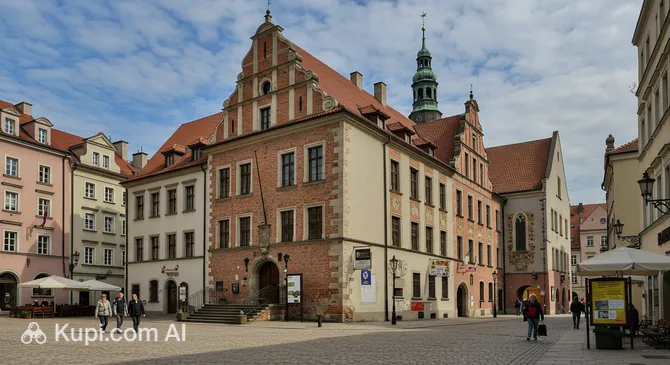
Elbląg Old Town. Illustration.
Source: Kupi.com AI

Traveler photos:

For connoisseurs of cultural leisure, the evening program may include attending concerts or gallery openings. A unique venue for such events is the Art Center – Gallery EL. Located within the walls of an ancient church, it often hosts jazz festivals, avant-garde music concerts, and performances that provide a completely different experience of the city at night.

Practical tips for night walks: Elbląg is a safe city, and walking around the center at night does not cause concern; however, as anywhere, you should keep an eye on your personal belongings. The average check in bars here is noticeably lower than in neighboring Gdańsk: a glass of beer or a cocktail is quite budget-friendly. Public transport runs less frequently at night, so to return to your hotel, it is more convenient to use a taxi, which can be ordered through popular apps or found at stands near the Old Market.

If you are planning entertainment for the daytime, especially with children or a group of friends, the city offers excellent options for active leisure. Fans of outdoor activities should visit the Active Recreation Park to let off some steam. For families with children, the Nowa Holandia Family Entertainment Park is an ideal choice, offering many attractions and play areas to diversify your journey.

Parks & Museums

Elbląg is not only about red-brick Gothic architecture and water canals, but also a surprisingly green city where cultural heritage is harmoniously intertwined with natural landscapes. For travelers wishing to take a break from the urban bustle or immerse themselves in studying artifacts of the past, ideal conditions have been created here. Walks through wooded hills and visits to unique museum spaces will allow you to see the city from a completely new perspective.

The main natural gem of the city is rightfully considered the Bażantarnia forest park. Locals call it the "lungs of the city" and often compare it to mountain areas because of its picturesque hilly terrain. It is an ideal place for hiking, Nordic walking, and cycling along the Srebrny Potok stream. In winter and summer, the Góra Chrobrego becomes a point of attraction for active tourists. From its summit, perhaps the best panorama of the city and surroundings opens up, and equipped trails make it a center for winter sports and summer extreme entertainment.

For family vacations in nature, choose the Nowa Holandia Family Entertainment Park. This is a unique territory permeated by a network of artificial canals where you can go boating. The park is famous for its ecological focus: there is a mini-zoo, educational trails, and the largest lion-shaped slide in Poland, making it a favorite for young travelers.

Cultural life in Elbląg is concentrated in its museum spaces, which hold evidence of the region's turbulent history. A must-visit is the Museum of Archaeology and History in Elbląg. Located in the buildings of the former Outer Castle, it possesses one of the richest archaeological collections in the country. Tourists are particularly drawn to exhibits related to the legendary Truso Viking trading settlement and the heritage of the Teutonic Order. Modern interactive technologies allow you to literally touch the past.

Museum of Archaeology and History in Elbląg. Illustration.
Source: Kupi.com AI

Traveler photos:

A completely different experience is provided by the Art Center – Gallery EL. This place amazes with the contrast between form and content: avant-garde contemporary art is exhibited in the austere interiors of a restored 13th-century Gothic church. High vaults, the play of light through stained glass, and bold installations create a unique mystical atmosphere highly valued by art lovers.

Insider tip: If you find yourself in Bażantarnia Park, try to find the old concert shell in the forest (Muszla Koncertowa). It is a quiet and atmospheric place where you can take beautiful photos without the tourist crowds and enjoy the sounds of the forest just a couple of kilometers from the city center.

Getting Around

Public transport in Elbląg is a convenient and intuitive system that allows tourists to move comfortably between the historical center, the station, and recreation areas. The basis of city mobility consists of trams and buses. The city's tram network deserves special attention: it is one of the oldest in the region, operating since 1895. The green and yellow cars run along five main routes, covering key areas, making them the most popular way to get around among locals and visitors.

The fare payment system is uniform for all types of municipal transport managed by the ZKM Elbląg organization. It is most profitable for tourists to use timed tickets (for example, for 1 hour or 24 hours) or single-ride tickets. Fares are quite democratic. Paper tickets can be purchased at newsstands or stationary ticket machines at major stops. It is important to remember: a ticket purchased at a kiosk must be validated immediately after entering the vehicle; otherwise, it is considered invalid.

For those who prefer modern technology, there are several convenient ways to pay without cash. Most vehicles are equipped with modern terminals where a ticket can be bought using a contactless bank card. In addition, mobile applications (such as SkyCash, mPay, or moBILET) are widely popular. Using an app eliminates the need to look for a kiosk and deal with validators—the ticket is activated right on your smartphone.

The transport schedule is stable: daytime routes run from early morning until about 23:00. During peak hours, intervals are short, but on weekends and late in the evening, the wait can be longer, so we recommend checking the schedule via online maps (for example, Google Maps or Jakdojade). Night service is represented by a limited number of bus lines, so for late returns, it's worth considering alternative options.

If you value comfort and speed, taxi services are well-developed in Elbląg. In addition to local dispatch services, popular international apps (such as Bolt or Uber) operate here, allowing you to see the cost of the trip in advance and not worry about a language barrier. Given the city's compactness, many distances are easily covered on foot, and infrastructure for cyclists is available for active leisure enthusiasts, although there is currently no centralized city bike rental system, and it is better to rent a bicycle at private points or hotels.

Accommodation

The choice of accommodation in Elbląg will pleasantly surprise travelers with its variety and value for money. The city offers a wide range of accommodation options: from modern hotels with high levels of service to cozy guesthouses and budget hostels. Apartments have become particularly popular in recent years, often located in historical buildings with modern interiors, allowing guests to feel the atmosphere of the city from the inside.

The most attractive area for tourists to stay is the Elbląg Old Town. Staying here, you will be within walking distance of the main attractions, museums, and the embankment where the evening life is concentrated. Many hotels in this part of the city are located in so-called "retroversions"—buildings restored on medieval foundations but offering 21st-century comfort. Staying in the center is also convenient for those planning water excursions, as the pier is very close by.

The price range in Elbląg is generally lower than in neighboring Gdańsk or the Baltic coast resorts, making it an excellent base for budget travelers. The cost per night varies from democratic prices in hostels to mid-range and high-end boutique hotels. For booking, it is most convenient to use popular international online platforms where you can read reviews and choose the right option. We recommend booking accommodation in advance if your trip falls during the summer season or during major festivals, as the best offers are snapped up quickly.

Nearby Cities

For those who want to explore the surrounding area, Elbląg serves as an excellent starting point for day trips to several interesting nearby locations. The city's convenient location allows for quick access to key attractions in Pomerania and neighboring historical centers.

Just an hour's drive away is the majestic Gdańsk. This is a city with a thousand-year history, famous for its architecture, the Royal Route, and the unique atmosphere of an ancient port metropolis. A walk along Długa Street and the Motława embankment will provide unforgettable impressions for lovers of history and gastronomy.

If you are interested in the medieval heritage of the Teutonic Order, it is worth visiting Kwidzyn. An impressive castle-cathedral complex is located here. Its signature feature is a unique architectural detail—a huge sanitary tower (gdanisko), connected to the main castle by a long covered bridge on arcades, making the fortress silhouette recognizable at first sight.

For lovers of maritime romance and modernism, Gdynia is an excellent choice. This young and dynamic city attracts tourists with its ship-museums, oceanarium, and wide sandy beaches, ideal for walks along the Baltic Sea.

CityPopulationDistance
Paslek12 07420 km
Nowy Dwór Gdański9 61820 km
Malbork38 89527 km
Sztum9 51536 km
Braniewo16 99237 km

These nearby destinations allow you to get a sense of the diverse culture and landscapes of the region, making your journey through northern Poland even more rich and memorable.

Shopping & Souvenirs

Shopping in Elbląg is a calm and pleasant activity, devoid of the bustle of huge metropolises. The city does not claim to be a fashion capital, but it has everything necessary for a comfortable stay and successful purchases. Tourists will find a harmonious combination of modern shopping galleries with familiar European brands and small atmospheric shops offering unique local products. Prices in Elbląg are often slightly lower than in larger tourist centers like Gdańsk, making shopping here particularly cost-effective.

The heart of tourist shopping is, of course, the Elbląg Old Town. Strolling through its restored streets, you will encounter many souvenir shops, art galleries, and jewelry boutiques. This is the place to look for handmade goods, paintings by local artists, and unique jewelry. The atmosphere of this district encourages leisurely gift selection between viewing architecture and visiting cafes.

For those who prefer classic shopping with a wide selection of clothing, shoes, and accessories, several large complexes operate in the city. One popular place is the Zielone Tarasy Shopping Center. This is a modern space where shops of famous brands, service points, and recreation zones are gathered under one roof. Here you can not only update your wardrobe but also have a delicious snack or coffee, making the center a great place for family leisure on a rainy day.

Green Terraces Shopping Mall. Illustration.
Source: Kupi.com AI

Traveler photos:

Another significant point on the shopping map is the Elzam Shopping Hall. This is a place with long traditions that locals value for its variety of goods. Here you can find industrial goods, clothing, and specialized departments. Unlike glossy malls, a more democratic and simple atmosphere often reigns here.

If you want to feel the real taste of the region, be sure to stop by the City Market (Targowisko Miejskie). This is a place where farmers from surrounding villages sell the freshest products. Seasonal fruits and berries (especially strawberries and apples), homemade cheeses, honey from local apiaries, and traditional Polish smoked meats—all this can be tasted and bought right here. The market is a great opportunity to see the non-tourist life of the city.

Speaking of souvenirs, it is worth bringing amber back from Elbląg—"Baltic gold," which is sold here in abundance and at reasonable prices. Local ceramics and linen products are also popular. Don't forget about gastronomic gifts: Polish sweets (for example, gingerbread or "Ptasie Mleczko" candies) and, of course, local beer. Elbląg has rich brewing traditions, and a bottle of a local variety will make an excellent present for friends.

Shops in the city usually operate from 9:00 or 10:00 to 21:00 (shopping centers), while small boutiques close earlier—around 18:00. It is important to remember that in Poland there is a law banning trade on Sundays. Most shops are closed on this day, with the exception of a few "shopping Sundays" a year and small private shops or convenience stores at gas stations. Payment is possible by bank card (Visa, Mastercard) almost everywhere, contactless payments are very well developed, but it is better to have some cash in zlotys at the market or kiosks.

Tourists from non-EU countries can use the Tax Free system (VAT refund) when buying goods for a certain amount (usually from 200 PLN) in stores marked with a special sign. Don't forget to ask the seller for a special form when paying for your purchase to arrange a refund at the border or airport when leaving the European Union.

Reached the end of the page?

That means the route is fully explored