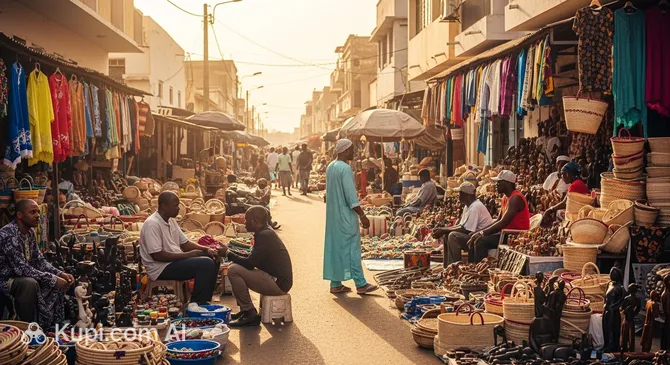
Guediawaye is a vibrant and densely populated city in Senegal, located in the Dakar region on the scenic Atlantic coast. Founded in the 1950s as a satellite city of the capital, it was designed to alleviate pressure on the growing metropolis, which has shaped its unique character. By exploring the history of its founding, one can understand how this site grew from a small settlement into a major residential area with a population of over 320,000 people.
Guediawaye. Illustration.
Source: Kupi.com AI
Geographically, the city lies northeast of Dakar, occupying flat coastal lands. It lacks the hustle and bustle of central business districts, but the daily life of modern Senegal can be felt here in full. Guediawaye is administratively divided into five communes, the largest of which is Golf Sud. Each has its own personality, but they are all united by the dense urban development and active street trade typical of Dakar's outskirts.
For tourists, Guediawaye is primarily interesting for its authenticity. This is not a classic resort or an open-air museum, but a place where you can see Senegal "unfiltered." Bustling markets, proximity to the ocean, and the genuine hospitality of the locals create a unique atmosphere of a living, pulsating city. A visit to this district is an excellent addition to a trip around the country for those seeking a deeper immersion into local culture and everyday life.
Weather Overview
The climate in Guediawaye, as in the rest of the Dakar region, is a tropical savanna type. Two distinct seasons are observed here. The dry season lasts from December to May, when the weather is most favorable for travel: temperatures range from +24...+32°C, and humidity is minimal. From June to November, the wet season arrives, bringing tropical downpours, which are especially intense in August and September.
Based on data about the weather in Guediawaye, you can expect very hot and humid days in late summer, when the thermometer often rises above +30°C, and rainfall can reach 150 mm per month. However, the proximity of the Atlantic Ocean gives the city a pleasant sea breeze, which significantly tempers the heat compared to the inland regions of the country.
For those planning a visit, the winter and spring months are the ideal time. During this period, there is virtually no precipitation, and the sky remains clear. It is important to consider that during the dry season, the Harmattan wind can sometimes blow from the desert, bringing fine dust, so it is worth checking the current forecast in advance to ensure your trip is as comfortable as possible.
Average monthly temperature
Average monthly precipitation
Interesting Facts
Guediawaye was designed and founded in the 1950s as the first satellite city in the history of Senegal, intended to solve the problem of Dakar's overpopulation.
The city administratively consists of five communes, each with its own specifics; the largest, Golf Sud, exceeds many other cities in the country in terms of population.
Digital technologies are actively developing in the city: it has its own registered IP providers, which contributes to the growth of internet accessibility for young people.
The local football team, Guediawaye FC, enjoys immense support from the townspeople and is a regular participant in national championships.
Despite the dense urban development, the city is in direct proximity to the ocean coast, which provides natural air cooling during hot seasons.
How to Get There
The transport accessibility of Guediawaye is defined by its role as a key suburb of the capital. The main flow of travelers arrives here from neighboring Dakar. The straight-line distance between the cities is only about 10–15 km, but due to heavy traffic, the journey by car or taxi usually takes 30 to 60 minutes. Detailed information on routes and logistics can be found in the how to get there section.
For international travelers, the nearest air gateway is Dakar's airport. Although there is no airport in Guediawaye itself, it is easily reachable from the region's main aviation hubs. A taxi ride from the airport to the residential quarters of Guediawaye takes on average about 45–75 minutes, depending on the time of day and traffic conditions.
Rail service in the region is also developing, connecting coastal areas with the capital and other parts of the country. Although buses remain the most popular means of transport, the train can be a convenient alternative for those wanting to avoid the capital's traffic jams when entering the city.
Station
Passenger traffic
Distance
Dakar station
5
13 km
Main Attractions
While Guediawaye is not considered a classic tourist hub with an abundance of historical monuments, it offers travelers a unique experience of immersion into the daily life of Senegal. One of the city's main features is its location along the Atlantic Ocean. Strolling along the coast allows you to enjoy the sea breeze and observe local fishermen, whose brightly colored pirogues can often be seen by the shore.
The heart of the city's social life is its markets, particularly the central squares in the Golf Sud and Sam Notaire communes. Trade is bustling here, and it is in these markets that you can feel the true rhythm of Guediawaye. These are places where everything is sold—from fresh tropical fruits and fish to vibrant African fabrics. For a tourist, such a market is primarily an opportunity to see authentic life and interact with locals in a relaxed setting.
Sports enthusiasts might enjoy visiting the local stadium or watching the Guediawaye football team during their training sessions. Football in this part of the world is more than a game; it is a passion that unites thousands of people. Despite the lack of "star" attractions, Guediawaye appeals with its sincerity and the chance to see the Dakar region's life from the inside, far from standard tourist routes.
Local Cuisine
Guediawaye's culinary traditions represent the essence of Senegalese gastronomy, where rice, fish, and aromatic spices play the leading roles. You must try the national dish, Ceebu Jën (Thieboudienne)—rice stewed with fish and vegetables in a rich tomato sauce. This dish is a true symbol of Senegal, and in Guediawaye, it is prepared with a delicious homemade touch in many street eateries.
Fans of bold flavors will enjoy Mafe—meat (usually beef or chicken) cooked in a thick peanut sauce, typically served with white rice. Among beverages, Bissap (a bright red, refreshing infusion made from hibiscus flowers) and Bouye—a thick and sweet drink made from baobab fruit, rich in vitamins and having a unique tangy taste—are incredibly popular here.
The food culture in the city is concentrated around small family-run restaurants and lively markets, such as the one in the Medina Gounass commune. This is where you can find the most authentic street food at affordable prices. There are virtually no luxury restaurants in Guediawaye, so residents and tourists usually head to Dakar for international fine dining. However, it is in Guediawaye that you can experience the true taste of Senegalese "Teranga"—the hospitality that is evident in every plate served.
Travel Tips
Planning a trip to Guediawaye requires some preparation to ensure your stay in this lively Dakar suburb is as comfortable and safe as possible.
Clothing and Essentials: Choose light clothing made from natural fabrics, as a hot climate prevails in Senegal. Don't forget comfortable shoes for walking on sandy streets and market squares. Senegal is a country with secular traditions, but a respectful style of dress (covered shoulders and knees) will be appreciated when visiting residential quarters.
Transport: It is best to use taxis for getting around the city. If you decide to experience local flavor in car rapides, be prepared for cramped conditions. Avoid traveling during peak hours when traffic jams toward the capital become massive.
Finance: The main currency is the West African Franc (CFA). Cards are rarely accepted, only in very large pharmacies or supermarkets, so always carry cash with you. It is best to look for ATMs in the central parts of the city or in Dakar.
Health and Safety: Use mosquito repellents and drink only bottled water. In crowded places, especially markets, keep a close eye on your belongings to avoid being a victim of pickpockets.
Communication: The official language is French, but most residents speak Wolof. Knowing basic French phrases will significantly ease communication. English is not widely spoken, so an offline translator on your phone will be useful.
Local Etiquette: Senegalese people are very friendly and appreciate a polite greeting. Always say hello before asking a question. Remember the concept of "Teranga"—the famous local hospitality.
What to Avoid: Do not take photos of people without their explicit consent, as this can cause a negative reaction. Also, refrain from walking alone at night in poorly lit areas, such as Medina Gounass.
Additional Tip: Buy a local SIM card immediately upon arrival—mobile internet in Senegal works quite well and will help you navigate the area.
Following these simple rules will help you focus on exploring the local culture and ensure you have only positive emotions from visiting this distinctive city.
Entertainment & Nightlife
The entertainment scene in Guediawaye is closely intertwined with the daily rhythm of local life. You won't find massive nightclubs or high-end casinos here, but you will experience the spirit of genuine Senegalese leisure. During the day, the main hubs of activity are the lively streets and local markets, where you can always find interesting conversation and watch street performances or impromptu football matches.
Evening life in the city is more relaxed and centered around small local cafes and commune squares. Residents often gather to discuss the news over a cup of tea or a traditional beverage. For those seeking active nightlife, discos, and loud parties, the ideal option is to head to neighboring Dakar, located just 10–15 kilometers away, where the hospitality industry is far more developed.
During the day in Guediawaye, you can spend time walking along the ocean shore. The coastline here is less crowded with tourists than in the capital's center, creating conditions for a more secluded rest and contemplation of the seascapes. Despite the modest choice of specialized entertainment venues, the city wins you over with its atmosphere of openness and simplicity, which can sometimes be more valuable than any attraction.
Parks & Museums
In terms of cultural institutions, Guediawaye is quite modest. There are no large national museums or art galleries here, as the settlement originally developed as a residential area for the working population. However, the lack of formal exhibition halls is compensated for by the vibrant culture that can be observed right on the streets: from local craftsmen's workshops to colorful graffiti decorating the walls of houses.
Park infrastructure in the city is underdeveloped, and given its dense construction, Guediawaye lacks green spaces. Nevertheless, the Atlantic Ocean coast serves as the main natural space for relaxation. Residents of the Wakhinane Nimzatt and Golf Sud communes often use the shoreline for evening walks and sports, finding respite from the city heat here.
For those who cannot imagine a trip without classic museums and well-kept parks, a short trip to central Dakar is recommended. There you will find the Museum of Black Civilizations and the IFAN Museum, which will satisfy your need for cultural enrichment, while Guediawaye will remain for you a place where you can see Senegal's life in its original form, untouched by the tourism industry.
Getting Around
The public transport system in Guediawaye is primarily represented by traditional regional modes of transport. The most recognizable way to get around is the car rapides—brightly painted minibuses that run between communes and connect the city with Dakar. This is the most affordable, though not the most comfortable, option, as the buses are often overcrowded, especially during morning and evening peak hours.
For short-distance trips within neighborhoods, locals often use moto-taxis. This is a fast way to move through narrow and sometimes congested streets, but it requires some courage and mandatory price negotiation before starting the journey. Standard taxis also operate in the city and are easier to catch on the main roads.
There is currently no unified electronic travel card system in Guediawaye, so payment is always made in cash to the conductor or driver. Tourists should remember that traffic during peak hours (from 7 to 9 AM and from 5 to 7 PM) can be extremely difficult due to jams at the exits toward the capital. If you value comfort, it is better to use official taxi services and plan your movements in advance, avoiding periods of maximum road congestion.
Accommodation
Hotel infrastructure in Guediawaye primarily caters to those looking for long-term stays or budget-friendly options. There are no large international luxury hotel chains here, but there is a wide selection of apartments and private guest houses. This is an excellent option for travelers who want to feel like part of the local community and save on accommodation while remaining close to the capital.
The most convenient areas to find accommodation are Golf Sud and Sam Notaire. These areas have the most rental offers, and transport links to central Dakar are well-established. The cost of living in Guediawaye is significantly lower than in the elite districts of the capital, making the city attractive to expats and budget-conscious tourists.
When planning a trip, it is recommended to book accommodation in advance, especially if your visit coincides with major holidays or football matches. Most apartment and guesthouse owners prefer payment in cash in local currency, so it's worth arranging for currency exchange beforehand. Despite the modest conditions, many accommodation options offer genuine Senegalese hospitality, known as "Teranga."
Nearby Cities
Thanks to its location on the edge of the capital region, Guediawaye serves as an excellent starting point for exploring the surroundings. Just a few kilometers away are key cultural and historical centers of Senegal, each of which deserves separate attention.
First and foremost, it is worth visiting Dakar—the country's capital, where the best museums, galleries, and restaurants are concentrated. Also nearby is the city of Pikine, another major center with its own unique energy and markets. For those interested in historical architecture, a trip to Rufisque, where traces of the colonial past remain, will be interesting.
Exploring these neighboring cities will allow you to see the multi-faceted nature of Senegalese life—from the ultra-modern districts of the capital to traditional suburbs. Transport connections between them are well-developed, making day trips easy and full of experiences.
Shopping & Souvenirs
Shopping in Guediawaye is a colorful adventure focused on bustling and vibrant local markets. You won't find huge shopping malls with global brands here, but you will fully enjoy the atmosphere of traditional African trade. The main shopping points are located in the Golf Sud and Sam Notaire communes, where stalls are literally overflowing with essential goods, clothing, and fresh produce.
If you are looking for something special to take home, look for Senegalese textiles. Guediawaye's markets offer a huge selection of batik and wax print fabrics, which local tailors can sew into clothing right before your eyes. You can also purchase wooden items, including baobab souvenirs, and traditional bead jewelry, which are very popular among visitors to the country.
Shops and markets usually open early in the morning and close at sunset. Payments are made exclusively in cash CFA francs, so small bills will be very useful. Bargaining here is not just appropriate; it is an important part of the buying and selling ritual. If you crave larger-scale modern shopping, it is better to head to Dakar's shopping centers, leaving Guediawaye for the most authentic and inexpensive goods.