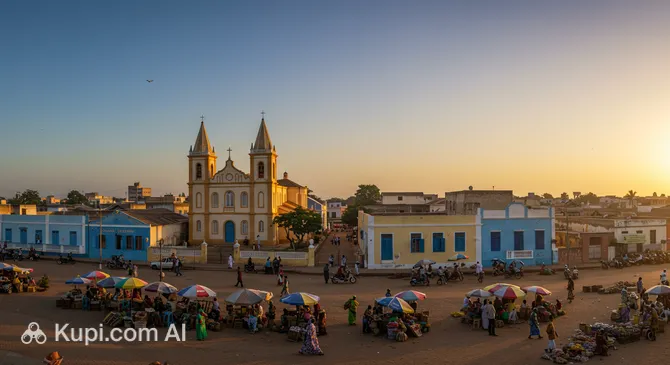
Located on the picturesque Atlantic coast, Rufisque offers a unique blend of industrial rhythm and a rich colonial past. Situated in Senegal just 25 kilometers from the capital, it is often called the "gateway to Dakar." Founded in the 17th century by the Lebou people, it served as an important trading hub for a long time, preserving a special atmosphere of an old port to this day.
Geographically, the city occupies a strategic position on the Cape Verde Peninsula. With a population of over 220,000, Rufisque today is a major residential and industrial center. Despite active urbanization, the amazing history of its founding and development as one of the first European colonies in the region can still be read in its appearance.
Rufisque. Illustration.
Source: Kupi.com AI
For tourists, the city is primarily interesting for its historical architecture. Strolling through its streets, you can see luxurious merchants' mansions and administrative buildings reminiscent of the golden age of local trade. Although the tourism infrastructure is still developing, the authenticity of daily life, traditional crafts, and the famous fish market make a visit to this place truly memorable.
We invite you to discover this underrated corner of West Africa, where ancient legends and the hospitality of local residents are hidden behind the facades of modern factories.
Weather Overview
The climate in Rufisque is typical for the coastal areas of West Africa: tropical weather prevails here with distinct dry and wet seasons. Thanks to the proximity of the Atlantic Ocean, the heat is often softened by pleasant sea breezes, which makes staying in the city more comfortable than further inland.
The most favorable time for a visit is from November to May, when there is practically no precipitation and the average air temperature stays around 23–25°C. During this time, the weather in the city is ideal for excursions and walks. September and October are considered the hottest months, when the thermometer can rise above 30°C. The rainy season falls in August and September; heavy but short-lived downpours are possible during this time.
Expect warm summers with occasional tropical rains and very pleasant, dry winters. If your trip is planned for the rainy season, you should consider the high humidity and the impact of rainfall on the transport accessibility of some areas.
Average monthly temperature
Average monthly precipitation
Interesting Facts
The city's name comes from the Portuguese phrase "Rio Fresco" (Fresh River)—this is how explorers named it in the 15th century due to the abundance of fresh water sources.
During the colonial period, Rufisque was one of the "Four Communes" of Senegal, which gave its residents a privilege rare for that time—full French citizenship.
For a long time, the city held the status of the main center for exporting peanuts, which remained the key agricultural crop of the entire country for centuries.
Local artisans are famous for the unique art of palm leaf weaving; their products are an important attribute of the Lebou people's traditional wedding ceremonies.
It was one of the earliest European colonies in Senegal, where French settlers began to establish themselves as early as the 1670s.
How to Get There
Thanks to its location on the main highway corridor, Rufisque is an important transport hub connecting the capital with the southern and eastern regions of the country. The city's accessibility makes it a convenient point for a short visit or an intermediate stop while traveling through Senegal.
The easiest way to get here from Dakar is by taxi or the traditional intercity minibuses known as "brousse." The trip usually takes 40 to 60 minutes, though travel time can increase significantly during peak hours due to heavy traffic. For a more comfortable trip, it is recommended to use official taxi services or rent a car with a driver. To plan your route in advance, it is worth checking information on how to get to the city in the most convenient way.
Currently, the regional rail service is undergoing a modernization process. The city has a historical connection to the railway, which previously played a key role in transporting goods to the port. It is best to check current schedules and station status immediately before your trip.
Station
Passenger traffic
Distance
Dakar station
5
18 km
The international airport is located south of the city, so Rufisque is often the first major settlement tourists see on their way from the airport to central Dakar. This makes the city logistically attractive for those who want to immediately immerse themselves in the atmosphere of the Senegalese coast.
Main Attractions
Although Rufisque is better known as an industrial center, it hides several locations that can surprise a curious traveler. The main point of attraction here is the historical fish market. Located right at the edge of the Atlantic Ocean, it is a living canvas of traditional Senegalese life: brightly colored pirogue boats, bustling trade, and fresh catch that is immediately sorted and sold.
History buffs should pay attention to the city's colonial quarter. Old administrative buildings and former mansions of wealthy peanut merchants have been preserved here. These architectural monuments, although marked by the passage of time, allow you to imagine the city's former greatness during the era when it was a key exporter of the region's agricultural products.
Not far from the city lies one of Senegal's most famous natural attractions—Lake Retba, better known as the Pink Lake. It is famous for its unusual water color, caused by specific microorganisms, and its salt harvesting industry. A trip to the lake from the city takes very little time, making it a must-see on the itinerary of any tourist in the area.
Local Cuisine
The culinary traditions of Rufisque are inextricably linked to the ocean. The basis of the local diet is fresh fish and seafood supplied directly from the city market. Be sure to try Thieboudienne—the national dish of rice and fish, which local establishments prepare with special skill, adding a thick tomato sauce and seasonal vegetables.
Another gastronomic feature of the region is the active use of peanuts. You can find original peanut-based sauces served with meat or fish, giving the dishes a rich and recognizable flavor. Street food also deserves attention: fried fish cakes and spicy snacks, popular among the locals, are often sold in the markets.
Among drinks, palm wine and local beer are favorites. Refreshing juices made from local fruits and traditional mint tea are also offered everywhere. It is best to dine in small family restaurants where recipes are passed down from generation to generation, ensuring an authentic taste of Senegalese cuisine.
Travel Tips
A trip to Rufisque is a great chance to see the real Senegal without the tourist gloss. To ensure your acquaintance with the city goes smoothly and leaves only pleasant impressions, we have prepared several practical recommendations.
Clothing and items: Choose light clothing made from natural fabrics, as the climate here is tropical and humid. Given local traditions, it is recommended to avoid overly revealing outfits in public places. Comfortable shoes are a must for walking through markets and sandy stretches of the coast.
Transport: Use taxis to get around the city. Always discuss the fare with the driver in advance. If you plan a trip to Dakar on weekdays, leave early to avoid getting stuck in traffic jams.
Finance: The main currency is the West African CFA franc (XOF). Always carry cash, especially in markets and small cafes. Cards are accepted very rarely, mostly only in large hotels.
Safety: In general, the city is safe for tourists, but it is recommended to avoid walking in remote industrial outskirts after dark. Keep your valuables in the hotel safe.
Communication: The official language is French, but most residents speak Wolof. Knowing a few basic phrases in French (greetings, thank you) will significantly facilitate communication.
Local Etiquette: Senegalese people highly value polite greetings. Start any conversation with "Bonjour" or the local "Salaam alaikum." Ask permission before photographing people or their goods at the market.
What to avoid: You should not take photos of government buildings and military facilities. Also, try not to display expensive equipment or large sums of money in crowded places.
Planning: The best option is to stay in Dakar and come to the city for a day trip, as there is little entertainment for a long stay.
May your journey be filled with bright colors and interesting encounters in this distinctive port city!
Entertainment & Nightlife
Nightlife in Rufisque is quiet and local in character, differing significantly from the fast-paced rhythm of the neighboring capital. Most social activity here is concentrated in small coastal cafes and traditional bars where locals gather after a day's work. The atmosphere in such establishments is relaxed, and the style of recreation is as authentic as it gets.
Daytime entertainment in the city is closely linked to the ocean. The beaches of the Atlantic coast are very popular on weekends when families come here to relax and swim. It is a great place to observe local culture and try street food while admiring the sunset over the ocean.
For those looking for larger-scale entertainment—modern nightclubs, theaters, or concert venues—the best solution is a short trip to Dakar. Most tourists prefer to spend the evening in the capital, returning to the city by taxi, which is available 24/7. Within the city itself, it is worth spending time visiting local markets, which transform into unique cultural performances during the day.
Parks & Museums
Green zones in Rufisque are concentrated mainly along the Atlantic coast, where the sea air and open space create conditions for walking. Although the city is quite densely built up due to its industrial nature, the coastline serves as the main recreation spot for residents and guests.
Majestic baobabs occupy a special place in the local landscape. In Senegal, these trees are considered sacred national symbols; they are forbidden to be cut down, and a special permit is required to climb them. These natural giants, scattered around the outskirts of the city, give the landscape a special character.
There are few museums in the classical sense in the city, but the historical part itself, with its colonial buildings, is a kind of open-air museum. The facades of old buildings, the remains of port fortifications, and old warehouses tell the city's history better than any exhibits, immersing visitors in the atmosphere of the last century.
Getting Around
The public transport system in Rufisque reflects its status as a busy transit hub. The main means of transport for locals are "brousse" minibuses. This is an inexpensive but specific type of transport: buses usually depart only after the interior is completely full, and the schedule is very approximate.
For tourists, taxis are a more convenient option. Both official services and private carriers operate in the city. It is customary to agree on the cost of the trip in advance, as meters are rarely used. In recent years, mobile ride-hailing apps have also been gaining popularity in the region, making trips more predictable in terms of price.
The central areas of the city are quite suitable for walking, but you should take into account the hot climate and significant distances between the outskirts. Thanks to the country's main highway passing through the city, the road infrastructure here is well-maintained, which makes it easier to travel by car toward the capital or the airport.
Accommodation
The hotel sector in Rufisque is primarily oriented toward business travelers and the local population, so luxury five-star complexes are virtually non-existent here. Nevertheless, cozy guest houses and small hotels are available to tourists, offering a basic set of amenities and traditional Senegalese hospitality at affordable prices.
When choosing accommodation, look for properties in the central part of the city or near the coast, where the air is fresher thanks to the sea breeze. Much of the housing stock consists of private apartments, which can also be found on international booking platforms, though service quality can vary significantly.
Since there are few accommodation options in the city itself, experienced travelers often choose hotels in Dakar and come here for excursions. If you do decide to stay in this city, we strongly recommend booking your room in advance, especially during local festivals or holidays when the demand for housing increases.
Nearby Cities
Rufisque serves as an excellent starting point for exploring the coastal areas and major metropolises of Senegal, offering tourists a variety of routes for every taste. Proximity to transport arteries makes it easy to plan day trips to neighboring cities.
Just 21 kilometers away is Dakar—the dynamic capital, where you can find world-class museums, modern shopping centers, and a vibrant nightlife. It is also worth visiting the town of Bargny, located just a few kilometers away, to see how a traditional fishing community lives in modern conditions.
Exploring the surroundings will give you the opportunity to see the contrasts of Senegal: from quiet coastal villages to bustling suburbs like Pikine or Guediawaye. Each of these places has its own unique character and helps to better understand the cultural diversity of the region.
Shopping & Souvenirs
Shopping in Rufisque is primarily about exploring colorful local markets and artisan shops. The city does not have huge shopping malls, but it is famous for its authentic goods. The main place for shopping remains the famous fish market, where, in addition to the ocean's bounty, you can find various related goods and locally produced items.
If you are looking for a unique souvenir, pay attention to products made from palm leaves. Weaving baskets, mats, and hats is a traditional craft of local artisans whose works are distinguished by high quality and original design. These decorative items are often used in Senegalese homes and will make a great reminder of your trip.
Shops and stalls usually operate from early morning until sunset, with a possible siesta break in the middle of the day. Payment in most places is made in cash in West African CFA francs (XOF). For a major wardrobe update or electronics, locals and tourists usually head to the shopping centers of Dakar, leaving the local markets for unique souvenirs and fresh food.