Support

Bratislava Castle

About

Bratislava Castle is a majestic fortress that is an integral part of the Bratislava skyline and one of the main symbols of Slovakia. Situated on a picturesque hill above the Danube, it draws attention with its monumental architecture and rich history. Due to its characteristic rectangular shape with four corner towers, locals sometimes jokingly call it an "upside-down table." This place is a must-visit for anyone wishing to experience the country's cultural and historical heritage.
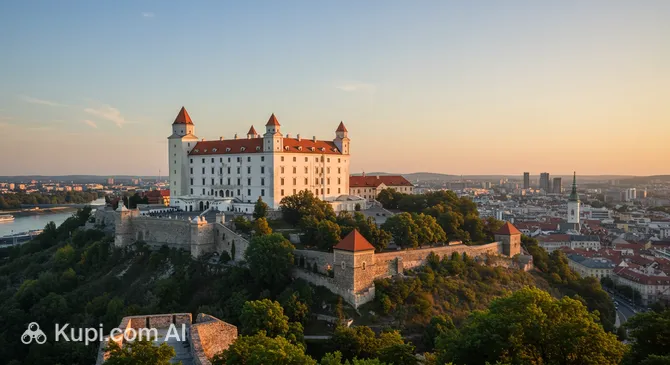
Bratislava Castle. Illustration.
Source: Kupi.com AI

Traveler photos:

The history of this site dates back to ancient times, with the first written mentions of a fortress on this hill dating to 907. The castle as we see it today is the result of numerous reconstructions, blending Gothic, Renaissance, and Baroque elements. The complex consists of four wings surrounding a central courtyard, the result of large-scale renovations in previous centuries. After a devastating fire in 1811, the castle lay in ruins for a long time and was only restored in the second half of the 20th century.

Today, Bratislava Castle is not only a historical monument but also an important cultural center. It houses the exhibitions of the Slovak National Museum, where you can see valuable archaeological finds and learn more about Slovak history. In addition to exploring the museum collections, visitors can walk through the well-maintained castle courtyards and the Baroque garden, as well as enjoy some of the best panoramic views of the Old Town and the Danube River.

Contacts

To plan your visit, check opening hours, or obtain additional information, you can contact the administration of Bratislava Castle, which houses the Historical Museum of the Slovak National Museum. All up-to-date information is available on the official website.

How to contactContact
Address811 06 Bratislava-Old Town, Slovakia
Phone number+421 2/204 831 10
Websitewww.visitbratislava.com

What to Do

A visit to Bratislava Castle offers guests unforgettable impressions, and one of the main ones is undoubtedly the panoramic view of the city and its surroundings. The terraces provide a wonderful view of Bratislava and the Danube. From here, you can fully appreciate the scale of the city, seeing both the largest residential district, Petržalka, and the picturesque rooftops of the historic center. These observation decks are the perfect place to take spectacular photos and feel the grandeur of Slovakia's capital.

Inside the castle, the journey continues through the centuries. Here you will find the exhibitions of the Slovak National Museum, where you can dive into the country's rich history. Exhibits include archaeological finds, everyday items, weapons, and works of art. Of particular interest is the "Treasury of Slovakia's Ancient Past" exhibition, which features unique artifacts found during excavations on the castle grounds. Visitors can explore its architecture and learn about the important historical events that took place here.

In addition to the museum exhibits, it's worth spending time strolling through the well-kept castle grounds. You can take a leisurely walk through the spacious inner courtyards or relax in the magnificent Baroque garden, which was restored according to historical blueprints. The garden is adorned with patterned flowerbeds, sculptures, and fountains, creating a lovely atmosphere for relaxation after a full tour. Entrance to the area surrounding the castle and the garden is free, making it a popular spot for both tourists and locals.

Getting There

Thanks to its location in the central part of Bratislava, Bratislava Castle is easily accessible for tourists. One of the most pleasant ways to reach it is a walk from the Old Town. Cobblestone streets lead up the castle hill, and the climb takes about 10–15 minutes. This is not only healthy physical activity but also a chance to enjoy the gradually unfolding views of the city and the Danube.

For those who prefer public transport, there are several convenient routes. You can take bus No. 203 or No. 207 and get off at the Zámocká or Hrad stops, which are in the immediate vicinity of the castle. Another option is to take tram No. 4 or No. 6 to the Most SNP stop at the New Bridge, followed by a short climb up the hill. Tourist buses also run through the city and include the castle in their route.

If you are traveling by car, roads lead to the castle directly from the center and other districts. However, keep in mind that parking spaces right at the site may be limited. A more convenient solution might be parking in one of the garages in the city center and continuing on foot or by public transport. Of course, a taxi is a fast and comfortable way to reach the castle gates from any part of the city.

Nearest city: Bratislava

History & Facts

The history of Bratislava Castle dates back to ancient times. Archaeological finds indicate that the castle hill was inhabited as early as prehistoric times, and later served as the site of Celtic settlements and a Roman border fortification. The first written mention of a fortress on this site, then known as "Pressalauspruch," dates back to 907 in the Salzburg Annals. It is believed that the first stone fortifications were built during the time of Great Moravia, highlighting the strategic importance of this location throughout the centuries.

Over time, the castle was rebuilt and strengthened repeatedly. Since the mid-11th century, it became an important administrative center of the Kingdom of Hungary. Evidence of its rich medieval history is the Royal (or Crown) Tower, built in the 13th century and considered the oldest preserved part of the modern complex. It was in this tower that the coronation regalia of Hungarian monarchs were kept for centuries when Bratislava was the capital of Hungary.

One of the most significant stages in the castle's history is associated with the reign of King Sigismund of Luxembourg. In 1427, he initiated a large-scale reconstruction that transformed the fortress into a majestic Gothic palace. During this period, new walls and the famous Sigismund Gate, which still stands today, were built. Later, in the 16th–18th centuries, the castle acquired Renaissance and Baroque features, becoming a luxurious royal residence. Despite a devastating fire in 1811 and subsequent neglect, the castle was meticulously restored in the 20th century and is today one of the main symbols of Slovakia.

Time Needed

When planning a visit to Bratislava Castle, you should allow for a duration of 1.5 to 3 hours. If you only want to walk through the castle courtyards, enjoy the views from the hill over Bratislava and the Danube, and relax in the Baroque garden, one hour might be enough. Entry to the castle grounds themselves is free, making it a wonderful place for a leisurely stroll and a photo shoot.

However, a full immersion into the history of this landmark requires more time. We recommend setting aside at least 2.5–3 hours to explore the Historical Museum exhibitions located inside the castle without rushing. Visiting the exhibitions dedicated to the history of Slovakia, viewing the Treasury with its unique archaeological finds, and climbing the Crown Tower for the best view of the city can take up to two hours. Thus, your visit can easily extend to half a day, especially if you decide to take a break at one of the on-site cafes.

Working Hours

Bratislava Castle is open to visitors year-round, but opening hours may change depending on the season. Generally, during the summer period (April 1 to October 31), museum exhibitions are open from 09:00 to 18:00. In the winter season (November 1 to March 31), hours are reduced, and the castle welcomes guests from 9:00 to 17:00. It is important to note that the Historical Museum, located inside the castle, typically operates from 10:00 to 18:00, with last entry at 17:00, and Monday is a closing day. The castle grounds and the beautiful Baroque garden are open for walking longer than the museum halls, and admission there is free.

While advance booking is not required for a regular stroll through the castle grounds, purchasing tickets in advance may be advisable if you plan to visit the museum exhibitions during the peak tourist season or on holidays. This will help you avoid queues. For the most accurate and up-to-date information on opening hours, potential schedule changes, and special events, it is highly recommended to check the official Slovak National Museum website before your visit.

Nearby

Visiting Bratislava Castle is just the beginning of discovering the rich history and culture of the Slovak capital. The castle hill is an excellent starting point for exploring the cozy streets of the Old Town that spread out at its foot. A walk through the surrounding area will allow you to immerse yourself deeper in the atmosphere of Bratislava, discovering new interesting spots literally around every corner.

Descending the hill, you will find yourself in a labyrinth of historical buildings, squares, and hidden courtyards. Many of the city's key attractions are within walking distance of the castle, making exploration convenient and exciting. Below is a list of some interesting places located nearby to help complement your impressions of the city.

NameDistance
Viecha pod hradom0.2 km
St. Martin's Cathedral0.3 km
Church of St. Stephen of Hungary0.5 km
Gatto Matto Panska0.5 km
Hviezdoslav Square0.5 km
Michael's Gate0.6 km
Maximilian Fountain0.6 km

Have you reached the end of the page?

So the route has been studied inside and out