Support

Lanzarote Airport

About the Airport

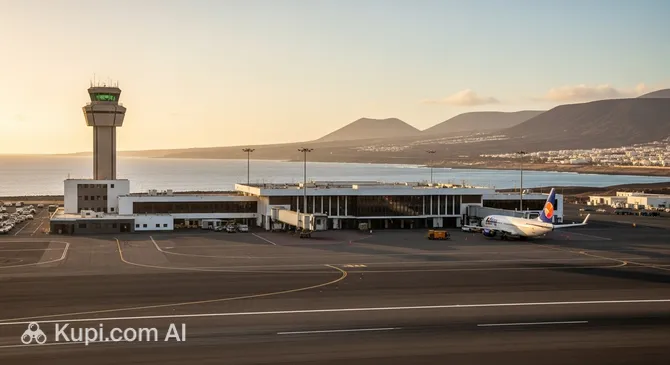
Lanzarote Airport. Source: Kupi.com Binoculars

Welcome to the aerial gateway of the "Island of Fire", where your journey begins long before you step out into the city! César Manrique-Lanzarote Airport is not merely a transport hub, but a true architectural prologue to your holiday, harmoniously integrated into the unique volcanic landscape. Here, the pristine white walls of the terminals contrast with the black lava, and the approach for landing offers a breathtaking view of the endless Atlantic Ocean and golden beaches, as if the aircraft touches the water just before touching down.

IATA Code ACE
ICAO Code GCRR
City Arrecife (San Bartolomé)
Distance to centre 5 km
Status International
Passengers per year Over 8.2 million (2023)
Schedule Online Flight Board

Features and Advantages of the Airport

Lanzarote Airport stands out among others for its unique cultural and aesthetic significance.

  • Influence of César Manrique: The airport bears the name of the famous artist and architect whose vision defined the appearance of the entire island. Inside, you can see his signature style and large-scale artistic works, including an impressive mural. The building is designed to disturb the natural landscape as little as possible.
  • Aviation Museum: Located on the airport grounds, in the old passenger terminal (built in 1946), is an interesting Aviation Museum. Entrance is free, and it is an excellent way to learn about the history of aviation in the Canaries while waiting for your flight.
  • Convenient Navigation: The airport complex consists of two terminals. T1 serves international and mainland flights, while T2 is designed for flights between the islands of the archipelago (for example, to Tenerife or Gran Canaria). This separation helps avoid confusion and queues.
  • Proximity to Resorts: The airport is incredibly conveniently located — just a 5–10 minute drive from the capital, Arrecife, and the popular resort town of Puerto del Carmen. Playa Honda beach is literally within walking distance of the terminal, allowing you to enjoy a dip in the ocean almost immediately after arrival.

Contact Information

To ensure your journey through Lanzarote Airport goes smoothly, save its main contacts. Below is all the necessary information for communicating with the airport.

  • Official Website: You can find all current information about flights, services, rules, and terminal operations on the official portal of the operator Aena: www.aena.es.
  • Information Service Phone: For information about flights, services, and airport operations, you can call the unified Aena call centre at: (+34) 91 321 10 00.
  • Airport Address: Aeropuerto de Lanzarote, Apartado de Correos 86, 35500, Arrecife, Las Palmas, Spain.
  • Email: For official enquiries, it is recommended to use the feedback form on the airport website, as a public email for general questions is not provided.
  • Social Media: News and updates can be followed on the official social media pages of the operator Aena, for example, on X (formerly Twitter) — @aena.
  • Lost Luggage Information: Important! If your luggage was lost or damaged during the flight, you must immediately contact your airline's Lost & Found service. If you left personal items in the terminal building, contact the airport's lost property office (Oficina de Objetos Perdidos).
  • Passenger Support Contacts: Assistance can be obtained at information desks located in the arrival and departure halls, or via the general information service phone.

How to Get to the Airport

Getting to Lanzarote Airport (ACE), located near the island's capital, the city of Arrecife, is quite simple. Depending on your budget, amount of luggage, and plans for travelling around Spain, you can choose one of several convenient methods.

Public Transport: Buses

The most economical way to travel is by local buses, which are called `guaguas` in the Canary Islands. Several routes connect the airport with key points on the island:

  • Route 22 and 23: Regularly runs between the airport and the bus station in Arrecife. The trip takes only 10-15 minutes, and the ticket cost is approximately 1.40 EUR.
  • Route 161 and 261: Connects the airport with the popular resorts of Puerto del Carmen (Playa del Carmen) and Playa Blanca. Travel time to Puerto del Carmen is about 20 minutes, and to Playa Blanca — 30-40 minutes. The fare ranges from 1.70 to 3.30 EUR.

This is an excellent choice for travellers with light luggage who wish to save money.

Taxi and Private Transfer

For maximum comfort, especially if you are travelling with family or a large number of suitcases, use a taxi. Ranks are located directly at the exits of terminals T1 and T2. A trip to the centre of Arrecife will cost approximately 10-15 EUR, to Puerto del Carmen — 15-20 EUR, and to Playa Blanca — about 40-50 EUR. You can also book a private transfer in advance — the driver will meet you with a sign, and the price will be fixed, helping to avoid surprises.

Car Rental and Parking

Renting a car is the best way to explore the unique landscapes of Lanzarote. In the airport arrivals hall, there are counters for many international and local rental companies. By booking a car online in advance, you will save time and money. The airport has convenient parking located opposite both terminals, where you can leave a car for both short and long terms. This is convenient if you are renting a car or arriving at the airport in your own vehicle.

Although Lanzarote Airport is the main one for the island, neighbouring islands also have major transport hubs, such as Fuerteventura Airport or Gran Canaria Airport, which can be reached by ferry or a short domestic flight.

Terminals and Map

Lanzarote Airport (ACE) has a simple and clear structure consisting of two passenger terminals — T1 and T2. Each performs a distinct function, which significantly simplifies navigation for travellers.

Terminal 1 (T1) is the main and largest terminal of the airport. It serves all international and domestic flights connecting Lanzarote with mainland Spain and other European countries. The terminal building is two-storey: on the ground floor (Planta 0) are the check-in counters and the arrivals area with baggage claim belts, and on the first floor (Planta 1) is the security area and departure gates with shops and restaurants. This is where the majority of tourists arrive and depart.

Terminal 2 (T2) is an older and more compact terminal, fully dedicated to inter-island flights within the Canary Archipelago. If you plan to fly to Tenerife, Gran Canaria, or another neighbouring island, your flight will likely be handled here. Due to its small size and lower passenger flow, all procedures in T2 are significantly faster.

The terminals are located in separate buildings but are in close proximity to each other. Walking between them takes no more than 5 minutes along a specially marked path. Navigation inside the airport is intuitive, with signs in Spanish and English everywhere. For international flights from Terminal 1, it is recommended to arrive 2-3 hours before departure, especially during the high season. For flights between islands from Terminal 2, 1-1.5 hours is usually sufficient.

History of the Airport

The history of Lanzarote Airport, located near the city of Arrecife, is closely linked to the development of tourism on the island. Its story began in the 1930s with the construction of a temporary airfield for military aviation needs. After several years of military use, on 3 March 1946, the airport was officially opened for civil transport, initially serving flights to mainland Spain and between the Canary Islands.

A real breakthrough in the airport's development occurred in the 1970s with the start of the tourism boom. To cope with the growing flow of travellers, a new runway was built and the first full-fledged passenger terminal was opened. It was in 1970 that the airport received international status, which became a key moment for Lanzarote's economy, opening the island to direct charter flights from Europe.

By the end of the 20th century, it became obvious that the existing infrastructure was no longer sufficient. In 1999, a large-scale modernisation was carried out: a new, spacious, and modern terminal opened (today this is Terminal 1), capable of serving millions of passengers a year. The old terminal, built in the 1970s, was reconstructed and reopened in 2005 as Terminal 2, designed for flights between the islands of the Canary Archipelago.

One of the most interesting facts in the airport's history is its close connection with the name of the famous local artist and architect César Manrique. In honour of his contribution to preserving the unique appearance of Lanzarote, in 2019 the airport was renamed — César Manrique-Lanzarote Airport. Today it is one of the busiest airports in Spain in terms of international traffic, continuing to play a vital role in the life of the island.

Services and Amenities

Lanzarote Airport (ACE) is a modern and well-equipped complex offering passengers a wide range of services for a comfortable stay while waiting for a flight. Here you will find everything you need, from shops and restaurants to relaxation zones and business services.

Numerous establishments to suit every taste and budget are located within the airport terminals. You can grab a bite at a fast-food café, have a coffee in a cosy coffee shop, or enjoy a full meal in a restaurant offering local and international cuisine. For shopping enthusiasts, Duty Free shops are open with a wide assortment of perfumes, cosmetics, confectionery, and tobacco products, as well as boutiques with clothing, accessories, and souvenirs where you can buy memorable gifts from the Canary Islands.

For passengers preferring to wait in a calmer atmosphere, the Guacimeta VIP Lounge is available. Guests of the lounge are offered complimentary snacks and beverages, fresh press, comfortable armchairs, and work areas. Free Wi-Fi is available throughout the airport, and numerous sockets and USB ports for charging mobile devices are provided in the waiting halls at the departure gates.

All necessary financial services are available at the airport, including ATMs and currency exchange points. In case of unforeseen health situations, a medical point is in operation to provide first aid. For travellers with children, special mother and child rooms are equipped, and there is a children's play area to help little ones stay entertained before the flight.

The airport is fully adapted for passengers with reduced mobility. An assistance service (Sin Barreras) is provided, which is recommended to be booked in advance through the airline. Terminals are equipped with ramps, lifts, and specially equipped restrooms, ensuring a barrier-free environment for all travellers.

Although there are no hotels directly on the airport grounds, many hotels and apartments are just a few minutes' taxi ride away in nearby tourist centres such as Puerto del Carmen and Playa Honda. Basic business services, such as workspaces, are available in the VIP lounge, although separate conference rooms are not provided at the airport.

Where to Eat

At Lanzarote Airport (ACE), travellers will find sufficient options for a snack or a full meal to spend time comfortably while waiting for a flight. Catering establishments are located in both terminals and offer a varied menu to suit every taste and budget.

Terminal 1 (T1) — International and National Flights

The main concentration of cafés and restaurants is found here. Before Security Control (Landside): In the general arrival and departure area, there are several cafés where you can have coffee and pastries while saying goodbye to those seeing you off or waiting for check-in. This is a convenient place for a leisurely snack. After Security Control (Airside): In the departure area, the choice is significantly wider. Here you will find:

  • Fast Food: For those in a hurry, outlets of famous global chains are operating, offering burgers, sandwiches, and fries.
  • Cafés and Coffee Shops: An ideal option for a light snack. Here you can order fresh pastries, sandwiches, salads, and, of course, excellent coffee. If you want to try something local, look for traditional Spanish snacks tapas or Canarian coffee on the menu.
  • Restaurants and Lounges: For passengers with enough time, establishments with à la carte service are open. Here you can order pizza, pasta, as well as Spanish cuisine dishes. The lounges offer a good selection of beverages and local specialities.

Terminal 2 (T2) — Inter-island Flights

Terminal T2 is significantly smaller, and the choice here is more modest but sufficient for passengers awaiting flights to neighbouring Canary Islands. Typically, one or two cafés operate here, located in the departure area after security control. They offer a standard set: coffee, refreshing drinks, sandwiches, pastries, and light snacks.

Features and Recommendations

Prices: The cost of food and drinks at the airport is, as expected, higher than in the island's cities. Nevertheless, options can be found for different budgets — from an inexpensive coffee to a full meal in a restaurant.

Dietary Preferences: Many establishments offer vegetarian options, such as meat-free salads or sandwiches. It is best to clarify information about Halal-friendly, gluten-free, or vegan dishes directly with the café staff — they are usually ready to assist.

Opening Hours: Most food outlets operate in accordance with the flight schedule, opening early in the morning and closing after the departure of the last aircraft. However, some establishments may have reduced hours during less busy times.

Tips for Travellers

To ensure your journey through Lanzarote Airport, located near the city of Arrecife, goes as smoothly as possible, make use of our tips. We recommend arriving at the airport well in advance: 2.5-3 hours before international flights and approximately 2 hours before domestic flights within Spain. During the peak tourist season, especially in summer and during holidays, the airport can be busy, so extra time is always helpful.

To save time, complete online check-in for your flight before arriving at the airport. This will allow you to head straight to the bag-drop counter or, if you are travelling light, directly to security. When passing through security control, have your boarding pass and passport ready in advance, and remove laptops and other large gadgets from your hand luggage. All liquids must be in containers of no more than 100 ml and packed in a transparent bag.

When choosing a seat on the plane, consider your preferences. A window seat will offer you unforgettable views of Lanzarote's unique volcanic landscapes during take-off or landing. An aisle seat provides more legroom and the ability to stand up freely during the flight without disturbing neighbours.

Hand luggage rules at Lanzarote Airport comply with general European standards. Sharp objects, weapons, and flammable substances are prohibited. The volume of liquids is limited to 1 litre per passenger, with each container not exceeding 100 ml. Always check the exact weight and dimension limits for hand luggage with your airline to avoid extra charges at the airport.

Lanzarote is largely a final destination, so there are few transit passengers. If you do have a connection planned, ensure your luggage is checked through to the final destination. Watch the departure boards closely so as not to miss your next flight, and allow sufficient time to move between gates.

Customs control for passengers arriving from countries outside the Schengen area follows the standard scheme with "green" and "red" channels. If you have no goods to declare, proceed through the green channel. For travellers within the EU, formal customs control is usually absent.

To save money, book your transfer from the airport online in advance — this is often cheaper than taking a taxi on the spot. Bring an empty water bottle, which can be filled at drinking fountains after passing security control, avoiding the purchase of expensive water in shops. Also, do not forget the possibility of claiming a Tax-Free refund for purchases made on the island if you are not an EU resident. Relevant counters are located in the departure hall.

In the event of a flight delay, remain calm. First of all, contact your airline representative for information on the flight status and your rights. According to EU regulations, for long delays, passengers are entitled to drinks, meals, and, if necessary, hotel accommodation. The airport has cafés, restaurants, and shops where you can comfortably spend time waiting for departure.

Reached the end of the page?

That means the route is fully explored