Support

Tenerife South Airport

Airports in the city

About the Airport

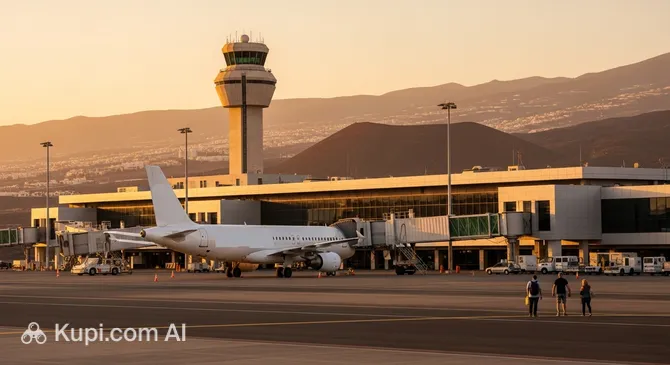
Tenerife South Airport. Source: Kupi.com Binoculars
Tenerife South Airport (TFS), often referred to as Reina Sofía, is not merely a transport hub but a true gateway to summer. Located in the sunniest part of the island, it instantly immerses arrivals in an atmosphere of Canarian hospitality and relaxation. This is where the majority of tourists arrive, seeking the golden beaches and ocean waves of the southern coast, as the transfer to the main resorts takes just a matter of minutes.
IATA Code TFS
ICAO Code GCTS
City Granadilla de Abona (serves Tenerife Island)
Distance to Centre ~60 km (to Santa Cruz de Tenerife)
Status International
Passengers per Year ~13.7 million (2024)
Schedule 24 Hours

Airport Features and Advantages:

Tenerife South operates 24 hours a day and handles the vast majority of international flights on the island. The main advantage of the airport is its location: it is situated just a 15–20 minute drive from the most popular resort zones, such as Los Cristianos, Playa de las Américas, and Costa Adeje. For a comfortable wait, passengers have access to the Montaña Roja VIP lounge with views of the runway and the ocean.

Transport accessibility here is organised at the highest level. The TITSA bus network connects the terminal with all corners of the island: route No. 40 goes to the southern resorts, No. 111 and No. 711 connect the airport with the capital, Santa Cruz, and the express No. 343 allows you to get directly to the northern airport (TFN) without transfers. The terminal is fully equipped for passengers with reduced mobility under the "Sin Barreras" (Without Barriers) programme.

Contact Information

For your convenience, we have compiled the main contact information for Tenerife South Airport (TFS). We recommend checking the currency of the data on official resources before your trip.

  • Official Website: You can find the most complete and up-to-date information on flights, services, and regulations on the official website of the Spanish airport operator Aena: www.aena.es/es/tenerife-sur.html
  • Information Service Phone: For information by phone, you can call the unified Aena call centre: (+34) 91 321 10 00.
  • Airport Address: 38610 Granadilla de Abona, Santa Cruz de Tenerife, Spain.
  • Email: A direct email address for general inquiries is not published. For communication, it is recommended to use the official query form on the Aena website.
  • Social Media: You can follow news and updates on Aena's official social media pages, for example, on Twitter (@aena).
  • Lost Luggage Information: If your luggage was lost or damaged during the flight, you should immediately contact your airline's Lost and Found service. The carrier's representative offices are located in the arrivals area. If you have lost personal items within the terminal, please contact the airport's Lost Property office.
  • Passenger Support Contacts: Assistance for passengers, including people with disabilities, can be requested via information desks in the terminal or through the main information service phone number.

How to Get to the Airport

Getting to Tenerife South Airport (TFS), the island's key transport hub, is quite simple from any point in Tenerife. The airport is conveniently located next to the main TF-1 motorway, ensuring quick connections to the main resorts and the island's capital.

Public Transport: Buses
The most economical way to get to the airport is to use the TITSA bus company services. The green buses are easy to recognise, and stops are located right at the terminal exit.

  • Route 111 connects the airport with the capital Santa Cruz de Tenerife and the main resort centre of Costa Adeje. Travel time to the capital is about 1 hour.
  • Route 711 is the night version of route 111, operating in the same direction.
  • Route 343 is a direct express linking the South Airport with Tenerife North Airport (TFN), which is especially convenient for transfers between flights.
  • Routes 450 and 451 run along the coast, linking the airport with the resorts of Costa Adeje and Los Cristianos. The trip to these locations takes just 20–30 minutes.
The fare depends on the distance but averages between 3 and 10 Euros. For savings, you can purchase a reloadable Ten+ transport card.

Taxi and Transfer
A taxi is a more comfortable option, offering privacy for families, though it is significantly more expensive. Official white cars with meters await passengers at a designated stand near the arrivals hall exit. A trip to the nearest resorts (Los Cristianos, Playa de las Américas) will cost approximately 25–35 Euros. The journey to Santa Cruz de Tenerife will cost about 70–80 Euros. An excellent alternative can be a pre-booked transfer: you will know the exact cost of the trip in advance, and the driver will meet you with a name sign.

Car Rental
If you plan to actively explore the island, renting a car is your best choice. Many international and local rental companies have desks right inside the airport building. It is recommended to book a car in advance, especially during the peak tourist season. Returning the car before departure is also very simple, following the "Rental Car Return" signs. The drive from the centre of the resort zone in the south takes no more than 15–20 minutes.

Airport Parking
For those arriving at the airport in their own or a rented car, a large official car park is provided. There are zones for short-term parking (for dropping off and picking up) and for long-term vehicle storage during your travels. Tariffs vary depending on the duration, but it is a convenient and safe way to leave your car.

Terminals and Map

Tenerife South Airport (TFS), also known as Queen Sofia Airport, is designed for maximum traveller convenience and consists of one large terminal. This significantly simplifies navigation, as all zones—from check-in to baggage claim—are located within a single building, so you won't have to worry about transfers between terminals.

The airport layout is logical and intuitive. The terminal is divided into three levels:

  • Ground Floor (Planta 0): Located here are the flight check-in counters, the arrivals area, and baggage claim belts. After retrieving your suitcases, you enter the general hall, where car rental offices, tourist information desks, cafes, and exits to bus stops and the taxi rank are found.
  • First Floor (Planta 1): This is the departures zone. After checking in on the ground floor, you proceed here to pass through security control. Immediately after screening, you find yourself in a spacious commercial zone with numerous Duty Free shops, restaurants, and cafes, leading further to the boarding gates.
  • Basement Floor (Planta -1): Located here are offices and service rooms, which are generally not of interest to most passengers.

Navigating the airport will not cause difficulties thanks to numerous signs in Spanish and English, as well as information screens. Departure zones are divided into Schengen and non-Schengen destinations, which affects the need for passport control. Typically, gates for flights to countries outside the Schengen zone are located in a separate part of the terminal.

Regarding timing, during peak seasons (summer, Christmas, and Easter holidays), queues may form at check-in counters and security checkpoints. It is recommended to arrive at the airport at least 2.5–3 hours before international flights and 2 hours before domestic flights. At other times, completing all formalities usually takes no more than an hour. To save time, use online check-in if your airline provides this option.

Airport History

The history of Tenerife South Airport, officially known as Queen Sofia Airport (Aeropuerto de Tenerife Sur Reina Sofía), is inextricably linked with the development of tourism in the Canary Islands. The decision to construct it was made in the late 1960s when it became obvious that the existing Los Rodeos airport (now Tenerife North) could not cope with the growing flow of tourists and was often closed due to adverse weather conditions, particularly fog. The need for a new, more modern, and reliable air harbour in the south of the island, where the main resorts are concentrated, became critical.

The grand opening of the airport took place on 6 November 1978 in the presence of Queen Sofía of Spain, in whose honour it was named. The first flight to land on its runway was an Iberia aircraft arriving from the neighbouring island of Lanzarote. From the very beginning, the airport was designed with the capacity to accept wide-body aircraft, which opened Tenerife to direct flights from many countries in Europe and the world.

Since its opening, the airport has constantly expanded and modernised to meet the status of one of the busiest in Spain in terms of international passenger traffic. Even in its first years of operation, it demonstrated rapid growth in passenger numbers. Significant renovations and terminal expansions were carried out in the 1990s and 2000s, increasing its capacity to more than 11 million passengers per year. New boarding gates were added, the baggage handling system was improved, and commercial zones were expanded.

One interesting fact is that the airport was built practically "from scratch" in the arid southern part of the island, which required large-scale engineering works. Today, it is a key infrastructure element that has contributed to transforming the south of Tenerife into one of the most popular tourist destinations in the world. Its history is a vivid example of how strategic planning and the development of transport hubs can radically change the economy and appearance of an entire region.

Services and Amenities

Tenerife South Airport (TFS) offers passengers a full range of services and amenities to make waiting for a flight as comfortable as possible. Conditions here are created for both tourists and business travellers.

Within the terminal, you will find a multitude of restaurants, cafes, and dining outlets to suit every taste: from fast food establishments to restaurants serving Canarian cuisine. Extensive shopping opportunities include a large Duty Free shop, as well as boutiques offering clothing, souvenirs, local delicacies, and press.

For those who value enhanced comfort, the Montaña Roja VIP lounge operates at the airport. Guests can enjoy beverages, snacks, fresh newspapers, and a calm atmosphere away from the main bustle. Free Wi-Fi from Aena is available throughout the terminal, as well as numerous charging stations for electronic devices located in the waiting areas.

Financial matters can be resolved right at the airport: bank branches, ATMs, and currency exchange points are at your service. In case of need, there is a medical point in the terminal building ready to provide first aid.

Travellers with children will appreciate the presence of play zones and mother and child rooms, equipped with everything necessary for baby care. For passengers with reduced mobility, a special support service is provided, which is recommended to be booked in advance, along with ramps, lifts, and equipped restrooms.

Although there are no hotels directly inside the airport building, many hotels for every budget are located a few minutes' drive away. For business travellers, conference rooms and business services are available, which can be booked for meetings or negotiations.

Dining Options

At Tenerife South Airport, travellers will find diverse dining options, from a quick coffee with pastries to a full lunch or dinner. Catering establishments are located both in the public area and in the passenger zone after security control, offering menus to suit every taste and budget.

In the public zone (before security control), the selection is usually more modest but sufficient for a snack before departure or while meeting arrivals. Several cafes operate here where you can order sandwiches, salads, desserts, and hot drinks. This is an excellent place if you have arrived at the airport well in advance and wish to quietly enjoy a coffee.

The majority of restaurants and outlets are concentrated in the departures zone (after security control). For those in a hurry, outlets of famous chains such as Burger King are ideal, where you can quickly order standard burgers and fries. Cafes like Camden Food Co. or Starbucks offer a wide selection of sandwiches, fresh juices, salads, and, of course, coffee. These establishments are a wonderful choice for a light and quick snack.

If you have time and wish to enjoy a more substantial meal, pay attention to restaurants with à la carte service. You can often try Spanish and Canarian dishes in them. Do not miss the opportunity to order traditional tapas snacks or a bocadillo sandwich with cured meat. For a relaxed atmosphere before your flight, there are lounges where you can enjoy refreshing beverages.

Most establishments strive to accommodate the needs of different passengers. In many cafes and restaurants, you can find vegetarian, vegan, and gluten-free options on the menu—look for special labels or ask the staff. Prices at the airport are generally higher than the average on the island, which is standard practice for major tourist hubs. The opening hours of most establishments are adapted to the flight schedule, so you will be able to find an open cafe even early in the morning or late at night.

Travel Tips

To ensure your journey through Tenerife South Airport passes as comfortably and stress-free as possible, make use of these proven tips. The airport handles a huge number of flights, especially during peak season, so a little preparation will help save time and nerves.

Arrival Time and Check-in: It is recommended to arrive at the airport at least 2-3 hours before international flights and 1.5-2 hours before domestic ones. To avoid queues, complete online check-in for your flight in advance. This will allow you to either head straight to the bag drop counter or, if you are travelling light, directly to the security checkpoint.

Security Screening and Hand Luggage: At security control, be prepared to remove all large electronic devices (laptops, tablets) and your bag of liquids from your hand luggage. Remember that the volume of each container with liquid must not exceed 100 ml. All of them must be packed in a single transparent resealable bag. A common mistake by tourists is trying to carry a large bottle of sunscreen in hand luggage. Check it into your hold luggage so you don't have to discard it.

Choosing a Seat on the Plane: Want to take beautiful photos of the island from above? Choose a window seat. If the ability to stand up freely during the flight or exit the plane quickly upon arrival is more important to you, your best choice would be an aisle seat.

For Transit Passengers: If Tenerife South is a transit point for you, check in advance whether you need to pass through passport control (this depends on where you are flying from and to—for example, from a non-Schengen country to a Schengen one). Watch the "Transit"/"Connections" signs carefully so as not to get lost and to catch your next flight.

Customs Control upon Arrival: When arriving from a country outside the European Union, you will need to pass through customs. If you do not have goods to declare, follow the "Green Channel". If you are carrying items that exceed duty-free allowances (for example, large quantities of tobacco or other restricted goods), you must choose the "Red Channel" and declare the goods.

Saving Time and Money: The most budget-friendly way to get to the resorts is via the Titsa buses, the stops for which are located right at the terminal exit. Prices for food and drinks at the airport are traditionally higher, so you can bring a small snack (non-liquid) with you. Free Wi-Fi will help you stay connected without spending money on roaming.

In Case of Flight Delay: If your flight is delayed, first contact your airline representative for information. Depending on the length of the delay, you may be entitled to vouchers for food or drinks. Be sure to keep all receipts and your boarding pass—they may be useful for claiming compensation in the future.

Reached the end of the page?

That means the route is fully explored