Support

Hierro Airport

About the Airport

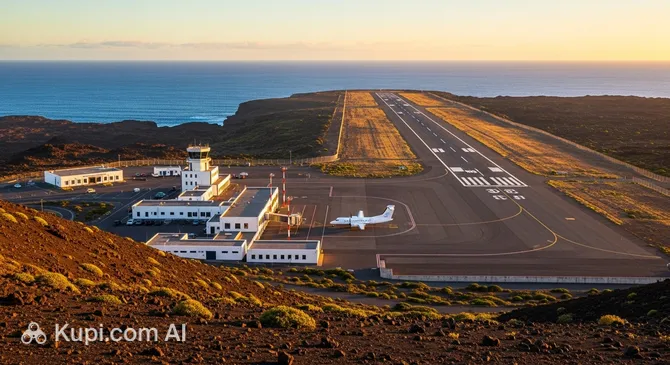
Hierro Airport. Source: Kupi.com Binoculars

Hierro Airport is not merely a transport hub, but a true gateway to the pristine nature of the most western and mysterious island of the Canary archipelago. Located on a narrow coastal strip between majestic volcanic slopes and the boundless Atlantic Ocean, this air harbour offers travellers breathtaking panoramas during the descent. Small and cosy, the terminal is renowned for its welcoming atmosphere and complete absence of hustle, allowing guests to instantly switch to the tranquil rhythm of island life.

IATA Code VDE
ICAO Code GCHI
City Valverde
Distance to centre 9 km
Status Domestic (Inter-island)
Passengers per year ~301,000 (2023 data)
Schedule Available on the official Aena website

Features and Advantages of the Airport:

The main advantage of Hierro Airport is its compactness and efficiency. Thanks to the small size of the terminal, the journey from the aircraft steps to the city exit takes mere minutes, and check-in and security procedures are surprisingly quick and queue-free. It is an ideal place for those who value their time and comfort.

The airport possesses a unique history and location: locals sometimes call it the "Crab Airport" (Aeropuerto de los Cangrejos), as it was built on a rocky stretch of coast previously inhabited only by these marine creatures. Despite the challenging terrain, engineers managed to create safe and modern infrastructure that blends harmoniously with the surrounding landscape of the biosphere reserve.

For the convenience of passengers, free unlimited Wi-Fi is provided here, allowing you to stay connected immediately upon arrival. The airport is also fully adapted for passengers with reduced mobility (Sin Barreras service), ensuring barrier-free access to all zones. Car rental desks are located at the terminal exit, which is extremely convenient, as a car is the best way to explore the winding roads and viewpoints of El Hierro.

Contact Information

Below you will find useful contact details for Hierro Airport (VDE), which will help you plan your trip and orient yourself upon arrival.

  • Official Website: Up-to-date information on flights, services, and airport regulations can always be found on the official Aena website: aena.es/es/el-hierro.html.
  • Information Service Phone: For inquiries, you can call the unified number for the Aena airport network: (+34) 91 321 10 00.
  • Airport Address: Ctra. del Aeropuerto, s/n, 38910, Valverde, Santa Cruz de Tenerife, Spain.
  • Email: A direct email address for general questions is not published. It is recommended to use the online forms on the official Aena website for communication.
  • Social Media: You can follow general news regarding Spanish airports on the official social media pages of the operator Aena.
  • Lost Luggage Information: If your luggage has been lost or damaged, you must contact the Lost & Found service of your airline directly.
  • Passenger Support Contacts: For general questions and assistance at the airport, please approach the information desks or call the general information service number.

How to Get to the Airport

Getting to Hierro Airport (VDE), located on the picturesque island of El Hierro in Spain, is quite simple, especially from the island's capital, the city of Valverde. The airport is situated just a 10-15 minute drive from the city centre. Despite the island's compact size, the transport system offers several convenient options for travellers.

Public Transport on the island is represented by the TransHierro bus network. This is the most budget-friendly way to get to the airport. Several routes connect the air harbour with key settlements, including Valverde, La Frontera, and El Pinar. Be sure to check the current schedule in advance, as the frequency of trips may vary depending on the season and day of the week. The fare is usually just a few euros. There are no railways or metro systems on the island.

Taxi or Private Transfer is a more comfortable and faster option. Taxi ranks are found in main tourist zones and the capital; a car can also be ordered by phone. The trip from Valverde to the airport will take about 10-15 minutes and cost approximately 15-20 euros. This method is ideal if you are travelling with a large amount of luggage or a small group, offering privacy and convenience.

Car Rental is an extremely popular choice among tourists in the Canary Islands. By renting a car, you gain complete freedom of movement to explore the unique nature of El Hierro. Most rental companies have desks directly at the airport, allowing you to conveniently collect and return the vehicle before departure. It is recommended to book a car in advance, especially during the high tourist season.

For those arriving at the airport in their own or rented vehicle, parking is provided. Hierro Airport has a public parking zone located in immediate proximity to the terminal. There are usually sufficient spaces available, and the parking cost is reasonable, which is convenient for both short-term and long-term stays.

Although Hierro Airport is the main air gateway to the island, it is worth knowing about other airports in the region that can serve as alternative points for travel around the Canary archipelago. Among them are La Gomera Airport (GMZ), La Palma Airport (SPC), as well as major international hubs such as Tenerife South Airport (TFS), Tenerife North Airport (TFN), and Gran Canaria Airport (LPA), from where flights to El Hierro operate.

Terminals and Map

Hierro Airport (VDE), serving the smallest of the Canary Islands, is a compact and functional aviation hub designed for passenger convenience. Its structure is extremely simple and intuitive.

The airport consists of one passenger terminal, which handles both domestic and international flights, although the vast majority are flights between the islands of the archipelago. Thanks to its small size and thoughtful layout, navigating the building presents no difficulties. All key zones—check-in counters, security screening, the departure lounge, and baggage claim—are located on a single floor and within walking distance of each other.

Departure and arrival zones are clearly separated. After entering the terminal, you immediately find yourself in the public area where the check-in counters are located. After completing check-in and dropping off luggage, passengers proceed to pre-flight security, which leads to a small but comfortable waiting hall with several boarding gates. The arrival zone is in another part of the building and includes a baggage reclaim belt and an exit to the public area, where you can meet arrivals or proceed to car rental desks.

Completing all formalities at Hierro Airport generally takes minimal time. Check-in and security usually last no more than 20-30 minutes. Nevertheless, it is recommended to arrive at the airport approximately 1-1.5 hours before departure to complete all procedures without haste. Getting lost in the terminal is practically impossible, as all directions are indicated on clear signs and display boards.

Airport History

The history of Hierro Airport (VDE) is a story of overcoming isolation and connecting the smallest of the Canary Islands with the rest of the world. For a long time, the island of El Hierro was accessible only by sea, which significantly limited its development. Everything changed on 12 December 1972, when the airport was officially opened for civil air traffic. This day became a true celebration for local residents and a turning point in the modern history of the island.

The first aircraft to land on the 1,000-metre runway was a Fokker F-27 of Iberia Airlines, which began operating regular flights on the Hierro — Tenerife North route. Passenger traffic grew, and as early as 1975, the first expansion of the passenger terminal was required. In subsequent years, the airport continued to develop: in the 1980s, the aircraft apron was expanded, and systems to enhance flight safety were installed.

The most significant changes occurred in the early 1990s. In 1992, a new, more spacious and modern passenger terminal was commissioned, along with a new control tower. The old terminal was converted for cargo use, and the old tower was demolished. The runway was extended to 1,250 metres, allowing it to accommodate larger turboprop aircraft, which continue to form the backbone of the fleet serving the island today.

In the 21st century, the airport continued modernization, paying special attention to safety and service quality. It played a crucial role during the underwater volcanic eruption off the coast of El Hierro in 2011-2012. The airport became a strategic centre for transporting specialists and equipment, and for potential evacuation, once again proving its indispensability to the island. Today, Hierro Airport serves hundreds of thousands of passengers annually, ensuring stable connections with Tenerife and Gran Canaria.

Despite its modest size, Hierro Airport is not just a transport hub, but a vital artery for the residents and guests of the island. Its IATA code — VDE — is derived from the name of the island's capital, Valverde. It remains one of the most unique airports in the Spanish operator Aena's network due to its location and critical role in the life of the UNESCO Biosphere Reserve that is the entire island of El Hierro.

Services and Amenities

Hierro Airport (VDE), despite its compact dimensions, offers passengers all essential services for a comfortable wait for their flight. In the terminal, you will find a cosy cafeteria where you can order snacks, hot and cold beverages, as well as a shop offering newspapers, souvenirs, and locally produced goods.

A general waiting hall is equipped for relaxation before departure. There are no specialized VIP lounges at the airport. Throughout the terminal, passengers have access to free Wi-Fi provided by Aena. Power outlets for charging mobile phones and other gadgets can be found in the waiting hall.

ATMs are installed in the terminal building for cash withdrawals. Please note that currency exchange bureaus are absent, so it is advisable to arrange for Euros in advance. Although there is no permanent medical centre at the airport, staff will provide first aid and organize a call for specialists if necessary.

The airport is well-equipped to serve passengers with special needs. Under the "Sin Barreras" (Without Barriers) programme, free assistance is provided for moving through the terminal, as well as boarding and disembarking from the aircraft. Ramps, adapted restrooms, and special parking spaces are available. For families with small children, changing tables are provided in the restrooms.

There are no hotels within the airport grounds. The nearest hotels and apartments are located in the island's capital, Valverde, and other neighbouring towns, which can be reached by taxi or rental car. Services for renting conference rooms or business centres are not provided at Hierro Airport.

Where to Eat

Hierro Airport (VDE) is a small and compact regional aviation hub, so the choice of dining establishments is appropriate for its size. Do not expect a wide variety of restaurants as found in major international hubs. The main options for a snack are concentrated in one location, which is convenient for passengers.

The main and, in fact, the only place to eat is the cafeteria, located in the public departure hall, accessible to all visitors before security control (landside). Here, passengers and those seeing them off can comfortably spend time waiting for a flight, enjoying coffee or refreshing drinks.

The establishment's menu offers a standard set for travellers: sandwiches (bocadillos), fresh pastries, salads, crisps, and sweets. To experience a bit of local flavour even at the airport, look for options using local products, such as a sandwich with the famous Queso Herreño cheese. This place is ideal for both a quick coffee with a croissant and a more filling but simple lunch before a flight.

Specialized dietary options (vegan, gluten-free, or Halal) here are likely to be extremely limited or unavailable. Passengers with strict dietary requirements are advised to bring food with them. The cafeteria's opening hours are usually synchronized with the flight schedule: it opens shortly before the first departure and closes after the last aircraft leaves. Prices are typical for airports, slightly higher than in the city, but generally moderate.

Tips for Travellers

Travelling through a small regional airport like Hierro Airport in Valverde, Spain, usually proceeds calmly and without hassle. To make your trip even smoother, take advantage of these tips. It is recommended to arrive at the airport 1.5-2 hours before departure. Although it is small, minor queues can occur during the peak tourist season.

To save time, complete online check-in for your flight and save the boarding pass on your smartphone. The security screening procedure here is generally faster than in major hubs, but safety rules are standard. When choosing a seat on the plane, note that window seats will offer you stunning views of the island of Hierro and the ocean during takeoff and landing. Aisle seats provide more convenience if you need to stand up during the flight.

Rules for carrying hand luggage are standard for the EU: liquids must be in containers up to 100 ml and packed in a transparent bag. Sharp objects, weapons, and flammable substances are prohibited. Always check your airline's regulations, as requirements for the weight and dimensions of hand luggage may vary.

Hierro Airport mainly handles direct flights to other Canary Islands and mainland Spain, so long layovers here are rare. If you have a connecting flight, it will likely be at a larger airport (for example, in Tenerife or Gran Canaria). Check with your airline whether you will need to collect and re-check your luggage at the transfer point. Customs control for flights within the Schengen Area, to which Spain belongs, is absent. You simply collect your luggage and exit the airport.

To save time and money, book your transfer from the airport in advance, especially if you are travelling during the high season. Also, consider travelling light with only hand luggage to avoid fees for checked baggage. Inside the airport, the choice of cafes is limited, so you can bring an empty water bottle and fill it after passing security.

In the event of a flight delay or cancellation, first contact your airline representative for information. Keep all receipts for food and drinks, as under EU regulations (EU261), you may be entitled to compensation. Given the island location, alternative options to reach your destination may be few, so it is useful to have a charged phone and internet access to promptly track flight status.

Reached the end of the page?

That means the route is fully explored