Support

Hassan I Airport

About the Airport

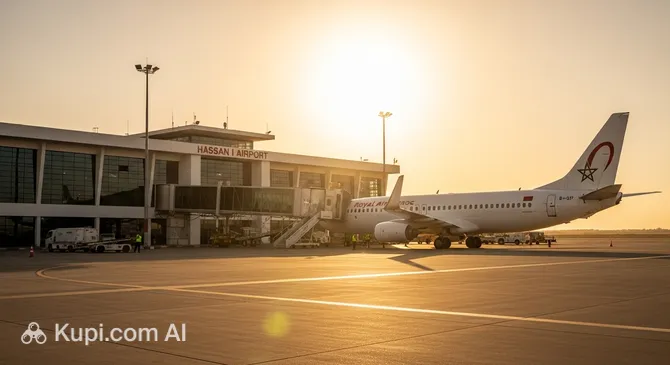
Hassan I Airport. Source: Kupi.com Binoculars

Hassan I Airport (IATA: EUN) is the main air gateway to the city of Laayoune and a key transport hub for the region. This air hub plays a vital role in ensuring connectivity with other cities and countries, serving both civil and military flights. Its convenient location and modern infrastructure make it the starting point for many travellers exploring the Atlantic coast of Africa.

IATA Code EUN
ICAO Code GMML
City Laayoune
Distance to Centre About 3 km
Status International, Civil/Military
Annual Passengers Over 183,000 (first 8 months of 2024)
Popular Airlines Royal Air Maroc, Binter Canarias, Iberia
Schedule Online Board "Hassan I Airport"

Hassan I Airport boasts modern infrastructure, including two runways and a spacious terminal capable of efficiently handling passenger traffic. Thanks to its status, the airport accommodates both domestic and international flights, connecting Laayoune with cities such as Casablanca, Agadir, and Las Palmas. Passengers can avail themselves of essential services required for a comfortable journey. Its proximity to the city, which can be reached in just a few minutes, is an undoubted advantage for tourists and business travellers.

Contact Information

  • Official Website: Hassan I Airport is managed by ONDA (National Airports Office). For the most up-to-date information, including flight schedules, it is recommended to check the official ONDA website in the section dedicated to the Laayoune airport.
  • Help Desk Phone: You can contact the airport by phone: +212 528 89 39 51. We recommend verifying the number before calling.
  • Address: Route de Smara, Laâyoune. The airport is located near the city centre.
  • Email: For official inquiries and requests, it is recommended to use the contact form on the ONDA operator's website, as a direct email address for the airport is usually not published.
  • Social Media: The airport does not have its own social media pages. News and updates can be tracked on the official pages of the management company, ONDA.
  • Lost Luggage Information: For issues related to lost or damaged luggage, you should primarily contact the Lost & Found service of your airline, which has a representative office at the airport.
  • Passenger Support Contacts: For assistance and answers to questions, please approach the information desks in the terminal or call the airport help desk.

How to Get to the Airport

Hassan I Airport (EUN) is located in the immediate vicinity of the city of Laayoune, just a few kilometres from its centre. This makes the journey to the terminal fast, inexpensive, and convenient for travellers.

Taxi and Transfer

The most popular and practical way to get to the airport is by taxi. A trip from the centre of Laayoune takes only 5–10 minutes depending on traffic conditions. It is recommended to use official "petit taxis" (small taxis), which are easy to find anywhere in the city. The cost of the trip is very affordable. For added convenience, you can book a private transfer in advance, which will meet you at your hotel and take you directly to the departure terminal.

Public Transport

There are no direct public transport routes, such as dedicated shuttle buses, to Hassan I Airport. Although city buses run nearby, this option is inconvenient for tourists with luggage. Given the short distance and low cost of taxis, most travellers prefer them.

Car Rental and Parking

If you plan to explore the surroundings, car rental is an excellent solution. You can hire a car both in the city and directly at the airport upon arrival. The drive to the airport in your own or a rented car will not take much time. The airport has a car park where you can leave your vehicle for both short and long periods.

Other Nearby Airports

Although Hassan I Airport is the main one for Laayoune, there are other air hubs in the region. The nearest Moroccan airport is Tan Tan Airport, located approximately 250 km away. On the Canary Islands, which can be reached by plane, there are major international airports such as Fuerteventura Airport, Lanzarote Airport, and Gran Canaria Airport. However, for direct travel to Laayoune, they are less convenient as they require an additional flight.

Terminals and Map

Hassan I Airport (EUN) is a modern but relatively small aviation hub with a structure that is simple and intuitive for travellers. Thanks to its compact size, navigating the airport will not be difficult even for those visiting for the first time.

The airport operates one passenger terminal, which serves both domestic and international flights. This means that all procedures — from check-in to boarding — take place in one building, significantly simplifying logistics for passengers. There is no need to move between different buildings, as all services are concentrated under one roof.

The terminal layout is logical and standard for airports of this type. The ground floor usually houses check-in counters, the arrival zone with baggage claim belts and customs control, as well as airline and car rental offices. After checking in, passengers proceed to the first floor or a separate area where the security checkpoint and passport control for international flights are located. Beyond these lies the departure lounge with boarding gates.

The departure and arrival zones are clearly separated. The arrival zone is in the public area of the terminal, accessible for meeting passengers. The departure zone is a "secure area" (airside) and is accessible only to passengers who have passed security screening. Despite its modest size, the waiting hall offers basic amenities such as small cafes and shops.

Completing all formalities typically does not take much time. For domestic flights, it is recommended to arrive at the airport 1.5-2 hours before departure, and for international flights — 2-3 hours. During periods of low traffic, check-in and screening may take no more than 30-40 minutes, but it is always better to have extra time in case of unforeseen circumstances.

For easy navigation through the terminal, follow the signs, which are in Arabic and French, with key information duplicated in English. Since all main areas are within walking distance of each other, getting lost in Hassan I Airport is practically impossible.

Airport History

The history of Hassan I Airport in the city of Laayoune is inextricably linked with key stages of the region's development. Its origins date back to the mid-20th century when it was founded as a military airfield during the Spanish presence. At that time, it primarily fulfilled strategic tasks and was not intended for civil transport in the modern sense.

The 1970s became a turning point in the airport's history. After the region came under the administration of Morocco, its transformation into a full-fledged civil airport began. It was then that it received its current name in honour of Sultan Hassan I, who ruled in the late 19th century, marking a new chapter in its development. This modernization aimed to integrate the southern provinces into the national transport network.

Over the subsequent decades, Hassan I Airport underwent several stages of reconstruction and expansion. New terminals were built, and the runway and navigation equipment were modernized. These improvements allowed it to accommodate larger and more modern aircraft, as well as significantly increase passenger traffic. Today, the airport is the main air hub of the region, ensuring stable air connections with key cities such as Casablanca, Agadir, and Marrakech.

An interesting fact: despite its military past, today Hassan I Airport is fully oriented towards civil needs. It plays a crucial role not only in transporting passengers but also in cargo logistics, contributing to economic development and supporting the tourism industry. Its history is a vivid example of how a strategic facility can be successfully transformed into modern civil infrastructure serving the interests of residents and guests of the region.

Services and Amenities

Despite its modest size, Hassan I Airport offers passengers a set of essential services to make waiting for a flight comfortable. The terminal provides all conditions for a convenient stay before departure or after arrival.

Dining and Shopping: Several cafes and snack bars operate in the airport, where you can have coffee, enjoy sandwiches, or purchase beverages. There are also small shops offering travel essentials, press, and souvenirs from Morocco, allowing you to buy last-minute gifts.

Lounges and Comfort: General waiting halls are equipped for passengers. For those who value enhanced comfort, VIP lounges may be available; however, their availability and access conditions should be checked in advance with your airline. Free Wi-Fi is available in the terminal, as well as power outlets and special stands for charging mobile devices, allowing you to stay connected.

Financial Services: ATMs for cash withdrawal are installed in the airport building. A currency exchange office is also available, where you can exchange major world currencies for local money.

Additional Services:

  • Medical Assistance: A medical post is active within the airport territory, ready to provide first aid if necessary.
  • For Passengers with Children: Mother and child rooms are provided where you can take care of your baby in a quiet environment.
  • For Passengers with Reduced Mobility: The airport is equipped for the needs of passengers with limited mobility. To receive assistance in moving through the terminal and boarding, it is recommended to notify your airline in advance.

Accommodation and Business Services: There are no hotels within the airport building itself, but the nearest hotels are located in the city of Laayoune, just a few minutes' drive away. Specialized conference rooms or business centres are not provided at the airport; for these purposes, it is better to use the infrastructure of hotels in the city.

Where to Eat

Hassan I Airport (EUN) is a compact regional airport, so dining options here are quite modest and primarily oriented towards quick snacks. Do not expect a wide variety of restaurants as found in major international hubs.

The main place to grab a bite is a small cafe or snack bar located in the general hall of the terminal before security. Here, travellers can purchase sandwiches, pastries, snacks, as well as hot and cold beverages. To experience local flavour before departure, look for traditional Moroccan mint tea or local pastries on the menu. Please note that prices at the airport are typically noticeably higher than in establishments in Laayoune.

After passing security control (in the "airside" zone), the selection becomes even more limited. There may not be full-service cafes, but vending machines with drinks and snacks are usually available. This is a convenient option if you get thirsty or want a light snack right before boarding your flight.

Passengers requiring a full meal or those with strict dietary requirements (e.g., specific vegan or gluten-free dishes) may find it difficult to find suitable options. In such cases, it is strongly recommended to dine at one of the many Halal restaurants in the city before travelling to the airport.

Tips for Travellers

Travelling through Hassan I Airport in Laayoune can be a pleasant start or end to your trip if you prepare in advance. The airport is not very large, making navigation quite simple. Here are a few tips to help you save time, stress, and money.

Arrival Time at the Airport. Despite the modest size of the terminal, it is recommended to arrive well in advance. For domestic flights, allow at least 1.5-2 hours before departure, and for international ones — about 3 hours. This time will be sufficient to complete all formalities without rushing, even if there are small queues.

Check-in and Security Control. Procedures at Hassan I Airport usually proceed quite quickly. To speed up the process, check in for your flight online if your airline offers this facility. Keep your passport, visa (if required), and boarding pass ready. Security control is standard; be prepared to remove electronics, liquids, and metal items.

Choosing a Seat on the Plane. If you want to enjoy views of the vast desert expanses during takeoff or landing, choose a window seat. The side is not as critical, as the landscape is impressive from any angle, but it depends on the specific flight route.

Hand Luggage Rules. Standards generally correspond to international regulations. You can carry liquids in containers up to 100 ml, packed in a transparent bag, in your hand luggage. It is forbidden to carry sharp objects, weapons, or flammable substances. Always check the current rules on your airline's website, as there may be nuances.

Transit Passengers. Hassan I Airport is not a major transit hub, so long layovers here are rare. If you have a connecting flight, be sure to clarify with the airline whether you need to collect your luggage and check it in again. Most often, for domestic transfers, luggage is transferred automatically.

Customs Control. When arriving on an international flight, you will need to fill out a migration card. Indicate the purpose of your visit and your place of residence. Be prepared to answer standard questions from the customs officer. If you are carrying items subject to declaration, prepare all documents in advance.

Saving Time and Money. The surest way to save time is online check-in and travelling light, with only hand luggage. To save money, it is better to have a snack before arriving at the airport, as the choice of establishments here is limited and prices are higher than in the city. A transfer to the city should also be booked in advance or the price agreed upon with the taxi driver before starting the trip.

In Case of Flight Delay. Remain calm. First, find the information board for updates. Then contact your airline's representative desk. Depending on the duration of the delay, you may be provided with drinks, meals, or even hotel accommodation. Familiarize yourself with your passenger rights in advance.
Reached the end of the page?

That means the route is fully explored