Support

Balcones de la Avenida Marítima

About

While strolling along the waterfront of the picturesque city of Santa Cruz de la Palma, it is impossible not to notice one of the most striking architectural gems that Spain has given the world. We are talking about the famous balconies on Avenida Marítima — a unique ensemble of residential houses whose facades are decorated with exquisite wood carvings.
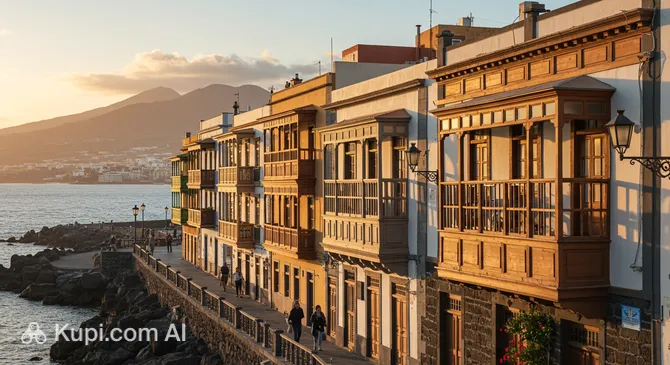
Balconies of Avenida Marítima
Balconies of Avenida Marítima. Иллюстрация. Источник: Kupi.com AI

These structures, known as saltdizos (overhanging balconies), are considered the best-preserved examples of this style in the entire Canary archipelago. They emerged under strong Portuguese influence and long served as a symbol of the high status and wealth of local shipowners and merchants. The bright colors and delicate carvings turn an ordinary walk along the sea into a visit to an open-air museum.

Beyond their beauty, the balconies are highly functional: they are designed to catch the sea breeze, providing natural ventilation for the interior rooms. Today, this architectural complex is included in the Spanish cultural heritage registry (Bienes de Interés Cultural), continuing to delight tourists with its authenticity and harmony with the surrounding landscape.

Contacts

To clarify current information about tourist routes or cultural events in the historic quarter, you can contact the municipal information center. The city's official website also provides useful information for independent travelers planning their leisure time. Additionally, you can obtain information about the opening hours of museums located in the immediate vicinity of the waterfront by calling the specified number.

How to contactContact
AddressAv. Marítima, 44, 38700 Santa Cruz de la Palma, Santa Cruz de Tenerife, Spain
Phone+34 922 42 65 00
Websitewww.santacruzdelapalma.es

What to Do

The main activity here is thoughtful contemplation and photo hunting. It is recommended to walk along Avenida Marítima several times: in the morning, when the light falls directly on the carved details, and in the evening, when the buildings are illuminated by soft lights. Pay attention to the variety of shapes — from simple single structures to complex double balconies with carved lattices reminiscent of Portuguese adufas.

During your walk, try to find ancient elements, such as coats of arms on the facades or historical openings hidden behind wooden panels that once served domestic needs. If your trip coincides with the Virgen de las Nieves festival, which takes place every five years, you will see the balconies in their most magnificent attire — locals decorate them with flowers and carpets, turning the waterfront into a theatrical stage.

Viewing the balconies combines perfectly with a visit to the Castillo de Santa Catalina fortress and a walk to Plaza de España, where you can see magnificent examples of Renaissance architecture. Since the city is quite compact, you can easily combine your cultural program with relaxation in cozy cafes located right across from the famous facades.

Getting There

The attraction is located directly in the historical center at Av. Marítima, 44. If you are arriving on the island by cruise ship, the walk from the port to the famous facades will take no more than 5–10 minutes of leisurely strolling along the coastline. The city is very compact, making it extremely easy to navigate.

From La Palma International Airport (SPC), Bus No. 300 runs regularly to the city center, with a journey time of about 30–40 minutes. You can also take a taxi or a rental car — the drive via the TF-1 highway takes about 20 minutes. For those traveling between islands, the ferry terminal is within walking distance of the waterfront.

If you are already in the central part of the city, for example, near Plaza de España, simply head towards the ocean. A walk through the ancient cobbled streets will lead you straight to the promenade, where the most beautiful historical buildings with carved balconies are concentrated.

Ближайший город: Santa Cruz de la Palma

History & Facts

The history of this unique location dates back to the late 15th century, when Spain was actively developing the Canary archipelago. During the peak of the sugar trade, wealthy settlers built luxurious mansions here, striving to outdo one another in the sophistication of their finishes. Carved wooden balconies became a symbol of the owners' status and prosperity during the era of colonial power.

Interestingly, these architectural flourishes were built despite royal decrees from Charles V and Philip II, which prohibited overhanging structures that obstructed passage through narrow streets. The island's inhabitants displayed a spirit of defiance, continuing to build balconies in the Portuguese style brought over by craftsmen from the mainland. Some buildings, such as the House of Don Jacobo de Monteverde, have been preserved since the 17th century and now hold the status of cultural heritage sites.

Beyond their aesthetic appeal, the balconies also served a practical purpose: they provided natural ventilation in the hot climate thanks to the trade winds. In the past, the floors of some balconies even featured special openings that served as toilets, from which waste was washed directly into the ocean. Today, these details are hidden by decorative panels, but historians value them as evidence of the way of life in past centuries.

Time Needed

To leisurely admire the famous facades and take a series of vibrant photographs, you will need between 30 and 60 minutes. This time is quite sufficient to walk along Avenida Marítima and study the intricate carving details on the most notable houses.

If you decide to combine your walk with a visit to the nearby Plaza de España, ancient churches, and a tour of the City Hall, we recommend allocating 2–3 hours to explore the city center. This will allow you to enjoy the atmosphere without rushing, browse local shops, or have a cup of coffee on one of the terraces overlooking the ocean.

Working Hours

Since the balconies are part of the exterior of private homes and are located on a public promenade, they can be admired 24/7 and completely free of charge. This is an ideal place for early morning walks or evening promenades when the heat subsides and the city lights come on.

However, if you plan to visit municipal institutions or cultural centers located in this area, please note the standard schedule:

  • Monday — Friday: 08:30 – 13:30
  • Saturday and Sunday: Closed
DayWorking hours
Понедельник8:30 – 13:30
Вторник8:30 – 13:30
Среда8:30 – 13:30
Четверг8:30 – 13:30
Пятница8:30 – 13:30
СубботаЗакрыто
ВоскресеньеЗакрыто

Nearby

A walk along the promenade is just the beginning of your journey into the rich heritage of La Palma's capital. The surrounding neighborhoods are filled with historical monuments, charming squares, and authentic architecture that allows for a deeper immersion into the atmosphere of the colonial era.

Exploring the neighboring streets will enrich your experience: here you can find ancient defensive structures and quiet corners that have preserved the spirit of centuries past. Below are the most interesting sites located within walking distance.

NameDistance
Santa Cruz de La Palma Beach0.1 km
Tasca Luis0.3 km
Church of El Salvador0.3 km
Tè con Te Bar & Lounge0.4 km
Naval Museum - Ship of the Virgin0.4 km
Castle of the Virgin0.5 km
Maroparque Exotic Animal Rescue Center1.5 km

Reached the end of the page?

That means the route is fully explored