Support

Castillo de San Cristobal

About

Imagine a place where history is literally hidden beneath the feet of modern city dwellers. Castillo de San Cristóbal was the first significant fortress on the island of Tenerife, built back in 1575. Located in the city of Santa Cruz de Tenerife, this fortification served for centuries as the main shield of the bay and the residence of the high military command until it was demolished in the early 20th century.
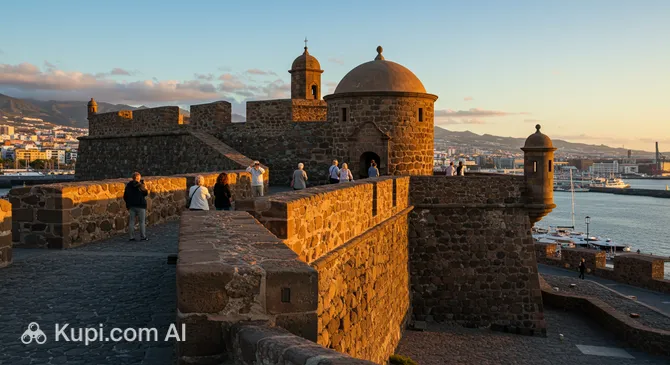
Castillo de San Cristóbal
Castillo de San Cristóbal. Иллюстрация. Источник: Kupi.com AI

Today, this site in Spain is a unique underground museum—an interpretation center located right beneath the city's main square. Here, fragments of the original walls and bastions, which were accidentally discovered by archaeologists in 2006, have been preserved. It is a must-visit for anyone wanting to understand how a small port transformed into a powerful maritime fortress.

The museum's main treasure is the legendary bronze cannon known as "El Tigre" (Cañón Tigre). This 18th-century weapon, weighing two tons, became famous because, according to historical lore, it was the one that seriously wounded Admiral Nelson during his failed attempt to capture the island. A visit to Castillo de San Cristóbal allows you to touch the living history of Tenerife in the very heart of its capital.

Contacts

To clarify details before your visit, you can use the official contact information for the museum.

How to contactContact
Addresss/n Plaza de España, 38003 Santa Cruz de Tenerife, Испания
Phone+34 922 28 56 05

What to Do

A visit to this site begins with a descent underground—into a special gallery beneath Plaza de España. Here, you can get an up-close look at the ancient fortress walls dating back to the 16th century. Interactive exhibits and models in the interpretation center clearly tell the story of how the city's defense system evolved over the centuries and the role the castle played in the life of Tenerife.

Be sure to visit the separate hall where the famous "El Tigre" cannon is displayed. This impressive three-meter-long bronze weapon is more than just a museum piece; it is a true symbol of victory for the local residents. Learning about its design and the legendary battle against the British fleet will be interesting for both adults and children.

After exploring the underground portion, we recommend a walk across the surface of the square itself. Look at the bottom of the artificial lake: there, you will see a dark outline that exactly follows the footprint of the old castle's foundations. You can finish your route with a stroll along the nearby Calle del Castillo, which was named in honor of this once-mighty citadel.

Getting There

Finding Castillo de San Cristóbal is easy, as the fortress is located in the very heart of the city, beneath Plaza de España. If you are in the center or have arrived at the port, the entrance to the interpretation center is just a few minutes' walk away. Use the signs in the square and the characteristic outline of the castle on the bottom of the artificial lake as landmarks.

The city's public transport is excellent: many TITSA buses stop at Plaza de España, including routes 01, 10, 15, 910, and 920. From Tenerife North Airport (TFN), the most convenient way is to take bus #343 (the trip takes about 30–40 minutes), and from Tenerife South Airport (TFS), the trip on buses #415 or #450 will take between 1 and 1.5 hours.

For those who prefer to drive, there are paid parking zones and underground garages around the square. If you're planning a walk, the route from the famous Auditorio de Tenerife takes about 15 minutes, and from the colorful Nuestra Señora de África market, it’s no more than 10 minutes. You can also always take a taxi from anywhere in the city.

Ближайший город: Santa Cruz de Tenerife

History & Facts

The history of the San Cristóbal Castle began in December 1575. At the initiative of Governor Juan Álvarez de Fonseca, a square fortress with four bastions was founded on the Blas Díaz reef. By early 1577, it had become the main defensive hub of the bay, the residence of the Captains General, and the administrative center of the island's military command for three centuries.

The fortress proved its significance numerous times, repelling attacks from famous admirals. The castle played a role in defenses against Robert Blake in 1657 and John Jennings in 1706. However, its most famous event occurred on July 25, 1797, during a battle with Horatio Nelson's squadron. It was here that the legendary "El Tigre" cannon, according to tradition, wounded the British admiral, leading to the loss of his right arm.

In the early 20th century, specifically in 1928, the castle was almost entirely demolished to expand urban areas and create the modern Plaza de España. It seemed the fortress had passed into history forever until 2006, when, during the renovation of the square, workers stumbled upon massive foundation fragments and walls. This archaeological discovery led to the creation of a unique underground museum on the site of the ancient fortifications.

Today, the memory of its former power is preserved in more than just stone: in 1803, for the heroism shown in defending against invaders, Santa Cruz de Tenerife received the honorary title "Loyal and Brave," and the castle has remained in the annals as a symbol of the resilience of Tenerife's residents.

Time Needed

To take your time exploring the archaeological remains, studying the information panels in the interpretation center, and taking photos with the famous cannon, most tourists need between 45 and 90 minutes. This is plenty of time to immerse yourself in the atmosphere of medieval fortifications.

If you plan to combine your visit with a walk around Plaza de España itself and a look at nearby monuments, it’s worth setting aside about two hours. The exhibit is compact and very informative, making a visit to the castle an excellent addition to a general introduction to the city's historical center.

Working Hours

The museum and interpretation center welcome visitors from Monday to Saturday, from 10:00 AM to 6:00 PM. Please note that Sunday is usually a day off, and access to the underground ruins is closed.

The schedule may change on public and local holidays, so we recommend checking the official website of the Museos de Tenerife association before your visit for the most up-to-date information.

DayWorking hours
понедельник10:00–18:00
вторник10:00–18:00
среда10:00–18:00
четверг10:00–18:00
пятница10:00–18:00
суббота10:00–18:00
воскресеньеЗакрыто

Nearby

Exploring the city center can easily be turned into a packed itinerary, as many other iconic sites are concentrated near the fortress. A walk around the neighborhood will allow you to deeper experience the architectural and cultural diversity of the island's capital.

NameDistance
La Capital Tenerife0.2 km
Palmelita - Castillo0.3 km
Museum of Nature and Archaeology0.4 km
Museum of Illusions Tenerife0.5 km
The Dubliner0.5 km
Bodegón El Puntero0.7 km
Casa del Carnaval0.9 km

Reached the end of the page?

That means the route is fully explored