Support

Vigo Airport

About the Airport

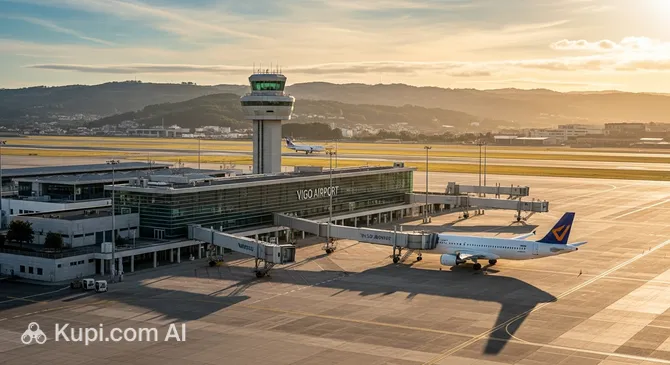
Vigo Airport. Source: Kupi.com Binoculars

Vigo Airport (VGO), also known as Peinador, is the air gateway to the picturesque region of Galicia in northwestern Spain. Located just a few kilometres from the centre of Vigo, it serves as an important transport hub for both tourists seeking to explore the Rias Baixas coast and business travellers. The airport plays a key role in connecting with one of Europe's largest fishing ports and the industrial heart of the region. Thanks to recent modernization of the terminal and infrastructure, it offers passengers a contemporary level of comfort and service.

IATA Code VGO
ICAO Code LEVX
City Vigo
Distance to centre 9 km
Status International
Passengers per year ~1.1 million (2023)
Popular Airlines Iberia, Air Europa, Vueling.
Schedule online arrivals/departures "Vigo Airport"

Features and Advantages

Vigo Airport is distinguished by its compactness and convenient navigation, making the completion of all formalities quick and comfortable. Following recent reconstruction, the terminal has become more spacious and functional, offering passengers all necessary services: from cafes and shops to car rental counters. Excellent transport connectivity is one of the main advantages — the city centre can be easily reached via the Vitrasa route A bus. Additionally, proximity to key highways AP-9 and A-52 ensures fast access to other cities in Galicia and northern Portugal, making the airport a convenient starting point for travels throughout the region.

Contact Information

For your convenience, we have compiled the main contact information for Vigo Airport. We recommend always checking the latest data on the official airport website before your trip.

  • Official Website: You will always find the most accurate and up-to-date information on flights, services, and airport regulations on the official website of Aena (the Spanish airport operator): www.aena.es/en/vigo.html
  • Information Desk Phone: For flight information, services, and assistance for passengers with reduced mobility, you can call the unified Aena number: (+34) 913 211 000.
  • Airport Address: Av. do Aeroporto, s/n, 36815, Vigo, Pontevedra, Spain.
  • Email: A direct email address for general inquiries is not published. It is recommended to use the contact forms on the official website for communication.
  • Social Media: You can follow news on the official Aena pages on social networks such as X (Twitter), Facebook, and Instagram.
  • Lost Luggage Information: If you have lost items on the plane or your checked baggage has not arrived, please contact your airline's representative office first. For items lost within the terminal (at security checkpoints, waiting lounges), please contact the airport's lost and found service.
  • Passenger Support Contacts: To request assistance for passengers with reduced mobility (PRM), a request must be made at least 48 hours before departure via the Aena website or by phone at (+34) 913 211 000.

How to Get to the Airport

Reaching Vigo Airport (VGO), located approximately 9 km from the city centre, is possible through several convenient methods. The choice depends on your budget, time, and amount of luggage. The most economical option is the city bus Vitrasa line C9A, which runs between the city centre (from Plaza de América) and the airport. The journey takes about 30 minutes, and the ticket cost is approximately €1.50, making it an excellent choice for budget-conscious travellers.

For those who value comfort and speed, a taxi or pre-booked transfer is the ideal solution. A taxi ride from the centre of Vigo to the airport will take about 15-20 minutes, with an average cost of €20-25. This is particularly convenient if you are travelling with family, a large group, or have significant luggage. Pre-booking a transfer helps secure a fixed price and avoids waiting for a car.

If you plan to actively explore the scenic Galicia region in Spain, consider renting a car. Offices of major international and local rental companies are present at Vigo Airport. It is recommended to book a vehicle in advance, especially during the high season, to secure the best rates and vehicle selection. For those arriving at the airport in their own vehicle, there is an official car park with options for both short-term and long-term parking.

Additionally, it is worth noting that there are other airports in the region. If you cannot find a suitable flight to Vigo, consider flying into Santiago de Compostela Airport (SCQ), located approximately 76 km away, or even the international Porto Airport (OPO) in neighbouring Portugal (about 110 km). From these cities, Vigo can be easily reached by bus or train, opening up more possibilities for planning your itinerary.

Terminals and Map

Vigo Airport (VGO), also known as Peinador Airport, is a compact and modern aviation hub. Its main feature is the presence of only one passenger terminal, which makes navigation exceptionally simple and convenient for travellers. This single terminal handles both domestic and international flights.

The terminal structure is intuitive. It is divided into two main levels: Ground Floor (Planta 0) and First Floor (Planta 1). Navigation poses no difficulties: clear signs in Spanish and English are installed throughout to help you orient yourself easily. Thanks to the airport's small size, there is no risk of getting lost.

The Arrivals Zone is located on the ground floor. Immediately after disembarking, passengers enter the baggage claim hall, and then the general hall, where car rental desks, an information point, and exits to taxis and buses are found. The Departures Zone is on the first floor. Here you will find airline check-in counters and the main security checkpoint, after which you enter the airside area with boarding gates.

Completing all pre-flight formalities at Vigo Airport typically takes significantly less time than in major international hubs. Check-in and security screening proceed quite quickly. Nevertheless, it is recommended to arrive at the airport as per standard practice: 1.5–2 hours before a domestic or Schengen flight and 2–2.5 hours before an international one, to avoid any rush.

Since the airport has only one terminal, transfers between different zones are not required — everything is within one building. The main advice for navigation is simply to follow the signs. If you are arriving for departure, go straight up to the first floor. If you have landed, stay on the ground floor to collect luggage and exit to the city. The compactness of Vigo Airport is its main advantage, ensuring a calm and comfortable start or end to your journey.

Airport History

The history of Vigo Airport (VGO), also known as Peinador Airport (Aeropuerto de Peinador), is a story of persistence and gradual development. The idea of building an air gateway in this region of Spain arose back in 1927, but due to the complex terrain and political events, the project's realization was delayed for decades. Finally, on April 20, 1954, the airport was officially opened, and on the same day, the first commercial Iberia flight took place on the Madrid-Vigo route.

A real breakthrough in the airport's development occurred in the 1970s, associated with the arrival of the jet age. In 1973, a new passenger terminal was built, and the runway was significantly lengthened to accommodate larger aircraft. Night flights began in 1974, and in 1975 an Instrument Landing System (ILS) was installed, allowing flights to be received in difficult weather conditions. It was during this period that the airport began serving its first international charter flights.

Subsequent decades were marked by constant modernization. In the 1990s, the terminal was expanded again to cope with growing passenger traffic, and in 1995 a new control tower was put into operation. In the 2000s, a large-scale reconstruction was carried out: a new large car park was built (2004), and in 2014, another expansion and renovation of the passenger terminal was completed, making it more modern and comfortable for travellers.

Interesting fact: the airport received the name "Peinador" from one of the districts in which it is located. Today, Vigo Airport is an important transport hub for Galicia, having come a long way from a modest airstrip to a modern air gateway connecting the region with major cities in Spain and Europe.

Services and Amenities

Vigo Airport (VGO) offers passengers all necessary amenities and services to make waiting for a flight as comfortable as possible. Regardless of the purpose of your trip to Spain, you will find modern and well-thought-out infrastructure here.

For those wishing to have a snack or do some shopping, the airport has several cafes and restaurants where you can enjoy coffee or a full meal. There is also a Duty Free shop with a wide assortment of perfumes, cosmetics, and souvenirs, as well as other retail outlets selling press and travel essentials.

Passengers can use free Wi-Fi throughout the terminal, as well as find points for charging electronic devices. For a more comfortable wait, a VIP lounge (Sala VIP Lino) is available, where guests can relax in silence and enjoy snacks and beverages. ATMs and currency exchange points are located in the terminal to handle financial matters.

The airport caters to all categories of travellers. For passengers with children, play areas and mother-and-child rooms are equipped. Passengers with limited mobility are provided with free assistance under the "Sin Barreras" service (must be requested in advance, at least 48 hours before departure). There is also a first aid station at the airport.

For business travellers, conference rooms and a business centre are available for meetings and work. Although there are no hotels directly within the terminal building, several hotels are located in the immediate vicinity of the airport, offering convenient accommodation for those with early departures or long layovers.

Where to Eat

At Vigo Airport (VGO), travellers will find several excellent establishments to have a snack or a full lunch before departure. Dining options are available in both the public area and the passenger-only area after security control, allowing you to spend time comfortably while waiting for your flight.

In the public zone (before security control), on floor P0, the Lavazza coffee shop is located. This is an ideal place for those seeing off or meeting passengers, as well as for travellers wishing to have a cup of aromatic coffee with fresh pastries or a sandwich before going through screening. Here you can quickly and conveniently refresh yourself in a calm atmosphere.

The main establishments are located in the departures zone (after security control). Here, passengers have a choice between two main spots:

  • Dehesa Santamaría: This is a cafe-bar specializing in traditional Spanish snacks. Here you can taste famous local specialties, various tapas, cheeses, and classic bocadillos (baguette sandwiches). An excellent option to enjoy the flavours of Spain before departure.
  • Air Food Court: This is a self-service food court zone offering a wider selection of dishes. Here you can find salads, pizza, pasta, and hot meals, which is convenient for a full lunch or dinner. This option suits travellers with varied taste preferences.

Regarding special dietary needs, vegetarian options such as salads or vegetable sandwiches can be found on the menus. It is best to check directly with staff for the availability of gluten-free or specific dietary dishes. Prices at the airport correspond to the average European level for air hubs and may be slightly higher than in the city. Most establishments operate according to the flight schedule, opening with the first flights and closing after the last ones, so you will always be able to find a place to eat.

Tips for Travellers

To ensure your journey through the airport of Vigo goes as smoothly as possible, take advantage of these useful tips. Vigo Airport (VGO) is small and quite convenient, but preparation is never superfluous.

Arrival time at the airport. Despite the airport's compact size, arrive in advance. For domestic flights within Spain and flights to Schengen zone countries, it is recommended to arrive 1.5-2 hours before departure. If you have an international flight outside the Schengen area, it is better to allow 2.5-3 hours, especially during the peak tourist season.

Check-in and security control. To save time, complete online check-in for your flight in advance and save the boarding pass on your phone. If you are travelling only with hand luggage, this will allow you to head straight to security. The security checkpoint here is standard: be prepared to remove laptops and other large gadgets from bags, as well as present your bag of liquids.

Seat selection on the plane. If the airline allows you to select a seat, consider your preferences. Window seats (A, F) will offer beautiful views of the Galician coast during takeoff and landing. Aisle seats (C, D) are convenient if you want to stand up freely during the flight. Emergency exit seats offer more legroom but usually require an extra fee.

Hand luggage rules. Remember the standard European restriction on carrying liquids: all containers must be no more than 100 ml and packed in a single transparent zip-lock bag with a capacity of up to 1 litre. It is prohibited to carry sharp objects, weapons, explosives, and flammable substances in hand luggage.

Passengers with transfers. Vigo Airport is rarely used as a major transit hub, but if you have a connecting flight, check with the airline whether you need to collect your luggage and check in for the next flight segment again. Usually, when transferring within the Schengen zone, re-screening is not required if you do not leave the transit area.

Customs control. When arriving from non-EU countries, you will need to pass customs control. If you have no goods to declare, proceed through the "Green Channel". If you are carrying items that require duty payment (for example, goods exceeding the established limit), head to the "Red Channel".

Saving time and money. Book a transfer in advance or study the bus schedule to the city — this will be cheaper than taking a taxi on the spot. Bring an empty water bottle to fill at a drinking fountain after passing security control — this will save money on beverages.

What to do in case of flight delay? In the event of a delay or cancellation, first monitor the information on departure boards and announcements. Contact your airline's representative at the airport. Remember that under EU rules (Regulation 261/2004), for long delays, passengers are entitled to meals, drinks, and in some cases — hotel accommodation and compensation.

Reached the end of the page?

That means the route is fully explored