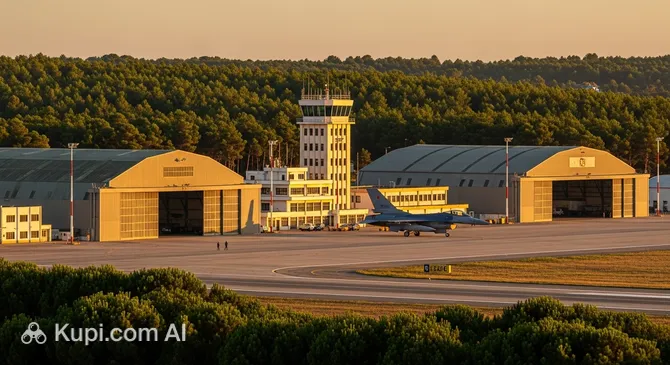
Source: Kupi.com AI
| Characteristic | Value |
|---|---|
| IATA code | QLR |
| ICAO code | LPMR |
| City | Leiria |
| Country | Portugal |
| Time zone | Europe/Lisbon |
| Schedule | Live departures board |
| Characteristic | Value |
|---|---|
| IATA code | QLR |
| ICAO code | LPMR |
| City | Leiria |
| Country | Portugal |
| Time zone | Europe/Lisbon |
| Schedule | Live departures board |
Since Leiria Airport (Monte Real Airbase, QLR) currently functions as a military facility (Base Aérea Nº 5) and does not serve regular commercial flights, standard tourist services are not available here. However, for official inquiries or clarification regarding potential civil use, contacts for the Portuguese Air Force and the base itself are available.
Since Leiria Airport (Monte Real) currently functions as a military base and does not accept regular commercial flights, the classic transport infrastructure typical of civil terminals (express trains, car rental desks within the terminal) is absent here. Nevertheless, getting to the Monte Real location from the city of Leiria or from the nearest international air hubs is not difficult.
For most tourists, the actual "gateways" to this region are Portugal's major airports. The nearest and most convenient option is Lisbon Portela Airport, located approximately 118 km to the south. Also popular is Porto Airport, located 158 km to the north. If you are travelling from Spain, you can consider Badajoz Airport or Vigo Airport, although they are significantly further away.
If your goal is to get directly to the village of Monte Real (where the airbase is located) from the centre of Leiria city, use the following methods:
Public Transport
There is no direct metro or airport express to the base. The main mode of transport is regional buses.
Taxi and Transfer
This is the fastest and most comfortable way to get to the location. A trip from the centre of Leiria to the airbase gates or hotels in Monte Real will take approximately 15–20 minutes (about 17 km). The estimated cost of a taxi ride or via apps (Uber, Bolt) varies from 15 to 25 Euros one way. It is recommended to check in advance if the driver can drive close to the entrance you need, as this is a restricted facility.
Car Rental
Car rental points are absent directly on the base but are widely available in the city of Leiria. You can rent a car in the city centre. To get to Monte Real, you need to take the A17 motorway and follow the signs for Monte Real. The road is of excellent quality and is usually not congested.
Parking
Attention! Parking for civilians on the territory of the airbase itself is strictly limited or prohibited without a special pass. If you plan to visit the area, the car will have to be left in public parking lots in the village of Monte Real, which is famous for its thermal springs.
Recommendations for Travellers
If you are planning a holiday in this region, it is wisest to fly into Lisbon or Porto, rent a car there, or take an intercity bus (Rede Expressos) to Leiria, and make local trips from there. For those arriving from the south of the country, a distant alternative could be Faro Airport, but the journey from there will take more than 3 hours.
It is important to understand that currently, Leiria Airport (QLR) does not have the standard structure of a civil terminal that tourists are accustomed to. Since the facility functions as an active Portuguese Air Force base (Base Aérea de Monte Real), there are no familiar passenger terminals, Duty Free zones, or business class lounges here. The infrastructure is entirely subordinate to military and logistical tasks.
Number of Terminals and Their Purpose
There is no division into Terminal 1 or Terminal 2 on the base territory. The entire complex represents a single operational zone, including:
Airport Map and Navigation
Unlike civil airports where maps are displayed at every corner, the plan of the Monte Real airbase is not intended for public distribution. The territory is a restricted facility.
Departure and Arrival Zones
Classic Check-in zones, baggage drop-off, and passport control in their tourist understanding are absent here.
Procedure Times
Since there are no regular flights, the concept of "arriving 2 hours before departure" is irrelevant here. However, if you are visiting the base as part of an official visit or air show, consider the following:
Navigation Recommendations
The main advice for a tourist in the Leiria Airport area is to watch the signs carefully. The territory around the base is well marked. Do not attempt to penetrate beyond the fences or photograph objects in the immediate vicinity of the checkpoint, as this may attract the attention of the security service. If a civil terminal is opened in the future, it will most likely be designed on the principle of a "compact airport," where the path from the entrance to the aircraft stairs takes no more than 15 minutes, which will be a huge advantage over congested Lisbon.
The history of the Monte Real airbase, which is today viewed as the prospective Leiria Airport (QLR), is inextricably linked with the development of Portuguese aviation in the second half of the 20th century. This facility was never an ordinary airfield; from the moment of its foundation, it was designed as a strategic outpost, becoming home to the country's most modern aircraft.
The official birth date of the base is considered to be October 4, 1959, when the grand opening of Airbase No. 5 (BA5) took place. However, construction began back in 1957. The location was not chosen by chance: flat terrain, proximity to the ocean, and a central position between Lisbon and Porto made this location ideal for protecting the airspace of the entire Iberian Peninsula.
The Era of Jet Aviation and Modernisation
From the very beginning, the airport's history was a history of speed. In the year of its opening, a squadron of the famous F-86F Sabre fighters was stationed here. This marked the beginning of the "jet era" for the region. In subsequent decades, the base was constantly reconstructed to accept increasingly complex equipment. In the 1980s, A-7P Corsair II attack aircraft arrived here, which required a significant expansion of hangars and renovation of the runway.
A key stage of modernisation occurred in 1994, when Monte Real became home to the multi-role F-16 Fighting Falcon fighters. To service these machines, a large-scale technological reconstruction was carried out, turning the airfield into one of the most high-tech facilities in Southern Europe. The infrastructure created then is maintained in perfect condition today, which is the main argument of proponents for opening a civil terminal here.
"Airport of the Popes" and Historical Visits
Although the airport is military, it has played a unique role in the history of Catholic pilgrimage. Due to its proximity to the sanctuary of Fatima (less than 50 km), this runway has repeatedly become the arrival point for Pontiffs.
These events proved the airfield's ability to accept large passenger liners (including Airbus A320 and A321 of TAP airline carrying delegations) and organise the reception of high-ranking guests at the highest level.
Interesting Facts and Achievements
Since Leiria Airport (Monte Real) does not currently function as a commercial passenger hub but is an active military airbase, travellers should be prepared for the absence of the usual level of service. Unlike international hubs, you will not find boutique galleries or food courts here. The entire infrastructure of the facility is subject to strict functional tasks of the Air Force. However, given the base's proximity to the populated area, many services are available in its immediate vicinity.
Restaurants, Cafés, and Shops
On the territory of the base itself (beyond the security perimeter), there are no public cafés, restaurants, or Duty Free shops. Meals are provided only for military personnel in specialised canteens.
Lounges and VIP Services
Classic Business Lounges or Priority Pass zones are absent at QLR. Existing infrastructure includes only briefing rooms for pilots and special premises for receiving high-level official delegations (e.g., Heads of State or the Pope). These zones are closed to the general public and open exclusively by special protocol.
Connectivity and Finance
Medical Services and Accessibility
The airbase has its own medical point and highly qualified personnel ready for emergencies. However, these resources are intended for flight support and assisting personnel.
Hotels and Accommodation
There are no hotels for civilians on the base itself. Nevertheless, the location of Monte Real is historically a famous thermal resort, which solves the accommodation problem for those visiting the region.
Conference Halls
Business centres for rent by civilians are not provided on the base. All available halls are used exclusively for military planning and internal meetings. For holding business meetings, it is recommended to use the conference halls of hotels in Monte Real or business centres in Leiria.
Since Leiria Airport (Monte Real) functions as an active military airbase without regular civil connections, passengers should take into account an important feature: there are no terminals here with the usual cafés, restaurants, food courts, or vending machines. Concepts of "airside" or "landside" with food outlets are not applicable here.
However, thanks to the base's location in the immediate vicinity of the resort village of Monte Real (just 2–3 km away), travellers and guests of the region can enjoy magnificent Portuguese cuisine literally on the airfield's doorstep. Here is a detailed guide to dining in the surroundings.
Where to Eat: Nearest Alternatives
All gastronomic life is concentrated in the centre of the village of Monte Real. There are no fast-food chains here, but there are cosy family establishments.
Local Cuisine: What to Try
The Leiria region is famous for its gastronomic traditions. If you find yourself near the airbase, be sure to pay attention to the following specialities:
Dietary Preferences
In small towns in Portugal, the menu is often focused on meat and fish, but options can always be found:
Prices and Opening Hours
Dining in the Monte Real area is significantly cheaper than in touristy Lisbon or the Algarve.
Since Leiria Airport (Monte Real) currently functions as a military airbase and does not accept regular commercial flights, standard rules for passengers have their own specifics here. Most recommendations concern cases when access to the base is open to civilians (for example, during air shows, open days, or official visits), as well as logistics planning for travellers heading to this region through other air hubs.
Arrival Time at the Airport
Unlike civil airports where the "2 hours before departure" rule applies, the visitation regime for the Monte Real base is strictly regulated. If you are visiting an event (e.g., the Dia de Base Aberta festival):
Registration and Security
Security procedures here are at the level of a military facility, which is significantly stricter than civil standards.
Seat Selection and Comfort on Board
Since there are no regular flights, seat selection on the plane is not available. However, if you are flying to Lisbon or Porto with the intention of visiting the Leiria region:
Hand Luggage and Prohibited Items
The list of prohibited items on the base territory is broader than in civil aviation. In addition to standard restrictions (weapons, explosives), special rules apply here:
Recommendations for Transit Passengers
Leiria is not a transit hub. If you are planning a complex route through Portugal:
Customs Control
Since the base is not a state border crossing point for tourists, customs control is not conducted here. All procedures are passed at the airport of first entry into the Schengen area (usually Lisbon). If you are carrying specific equipment for participation in aviation events, customs clearance must be agreed upon in advance through the embassy or organisers.
Saving Time and Money
Actions in Case of Flight Delay
This point applies to arrival airports (Lisbon/Porto). If your flight to Portugal is delayed:

Reached the bottom of the page?
Looks like you know this route inside out
We use cookies and services to collect user information. This is essential for the functioning of the site and for marketing purposes. You can find out more in .
Where travelers fly most — pick a route and check prices