Support

Faro Airport

About the Airport

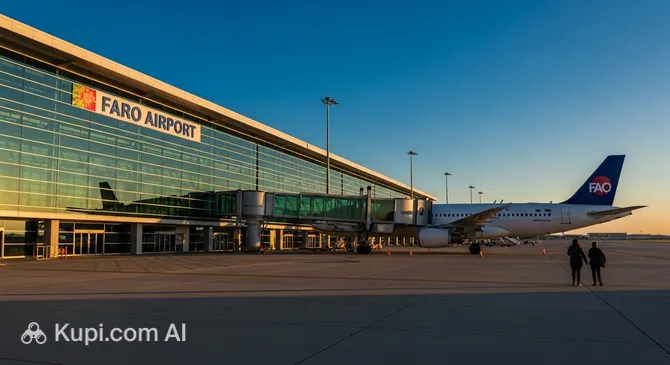
Faro Airport. Source: Kupi.com Binoculars

Faro Airport is not merely a transport hub, but a true gateway to the sun in one of Europe's most picturesque regions, the Algarve. Landing here often feels like a sightseeing tour in itself: aircraft descend over the labyrinthine lagoons of the Ria Formosa Natural Park, offering passengers stunning views of the ocean and sandspits before the wheels even touch the runway. This compact yet lively aviation hub is perfectly tuned to the rhythm of a holiday, allowing travellers to switch from an aeroplane seat to a poolside lounger as quickly as possible.

IATA Code FAO
ICAO Code LPFR
City Faro
Distance to centre 7 km
Status International
Passengers per year Approx. 9.8 million (2024)

The main feature of Faro's air harbour is its incredible proximity to the city and key resorts. The journey to the historic centre takes just 10–15 minutes, which is a rarity for major international airports. The terminal is designed with the seasonal influx of tourists in mind: it features spacious halls and intuitive navigation so that guests do not lose precious holiday time.

Among other advantages, the developed car rental infrastructure is worth noting. Since public transport in the Algarve does not always reach remote beaches, the airport boasts a huge car rental centre located within walking distance of the terminal exit. Furthermore, the "airside" zone features open terraces and cafés with views of the airfield, where you can comfortably await your flight while enjoying the final rays of the Portuguese sun.

Contact Information

Below you will find contact information for Faro Airport (FAO) to help you plan your trip and resolve any questions that may arise.

  • Official Website: The most complete and up-to-date information can always be found on the airport's official website: www.aeroportofaro.pt. The site is available in several languages, including English.
  • Help Desk Phone: For information by phone, you can call: (+351) 289 800 800.
  • Airport Address: Aeroporto de Faro, 8006-901 Faro, Portugal.
  • Email and Contact Form: For written enquiries, it is recommended to use the contact form on the official airport website. This is the most reliable way to receive a response from the appropriate department.
  • Social Media: The airport has an active presence on social media. You can find its official pages on Facebook, Instagram, and LinkedIn by searching for "Aeroporto de Faro" or "ANA Aeroportos de Portugal".
  • Lost Luggage Information: It is important to distinguish between luggage lost by the airline and items left in the terminal.
    • If your checked baggage has not arrived, you should immediately contact your airline's Lost & Found service in the arrivals area.
    • If you have lost personal items within the airport premises (including security checkpoints and boarding gates), contact the "Lost and Found" section managed by Groundforce. Contact details and opening hours are listed on the airport website.
  • Passenger Support Contacts: Information desks are located within the terminal building. You can also use the main airport telephone number for general enquiries.

How to Get to the Airport

Getting to the airport in the city of Faro (FAO), which serves the entire Algarve region, is quite simple thanks to its proximity to the city and a well-developed transport network. Regardless of your budget and plans, you will easily find a suitable way to travel to the terminal or from it to the city centre and popular resorts.

Public Transport: The most economical method is the city bus. Routes #14 and #16 operated by Próximo run regularly between the airport and the central bus station in Faro (Terminal Rodoviário). The journey takes about 20-25 minutes, and the ticket fare, purchased from the driver, is just a few Euros. Buses run from early morning until late evening, but it is worth checking the schedule in advance, especially if you have a night flight.

Taxi and Transfers: For greater comfort, especially if you are travelling with bulky luggage or family, you can take a taxi. The rank is located right outside the arrivals exit. A trip to the centre of Faro will take about 15 minutes and cost approximately 10-15 Euros. Ride-hailing services such as Uber and Bolt also operate in the region and may offer more competitive rates. Additionally, many hotels and private companies offer pre-booked transfer services not only to Faro but also to other resorts in the Algarve.

Car Rental and Parking: If you plan to actively explore the coast of Portugal, renting a car is an ideal option. Offices of all major international and local rental companies are present at the airport. It is recommended to book a car online in advance to secure the best price. For those arriving at the airport in their own or a rented vehicle, several parking zones are provided: from short-term car parks right next to the terminal to more budget-friendly options for long-term parking located slightly further away.

For travellers whose itineraries cover neighbouring regions, it is also worth considering alternative air hubs. For example, Seville Airport (SVQ) is located about two hours away by road, while the main international Lisbon Portela Airport (LIS) is 2.5-3 hours away by car, offering a larger number of flights.

Terminals and Map

Faro Airport (FAO) is distinguished by a structure that is simple and easy for passengers to understand. There is one passenger terminal in operation, which serves all domestic and international flights. This significantly simplifies navigation and eliminates the need to move between different buildings, making your arrival or departure as comfortable as possible.

The terminal is a two-storey building where arrival and departure zones are logically separated by levels:

  • Ground Floor (Piso 0) — This is the arrivals area. You enter here after disembarking from the aircraft. Located here are the baggage reclaim belts, customs control counters, car rental offices, tourist information points, and exits to taxis and buses.
  • First Floor (Piso 1) — The departures area. Escalators and lifts lead to this floor from the public area. Here you will find check-in counters, baggage drop-off points, and following them, the security screening area. After passing control, you enter a spacious airside zone with Duty Free shops, restaurants, and boarding gates.

The airport layout is intuitive, with signs in Portuguese and English installed throughout. Since there is only one terminal, transitions between zones take place within a single building. The path from the check-in counter to the boarding gate rarely takes much time, but seasonal congestion should still be taken into account.

On average, you should allow about 45-60 minutes to pass through check-in and security. However, during the peak season (from June to September), the airport can be heavily congested, so it is recommended to arrive early: 2 hours before flights within the Schengen zone and 3 hours before international flights outside it. This will allow you to complete all formalities without rushing and enjoy a cup of coffee before your flight, beginning your acquaintance with hospitable Portugal.

History of the Airport

The history of Faro Airport (FAO) is inextricably linked to the transformation of the Algarve region into one of Europe's major tourism centres. The decision to construct it was made to support the growing flow of travellers, and on 11 July 1965, the airport was officially opened. From the very beginning, it became a key element of infrastructure that contributed to the economic development of southern Portugal.

The original terminal, built in the opening year, quickly ceased to cope with the increasing passenger traffic. This led to the first major phase of expansion: in 1989, a new, more spacious passenger terminal was built. As the popularity of the Algarve continued to grow, especially with the entry of budget airlines into the market, the airport required further modernisation.

The most significant reconstruction in the history of Faro Airport took place between 2015 and 2017. This ambitious project aimed to increase capacity from 6 to 8 million passengers per year and increase service speed to 3,000 passengers per hour. During the works, the terminal area was expanded and modernised, the number of boarding gates and check-in counters was increased, and security zones and commercial areas were optimised.

An interesting fact: the airport's operation has a distinct seasonal character. In the summer months, from March to October, it handles the lion's share of its annual traffic, becoming one of the busiest airports in the country. Today, Faro Airport continues to play a vital role, serving as the main gateway for millions of tourists heading to the sunny beaches and resorts of southern Portugal.

Services and Amenities

At Faro Airport (FAO), a full range of services is available to travellers for a comfortable wait for their flight. In the terminal, you will find numerous shops, including Duty Free featuring perfumes, cosmetics, and confectionery, as well as boutiques with clothing, accessories, and traditional Portuguese souvenirs. The dining area offers a wide selection: from chain fast-food restaurants and pizzerias to cosy cafés where you can enjoy a cup of coffee and fresh pastries before flying to Portugal.

For those who value enhanced comfort, the airport operates a CIP Lounge — a paid lounge available to passengers of all airlines. Here you can relax in silence, use the complimentary Wi-Fi, have a snack, and drink refreshing beverages. Free Wi-Fi is available throughout the terminal, and numerous power outlets and USB ports are provided for charging electronic devices.

Financial matters can be easily resolved within the airport building: ATMs and several currency exchange points are at passengers' disposal. To ensure safety and health, a medical centre operates on the premises, ready to provide first aid. Pharmacies are also available where necessary medicines can be purchased.

Faro Airport is well-equipped for travellers with children. There are mother-and-child rooms for infant care and changing, as well as small play areas so that young passengers do not get bored. For passengers with reduced mobility, the MyWay assistance service is provided, which is recommended to be booked in advance through the airline to ensure help at all stages — from check-in to boarding.

Although there are no specialised business centres or conference rooms at the airport, business travellers can take advantage of the quiet environment and services of the VIP lounge for work. Regarding accommodation, there are no hotels directly within the terminal, but a large selection of hotels in various price categories is located in the immediate vicinity, which can be quickly reached by taxi or shuttle.

Where to Eat

At Faro Airport (FAO), travellers will find diverse options for a snack or a full meal, suiting different tastes and budgets. The majority of cafés and restaurants are concentrated in the single terminal, making navigation simple and convenient both before and after passing security control.

In the public zone (landside), before passing control, the choice of establishments is somewhat limited but quite sufficient for those seeing people off or arriving at the airport well in advance. Coffee shops and small refreshment points operate here, where you can order beverages and light snacks. This is an excellent place to have coffee before checking in for your flight.

The main gastronomic variety awaits passengers in the departure zone (airside), after passing screening. Represented here are both world-famous fast-food chains for those who want a quick bite, and restaurants with à la carte service. For a full lunch, you can choose an establishment offering European and international cuisine in a more relaxed atmosphere.

While in Portugal, do not miss the chance to try local specialities. In some airport cafés, you can find the famous pastel de nata custard tarts, which make a wonderful gastronomic souvenir or a final touch to your trip. Also pay attention to restaurant menus — they may feature dishes made from fresh seafood, for which the Algarve region is famous.

Most establishments try to cater to the needs of different passengers. Vegetarian dishes, salads, and fresh juices can often be found on the menu. It is best to clarify information regarding gluten-free, vegan, or halal options directly with the staff. Prices are generally higher than in the city, which is standard practice for airports. The opening hours of most cafés and restaurants in the departure zone are tied to the flight schedule; many open early in the morning and operate until the departure of the last aircraft.

Thus, for a quick snack, coffee shops or outlets in the food court in the departure zone are ideal. If you have time and wish to have a full lunch or dinner, choose one of the à la carte restaurants where you can relax while waiting to board your flight.

Tips for Travellers

To ensure your journey through Faro Airport goes as smoothly as possible, take advantage of our tips. The airport is particularly busy during the summer months, so proper preparation will help save time and reduce stress.

Arrival Time and Check-in. We recommend arriving at the airport at least 2 hours before flights within the Schengen zone and 3 hours before international flights, especially during the peak season (from June to September). To avoid queues, check in online and, if travelling with hand luggage only, head straight to security. Bag drop points usually operate faster than standard check-in counters.

Security and Hand Luggage. Passing through security control in Faro is standard for EU airports. All liquids (shampoos, creams) must be in containers of up to 100 ml and packed in a single transparent bag with a volume of no more than 1 litre. Take laptops and other large electronics out of your hand luggage in advance. Remember that local delicacies like bottles of olive oil or sauces exceeding 100 ml must be checked in.

Seat Selection and Savings. When choosing a seat on the plane, if you want to enjoy views of the picturesque Algarve coast, choose a window seat. The direction depends on the route, but often the best panoramas open up from the southern side. To save money, bring an empty water bottle with you and fill it at the drinking fountains after the security zone. Prices for food and beverages at the airport are typically high.

Transfer Passengers and Customs. Faro Airport mainly serves direct flights and is not a major transfer hub. If you do have a transfer planned, follow the "Transit" or "Connections" signs. Upon arrival from a non-EU country, you will have to pass customs control. Follow the green channel if you have nothing to declare, or the red one if you are carrying goods subject to declaration.

In Case of Flight Delay. If your flight is delayed, first contact your airline's counter for information. According to EU regulations, for lengthy delays, you are entitled to vouchers for food and beverages, and sometimes hotel accommodation. The airport has several cafés, shops, and free Wi-Fi to help pass the waiting time.

Reached the end of the page?

That means the route is fully explored