Support

Seville Airport

About the Airport

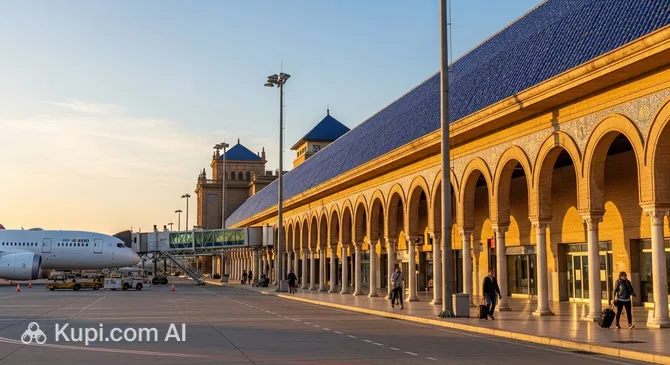
Seville Airport. Source: Kupi.com Binoculars

Seville Airport (also known as San Pablo) is not merely a functional transport hub, but a true architectural overture to your journey through Andalusia. Designed by the renowned architect Rafael Moneo for the Universal Exposition of 1992, the terminal welcomes guests not with cold glass and concrete, but with vaulted arches and traditional blue tiles. Inside, the atmosphere of a southern palace reigns: arrival zones are adorned with orange trees, creating a unique fragrance and mood immediately upon landing.

IATA Code SVQ
ICAO Code LEZL
City Seville
Distance to Center 10 km
Status International
Annual Passengers Over 8 million (2023)
Schedule Live flight board on the official website

Airport Features and Highlights

The main pride of this air harbour is its unique design. The complex is built in the traditions of Sevillian culture, combining elements of a mosque, a palace, and an orange garden, making the wait for a flight aesthetically pleasing. The airport consists of just one terminal, making navigation here intuitively understandable and simple: getting lost is practically impossible, and the path from the check-in counter to the boarding gate takes minimum time.

Comfortable conditions have been created for travellers: there are Duty Free zones with local products (premium olive oil, gourmet treats), cafes, and free Wi-Fi. Transport accessibility is also excellent: a special bus route EA (Especial Aeropuerto) connects the terminal with the Santa Justa train station and the Plaza de Armas bus station, and taxis operate on a fixed fare basis to the city centre.

Contact Information

For your convenience, we have compiled the main contact information for Seville Airport (SVQ), which may be useful when planning your trip or in case questions arise upon arrival.

  • Official Website: Up-to-date information on flights, services, and airport regulations can always be found on the official website of the Spanish airport operator Aena: www.aena.es/es/sevilla.html
  • Information Service Phone: To obtain information by phone, you can call the unified number for airports in Spain: (+34) 91 321 10 00.
  • Airport Address: Carretera N-IV Madrid-Cádiz, kilómetro 532, 41020 Sevilla, España.
  • Email: For general inquiries, it is recommended to use the feedback form on the airport's official website.
  • Social Media: You can follow news and updates on Aena's official pages on social media platforms such as X (formerly Twitter) and Facebook.
  • Lost Luggage Information: If you have lost items within the airport terminal, contact the lost and found office via email: svq.objetosperdidos@aena.es. In case of loss or damage to checked baggage, you should immediately contact your airline's representative.
  • Passenger Support Contacts: Information desks for passengers are located in the arrivals hall and the departures area. You can also use the general information service telephone.

How to Get to the Airport

Getting to Seville Airport (SVQ), located approximately 10 kilometers from the city centre, can be done in several ways suitable for any budget and preference. The most economical and popular option is the special bus Línea EA (Especial Aeropuerto). It runs between the airport and key points in the city, including Santa Justa station and Plaza de Armas. The entire journey takes about 35-40 minutes, and the ticket price is quite reasonable.

For those who value personal space and time, a taxi is the best choice. The trip from the city centre to the terminal will take just 15-20 minutes if there is no heavy traffic. In Seville, there is a fixed rate for trips to the airport, which is very convenient and helps avoid unpleasant surprises with the meter. The cost depends on the time of day and the day of the week. Alternatively, you can book a private transfer in advance, which is especially relevant for those travelling with large luggage or family.

If you have explored Andalusia by car, driving to the airport is straightforward. It is located next to the major A-4 highway. Several parking lots operate directly on the airport grounds — for both short-term and long-term parking. Most rental agencies allow you to return the vehicle directly at the terminal before departure, making travel across Spain even more comfortable.

Terminals and Map

Seville Airport (SVQ), also known as San Pablo Airport, is distinguished by a structure that is well-thought-out and convenient for passengers. There is only one passenger terminal here, which significantly simplifies navigation and eliminates the need for long transfers between different buildings. The terminal's architecture is inspired by the traditional Andalusian style with elements reminiscent of the region's rich history.

The layout of the terminal is logical and intuitive. The building has two main levels:

  • Ground Floor (Planta 0) — this is the arrivals area. Here you will find baggage claim belts, customs control counters, car rental offices, as well as cafes and the exit to taxi and bus stops.
  • First Floor (Planta 1) — the departures area. Airline check-in counters, security checkpoints, and passport control are located on this level. After passing control, passengers enter the "airside" zone with Duty-Free shops, restaurants, and boarding gates.

Since there is only one terminal, the issue of transferring between them is irrelevant — all operations, from check-in to boarding, take place within a single building. Navigation inside is well organized: there are signs in Spanish and English everywhere to help you orient yourself easily. Thanks to the compact size of the airport, moving between zones does not take much time.

It is recommended to arrive at the airport well in advance to complete check-in and security screening. For flights within the Schengen area, 1.5-2 hours is usually sufficient, while for international flights outside Schengen — at least 2.5-3 hours. Queues are possible during the peak tourist season or in the morning hours, so it is better to have a buffer of time. Overall, Seville Airport is considered quite efficient, and procedures here generally pass without unnecessary delays.

Airport History

The history of Seville Airport is closely interwoven with key events in the life of Andalusia and all of Spain. Its roots go back to the beginning of the 20th century when the Tablada military airfield was opened in 1914. By 1919, it hosted its first commercial flight connecting Toulouse and Casablanca. However, the modern airport, known as San Pablo, was officially opened in 1929, when the first plane from Madrid landed here, marking the beginning of regular civil aviation.

In the mid-20th century, the airport went through several stages of modernization. In the 1940s, three runways were built, and in 1957 — the first proper passenger terminal and control tower. These changes allowed the airport to meet the growing demands of aviation and accept more international and domestic flights, gradually turning into an important transport hub in the south of the country.

The most significant impetus for development was the preparation for the World Exhibition Expo '92. A large-scale reconstruction was carried out specifically for this event. In 1991, a new terminal opened, designed by the famous Spanish architect Rafael Moneo. The building became a true work of art, inspired by local culture: its design references traditional Andalusian palaces, mosques, and orange groves. At the same time, a new control tower was built, and the infrastructure was expanded.

Since then, Seville Airport has continued to grow and develop. It has become one of the key bases for budget airlines in the region, which has significantly increased its passenger traffic. Today, it is a modern and functional airport that not only provides comfort for millions of travellers but also serves as an architectural gateway to the rich culture of Andalusia, greeting guests with a unique design that is a landmark in itself.

Services and Amenities

Seville Airport (SVQ) offers passengers all necessary services for a comfortable wait for their flight. In the terminal, you will find various cafes and restaurants where you can enjoy dishes of both Andalusian and international cuisine. For shopping enthusiasts, there are stores including a large Duty Free offering perfumes, cosmetics, and local delicacies, as well as souvenir shops and fashion outlets.

For those who value enhanced comfort, the VIP Azahar Lounge operates at the airport. Here, guests can relax in a calm atmosphere, enjoy complimentary snacks and beverages, read the latest press, and use work zones. Free Wi-Fi is available throughout the terminal, and numerous charging points for electronic devices are equipped, allowing you to stay connected at all times.

Financial services are represented by ATMs and currency exchange points. In case of need, passengers can contact the medical centre for first aid. Families with children will appreciate the presence of specially equipped mother and child rooms. Comprehensive support is provided for passengers with reduced mobility: from special parking spaces to assistance with navigating the terminal and boarding, which must be requested in advance.

Although there are no hotels directly within the airport building, many hotels are located a few minutes' drive away, most of which offer transfers for their guests. For business travellers, the VIP lounge provides conditions for work, and there is also the possibility of renting conference rooms for meetings and negotiations.

Where to Eat

Seville Airport (SVQ) offers passengers various dining options to comfortably pass the time while waiting for a flight. Whether you are looking for a quick coffee, a hearty lunch, or a final refreshing beverage, you will find a suitable establishment both in the public area and after passing security control.

In the arrivals and check-in area (landside), accessible to all visitors, the choice is usually focused on coffee shops where you can have coffee with fresh pastries or grab a sandwich. This is an ideal place to have a snack if you arrived early or are meeting someone. After passing security (airside), significantly more opportunities open up: from world-famous fast-food chains like Burger King to cozy cafes and restaurants offering a more substantial menu.

One of the pleasant features of Seville Airport is the opportunity to enjoy the flavours of Andalusia before departure. Look out for establishments offering traditional tapas and local cheeses. This is a wonderful chance to taste the famous salmorejo one last time or simply enjoy the atmosphere of a Spanish eatery with a refreshing drink.

For passengers with special dietary needs, vegetarian variants such as salads, sandwiches with vegetables, and fresh fruits are found in most cafes. Vegan and gluten-free options are also available, but it is best to check with the staff of the specific establishment. The price range at the airport varies from moderate in fast-food chains to medium and high in restaurants. The opening hours of most points in the departure zone are adapted to the flight schedule and are open from early morning until late evening.

If you are short on time, the best choice would be one of the grab-and-go kiosks or a coffee shop where you can quickly buy drinks and snacks. For those who have time and want to have a full lunch or dinner in a quiet setting, one of the restaurants in the departure zone is perfect, where you can leisurely enjoy dishes and comfortably wait for boarding.

Travel Tips

To ensure your journey from Seville Airport goes as smoothly as possible, we recommend arriving at the terminal in advance. For international flights, allow about 2-3 hours before departure, and for domestic flights within Spain — at least 1.5-2 hours, especially during the peak tourist season. To save time, take advantage of online check-in on your airline's website. This will allow you to proceed directly to baggage drop-off or, if travelling light, to the security checkpoint.

Security screening at Seville Airport is standard. Prepare in advance: liquids up to 100 ml must be packed in a transparent bag, and laptops and other large electronics must be removed from your bag into a separate tray. It is forbidden to take sharp objects, weapons, and flammable substances in hand luggage. Always check the current rules on your airline's website to avoid unpleasant surprises regarding the size or weight of hand luggage.

When choosing a seat on the plane, consider your preferences: a window seat will offer beautiful views of Andalusia during takeoff and landing, while an aisle seat offers more legroom and the freedom to stand up easily. To save money, bring an empty water bottle with you and fill it at drinking fountains after passing security. A light snack brought from home can also help avoid extra expenses at airport cafes.

If you have a transfer in Seville, keep in mind that the airport is quite compact, and orienting yourself is easy. There are several cafes and shops to pass the waiting time. In case of a flight delay or cancellation, first contact your airline representative for information and instructions. Passengers departing from the EU are protected by regulation EU 261, which may provide for compensation, meals, and hotel accommodation depending on the length of the delay and flight distance. Be sure to keep all receipts for expenses.

Customs control for arriving passengers is organized according to the "green" and "red" channel system. If you are arriving from a country outside the EU and have goods subject to declaration (for example, exceeding limits in value or quantity), you should go through the "red" channel. Travellers within the EU usually use the "green" channel if they have nothing to declare.

Reached the end of the page?

That means the route is fully explored