Support

Malaga Airport

About the Airport

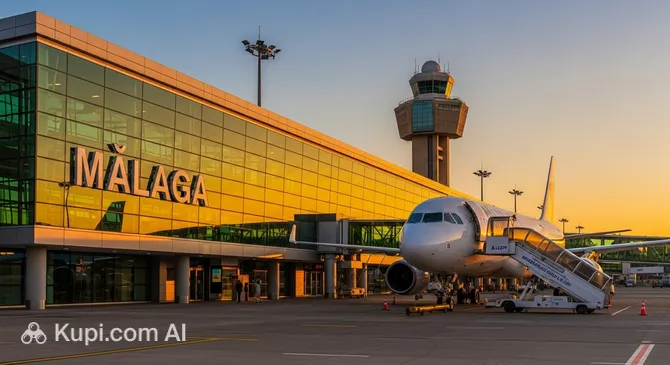
Malaga Airport. Source: Kupi.com Binoculars

Malaga-Costa del Sol Airport (AGP) is not just a transport hub, but a true sunny gateway to the very heart of Andalusia. From the first moments of arrival, you can feel the relaxed atmosphere of southern Spain here, where modern terminal architecture sits in harmony with palm trees and mountain views. As one of the oldest and busiest airports in the country, it serves as the ideal starting point for travellers heading to the golden beaches of Marbella, the historic streets of Malaga, and the picturesque "white villages" of the region.

IATA Code AGP
ICAO Code LEMG
City Malaga
Distance to Centre ~8 km
Status International
Annual Passengers Over 22.3 million (2023)

Features and Advantages of the Airport

The main advantage of this air hub is its exceptional transport accessibility. The airport is located just 8 kilometres from the city, and you can reach the centre of Malaga or neighbouring resorts (Torremolinos, Fuengirola) via the comfortable Cercanías train (line C1), the station for which is located directly opposite Terminal 3. This is one of the most convenient and affordable transfer methods in Europe.

Terminal T3, which handles the majority of international flights, is notable for its spaciousness and abundance of natural light thanks to high glass facades. Passengers have access to an extensive Duty Free area known as "The Shop", numerous restaurants serving Spanish and international cuisine, as well as comfortable VIP lounges for a relaxing wait before your flight.

A unique feature that distinguishes this airport from others is the National Museum of Airports and Air Transport located on its grounds. In this museum, you can see historical aircraft, an old control tower, and equipment telling the story of Spanish aviation, making for excellent entertainment if you have some free time before your flight.

Contact Information

  • Official Website: aena.es/es/malaga-costa-del-sol.html
  • Information Service Phone: (+34) 91 321 10 00
  • Address: Avenida del Comandante García Morato, s/n, 29004, Malaga, Spain
  • Email: For general enquiries, it is recommended to use the contact form on the official website. For suggestions and complaints, you can use the address: serviciosagp@aena.es.
  • Social Media: You can follow news on the official social media pages of the operator Aena, for example, on Twitter/X (@aena).
  • Lost Luggage Information: If your luggage is lost during a flight, you must contact your airline's representative directly. For items left within the terminal (excluding the aircraft), you should contact the airport's Lost and Found office (Objetos perdidos) by phone at (+34) 952 048 804 or by email: agp.objetosperdidos@aena.es.
  • Passenger Support Service: Aena information desks are located in Terminal T3. You can also use the general information service phone number.

How to Get to the Airport

Getting to Malaga-Costa del Sol Airport (AGP) from the centre of Malaga and other resort towns is quite simple thanks to an excellently developed transport network. Depending on your budget, time, and preferences, you can choose one of several convenient methods.

Public Transport

This is the most popular and economical method. You have two main options:

  • Train (Cercanías): The commuter train on line C1 is the fastest and most convenient way to get to the airport. It connects the centre of Malaga (Málaga Centro-Alameda and María Zambrano stations) with coastal resorts such as Torremolinos, Benalmádena, and Fuengirola. The journey from Málaga Centro-Alameda station to the airport takes just 12 minutes. The railway station is located directly opposite the exit of the Terminal 3 arrivals hall. Trains run every 20-30 minutes.
  • Bus: The "Línea A Express" express line runs between the airport and the city centre around the clock, with short breaks at night. The bus makes stops at key points, including the main railway station María Zambrano and the central square. The trip takes about 20-25 minutes depending on traffic. This is an excellent budget option, with tickets costing around 4 Euros.

Taxi and Private Transfer

For maximum comfort, especially if you have a lot of luggage or are travelling with family, you can take a taxi. Official taxi stands are located at the exit of Terminal 3. A trip to the centre of Malaga will take about 20 minutes and cost approximately 20-25 Euros. Surcharges may apply for travel at night or on public holidays. Private transfer booking services are also popular and can be booked online in advance at a fixed price.

Car Rental and Parking

If you plan to actively travel around Andalusia, renting a car is the best solution. Offices of all major international and local rental companies are present at Malaga Airport. For those arriving at the airport in their own or a rented vehicle, several types of parking are provided: from short-term parking near the terminals to more budget-friendly long-term lots connected to the terminals by shuttles. It is recommended to book a parking space online in advance to secure a more favourable rate.

Terminals and Map

Malaga Airport (AGP) is a modern and well-organised complex. Although formally consisting of three terminals (T1, T2, and T3), in practice they are integrated into a single space, and most passengers interact mainly with the newest Terminal 3 (T3). Terminal 1 is used extremely rarely, and Terminal 2 (named after Pablo Ruiz Picasso) flows seamlessly into T3, creating a unified building that is easy to navigate.

The airport structure is intuitive. The Departures zone is located on the upper floor, and the Arrivals zone is on the lower floor, which is standard for major international airports. The main entrance leads to the spacious check-in hall of Terminal 3, where most airline counters are located. After check-in, passengers pass through a centralised security checkpoint, which leads to a departure zone shared by all terminals, featuring shops, restaurants, and boarding gates.

Moving between terminals T2 and T3 is done on foot and takes just a few minutes; essentially, you will not even notice crossing from one to the other. All boarding gates are accessible after passing security. The gates are divided into three piers:

  • Pier B — for flights to non-Schengen countries.
  • Pier C — for flights within the Schengen area.
  • Pier D — used for both Schengen and non-Schengen flights.
Always check your flight information on the screens to find your gate number.

To complete all formalities — check-in, baggage drop, and security screening — it is recommended to arrive at the airport well in advance. During peak season (June to September) and during morning departure hours, queues can be longer. A general recommendation: arrive 2.5-3 hours before international and non-Schengen flights, and 1.5-2 hours before domestic or Schengen flights. This time is usually sufficient for a calm passage through all procedures.

To navigate the airport, follow the signs, which are duplicated in English. After passing security, you will find yourself in a large shopping hall, from where it is easy to reach any pier. Malaga Airport is one of the busiest in Spain, but its modern layout makes staying here comfortable and straightforward, even for first-time visitors.

Airport History

Malaga-Costa del Sol Airport (AGP) is not just a modern transport hub, but a place with a rich history spanning many years, closely intertwined with the development of tourism in southern Spain. Its history began on 9 March 1919, when a Salmson 2A aircraft made the first test flight, choosing a plot of land called "El Rompedizo" for landing. This moment marked the beginning of one of the country's oldest airports, which still operates at its original location.

The first regular commercial flights connected Malaga with Toulouse, Barcelona, Alicante, and Casablanca, laying the foundation for future international connections. In 1937, the airport became a military airbase and remained so until the end of the Civil War. The return to civil aviation in 1946 was marked by opening to national and international flights, and in 1948 the first civil passenger building was constructed — a modest terminal that is part of the cargo complex today.

A real breakthrough occurred in the 1960s with the start of the tourism boom on the Costa del Sol. To service the growing flow of travellers, a new terminal was opened in 1968, known today as Terminal 1. Its design was an important step in the airport's development. The next stage of massive expansion came in 1991, when Terminal 2, named after the great artist Pablo Ruiz Picasso, a native of Malaga, was opened in preparation for the Universal Exposition in Seville. This terminal, designed by architect Ricardo Bofill, significantly increased capacity.

The grandest modernisation took place in the 21st century. In 2010, King Juan Carlos I inaugurated the ultra-modern Terminal 3. This magnificent structure with an impressive design, abundance of light and space, transformed the airport into one of the key hubs of Southern Europe. At the same time, a second runway was built, allowing for even more flights. In 2011, the airport received its current name — Aeropuerto de Málaga-Costa del Sol, highlighting its inseparable link with the main tourist region of Andalusia.

Services and Amenities

Malaga-Costa del Sol Airport (AGP) is a modern and well-equipped complex offering passengers a full range of services for a comfortable journey. Everything here is thought out to the smallest detail to ensure your stay is pleasant, regardless of the purpose of your trip.

For those feeling hungry, there are numerous cafes, coffee shops, and restaurants operating in the airport. You can grab a quick bite at fast-food outlets, have a coffee with fresh pastries, or enjoy a full meal at a restaurant offering both local Andalusian and international cuisine. The shopping area delights with variety: from a large Duty Free store featuring perfumes, beverages, and sweets, to boutiques with fashion, accessories, and shops offering souvenirs and delicacies from Spain.

Free Wi-Fi is available throughout the airport, allowing you to stay connected. Numerous stations with power outlets and USB ports are equipped in waiting halls and at boarding gates for charging electronic devices. Passengers wishing to relax in a quieter environment can use the services of the VIP lounge, where beverages, snacks, fresh newspapers, and comfortable seating are offered while waiting for a flight.

To handle financial matters, bank branches, ATMs, and currency exchange points are located within the terminal. In case of unforeseen health issues, a medical centre operates around the clock, ready to provide first aid. Travellers with children will appreciate the presence of specially equipped nursing rooms and play areas, which help pass the time before departure.

Malaga Airport is fully adapted for passengers with reduced mobility. A free assistance service (Servicio Sin Barreras) is available upon prior request, and all infrastructure, including lifts, restrooms, and ramps, meets necessary standards. Conference rooms and business centres are available for business travellers. If you need to rest before an early flight or after a late arrival, several hotels are located in the immediate vicinity of the airport.

Where to Eat

At Malaga Airport (AGP), travellers will find plenty of options for a snack or a full meal to suit any taste and budget. Most cafes and restaurants are concentrated in Terminal 3 (T3), both in the public area and in the departure zone after passing security checks.

In the public area (landside), before security control, you can have coffee and pastries at establishments such as Starbucks or Costa Coffee. This is a convenient option if you are seeing someone off or have arrived at the airport early. Several small cafes offering sandwiches and drinks are also usually located here.

The main variety of establishments awaits passengers in the departure zone (airside), after passing screening. Popular fast-food chains, such as Burger King, are perfect for a quick bite. If you are looking for something more authentic, look out for tapas bars where you can enjoy the final tastes of Andalusia before your flight. Try local specialities, cheeses, or traditional Spanish appetisers. For a more substantial lunch or dinner, you can choose one of the restaurants, such as Vips, offering a varied menu, or the exclusive Dani García DeliBar, featuring dishes from the famous chef.

Many establishments offer options for passengers with special dietary needs. In the menus of most cafes, you can find vegetarian salads, sandwiches, and fresh fruit. Gluten-free options are also becoming increasingly available, though it is recommended to check details with the staff of the specific restaurant. The price range varies from budget offers in fast-food chains to higher prices in full-service restaurants, which is typical for major European airports.

The opening hours of most dining establishments in the departure zone are adapted to flight schedules, operating from early morning until late evening. Thus, you will always have the opportunity to eat, regardless of your flight time. If you are in a hurry, the best choice would be coffee and pastries to go, but if you have time, do not miss the chance to enjoy a leisurely dining experience.

Travel Tips

To ensure your journey through Malaga Airport goes as smoothly as possible, make use of our tips. Costa del Sol Airport (AGP) is one of the busiest in Spain, especially during the summer season, so a little preparation will help save time and reduce stress.

Arrival Time: We recommend arriving at the airport at least 2-2.5 hours before flights within the Schengen area and 3 hours before international flights outside it. In peak months (June to September), it is better to add another 30-40 minutes to this time due to possible queues for check-in and security screening.

Check-in and Security: The fastest way is online check-in, which most airlines open 24-48 hours before departure. This allows you to proceed directly to baggage drop (if you have any) or to security. When passing through security control, prepare liquids in advance (in containers up to 100 ml, packed in a transparent bag), and remove laptops and other large electronics from your hand luggage.

Luggage Regulations: Be sure to place all valuables, documents, medication, portable chargers, and fragile items in your hand luggage. Remember the liquids rule (no more than 1 litre in total, in containers up to 100 ml each). Sharp objects, weapons, and flammable substances are prohibited in the cabin. If in doubt, it is better to check your airline's rules in advance.

For Transfer Passengers: Malaga Airport has two main adjacent terminals, T2 and T3, and navigation between them is not difficult. If you have a single ticket, your luggage will likely be checked through to your final destination. However, if you are flying with different airlines on separate tickets, you may need to collect your luggage and check in again. Be sure to clarify this point during your first check-in.

Customs Control: For travel within the Schengen area, there is no passport control. If you are departing to or arriving from a country outside the Schengen zone, you will need to pass passport control. Customs inspection of belongings usually follows the "green" and "red" channel system. If you have no goods to declare, proceed through the green channel.

Saving Time and Money: To save money, book parking or airport transfers online — this is often cheaper than paying on the spot. Bring an empty reusable water bottle and fill it at drinking fountains after passing security. Prices in shops and cafes in the "airside zone" are traditionally higher, so you can bring a light snack with you.

In Case of Flight Delay: First, monitor information on departure screens and in your airline's app. If the flight is operated by a European carrier or departs from the EU, you are protected by regulation EU261. For long delays (2 hours or more, depending on flight distance), the airline is obliged to provide you with food and drinks, and if necessary, hotel accommodation. Keep all receipts and your boarding pass.

Reached the end of the page?

That means the route is fully explored