Support

Los Llanos

About the Airport

Los Llanos Airport (Albacete Airport) is not just an air gateway to the heart of the Castile-La Mancha region, but also a unique facility combining civil aviation with a major military airbase. Located just a few kilometers from Albacete, it serves as a starting point for journeys through the lands of Don Quixote and the picturesque corners of Spain. Although the airport is not among the largest in the country, its compactness and modern infrastructure make it convenient for passengers who value fast and comfortable service.
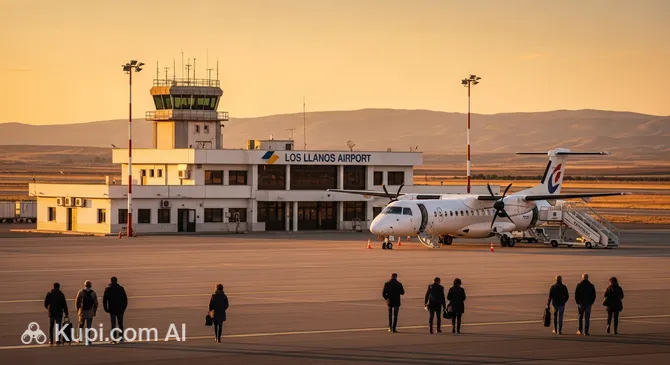
Los Llanos. Source: Kupi.com Binoculars
IATA Code ABC
ICAO Code LEAB
City Albacete
Distance to Centre approx. 6 km
Status Civil / Military
Annual Passengers less than 2,000 (based on 2023 data)
Popular Airlines Regular passenger flights are currently suspended

The main feature of Los Llanos Airport is its dual purpose. It shares the runway and infrastructure with a NATO airbase, which sometimes allows travellers to observe military aircraft flights. The passenger terminal, opened in 2003, is characterised by modern design, compactness, and well-thought-out logistics. There are no long queues or tiring walks here, making the check-in and boarding process as fast as possible.

Despite the fact that the airport is not currently serving regular commercial flights, it is fully equipped to handle charters and business aviation. Basic services are available in the terminal building, including car rental desks, a small café, and parking. Its convenient location makes it an important transport hub for accessing the province of Albacete, known for its natural parks, scenic routes, and cultural heritage.

Contact Information

Below is the essential contact information for Albacete Airport (Los Llanos), managed by Aena. It is recommended to check the latest data on the official website before travelling.

  • Official Website: You will find the most accurate and up-to-date information on flights, services, and regulations of Los Llanos Airport on the official portal of the Spanish airport operator Aena, in the section dedicated to Albacete Airport (Aeropuerto de Albacete).
  • Information Service Phone: For information regarding flights and airport services, you can contact the unified Aena information service by phone: (+34) 91 321 10 00.
  • Airport Address: Carretera de Las Peñas, km 3,9, 02071, Albacete, Spain (Carretera de Las Peñas, km 3,9, 02071, Albacete, España).
  • Email: Aena usually does not provide direct email addresses for general enquiries. It is recommended to use the official contact forms on their website for communication.
  • Social Media: Small airports typically do not have separate pages. You can follow news from the operator Aena on its centralised social media accounts (e.g., X/Twitter @aena).
  • Lost Luggage Information: For issues related to lost or damaged checked baggage, please contact your airline's representative directly. If you have left personal items in the terminal building, enquire at the airport information desk.
  • Passenger Support Service: Assistance for passengers, including those with reduced mobility, is provided upon prior request through the airline or at the information desks within the airport.

How to Get to the Airport

Albacete Airport (Los Llanos), located just 6 kilometres south of the city, makes the journey to the terminal quick and convenient. It is important to remember that this is a small airport, so transport options for getting here have their own specifics. The main ways to arrive are by taxi or rental car.

Taxi or Private Transfer is the most reliable and popular way to get to Los Llanos Airport from the centre of Albacete. The journey usually takes no more than 10–15 minutes. The estimated cost of a taxi ride is 15–20 Euros. Cars can be easily found at stands in the city or ordered by phone. For greater convenience, especially if you are travelling with family or a large amount of luggage, you can book a private transfer in advance.

Car Rental is an excellent option for those who value independence and plan to explore the picturesque region of Castile-La Mancha. There are offices of major rental companies in Albacete. The route to the airport from the city centre is simple and intuitive, mainly via the CM-3203 highway. Having a car will give you the freedom to travel throughout Spain.

If you arrive at the airport in a personal or rented car, a parking lot is available right next to the terminal building. Thanks to the compact size of the airport, there are almost always free spaces here, and you will not have to spend much time searching for a parking spot or walking to the check-in counters.

Regarding public transport, it is important to note that regular bus routes do not run to Los Llanos Airport. The Albacete-Los Llanos railway station, where trains from major cities in Spain arrive, is located in the city centre, and from there you will also need to take a taxi to the airport. Therefore, you should not plan to travel by bus or train directly to the terminal.

Thus, the optimal choice for travelling to Albacete Airport is a taxi. If the local flight schedule does not suit you, consider larger airports in the region as an alternative. The most popular ones are Valencia Airport and Alicante-Elche Airport, which are approximately a 1.5-2 hour drive away and offer a wide selection of international and domestic flights.

Terminals and Map

The structure of Los Llanos Airport (ABC) is extremely simple and intuitive, making it very convenient for travellers. It consists of one passenger terminal that handles all flights — both domestic and international (mostly seasonal and charter). An important feature: the airport shares infrastructure with a military airbase, but the civil part is completely separate and has its own entrance and terminal building.

The terminal is a compact single-storey building where all functional zones are located very close to each other. Upon entering the building, you find yourself in the check-in hall where airline counters are located. The arrivals area with the baggage claim belt is in a separate part of the building so that flows of arriving and departing passengers do not cross. The departure zone is located immediately after passing security control and includes a small but comfortable waiting lounge with boarding gates. Since there is only one terminal, there is no need for transfers between terminals.

The main advantage of a small airport is the minimal time required for formalities. Check-in and security screening procedures are very fast due to low passenger traffic. Typically, even on days with high loads, there are no long queues here. It is recommended to arrive at the airport approximately 1-1.5 hours before the departure of a domestic flight. This time is more than enough to check in luggage, pass control, and reach the boarding gate without rushing.

Navigation within the terminal will cause absolutely no difficulties. All key zones — check-in, security control, waiting lounge, baggage claim — are within walking distance of each other and are equipped with clear signs in Spanish and English. Thanks to the compact dimensions and simple layout, there is no risk of getting lost or missing a flight, making travel through Albacete Airport as comfortable and predictable as possible.

Airport History

The history of Albacete Airport, known as Los Llanos (IATA code: ABC), is unique because it is inextricably linked with military aviation. Today, it is a modern civil terminal that shares its runway with one of the most important airbases in Spain, giving it a special character.

The airfield's roots go back to the 1920s when a flight school was founded here. However, it began to play a key role during the Spanish Civil War (1936–1939), becoming one of the main bases for Republican aviation. This period laid the foundation for its future strategic importance and further development as a military facility.

After the war, Los Llanos continued to develop as a military airfield. In 1974, the famous 14th Wing (Ala 14) was formed here, which is today equipped with modern Eurofighter Typhoon fighters. A crucial stage in recent history was the hosting of the NATO Tactical Leadership Programme (TLP) here since 2009, turning the base into a prestigious international centre for training the alliance's best pilots.

The transition to civil use began gradually. Although individual passenger flights were operated earlier, the real breakthrough was the opening of the new passenger terminal on July 1, 2003. This large-scale modernisation allowed the airport to accept regular and charter flights, fully connecting the province of Albacete and the Castile-La Mancha region with other cities in the country and popular holiday destinations.

One of the most interesting facts about Los Llanos Airport is its double life. Passengers waiting for their flight can often observe training flights of fighter jets. Such close proximity of civil and military aviation gives the airport a unique atmosphere and makes it something more than just a transport hub.

Services and Facilities

Los Llanos Airport (ABC), serving the city of Albacete, is a small regional air hub. Thanks to its compact size, navigation here is intuitive, and pre-flight formalities take minimal time. Passengers should note that due to low passenger traffic, the range of services here is more modest than in major international hubs, but it provides basic comfort before departure.

Restaurants and shops in the terminal are available in limited numbers. Typically, there is a small café or refreshment area where you can order coffee, soft drinks, and light snacks (sandwiches, pastries). The shopping area is usually limited to a minimal assortment of travel goods, souvenirs, and press. Travellers accustomed to extensive Duty Free zones are advised to do their main shopping in the city beforehand.

To connect with the outside world, Wi-Fi is provided in the terminal. Access to the network is usually free, allowing you to check email or messaging apps. Charging stations for gadgets may be available in the waiting lounges, but it is recommended to carry a fully charged power bank, as the number of power outlets may be limited.

Regarding financial services, ATMs for cash withdrawal may be installed at the airport. There are no full-service bank branches or currency exchange points with a wide selection of currency pairs directly in the terminal, so it is better to arrange for Euro cash before arriving at the airport.

Special attention is paid to passengers with reduced mobility. The airport is equipped with ramps and special restrooms. To receive assistance during boarding and disembarking, you must notify the airline in advance (usually at least 48 hours before departure). Basic facilities are also provided for passengers with children, including baby changing rooms.

Medical services are represented by a first aid point for emergencies. Specialised VIP lounges or business lounges are generally not provided at Los Llanos Airport due to its low workload. For business meetings or negotiations, it is better to use the city's infrastructure.

There are no hotels on the airport territory itself. However, since the airport is located just a few kilometres from the centre of Albacete, passengers can easily reach city hotels by taxi. The city offers a wide range of accommodation options — from budget hostels to comfortable business-class hotels.

Where to Eat

Given the compact size and low passenger traffic of Los Llanos Airport (ABC), the choice of dining options here is quite limited. Travellers should not expect the gastronomic variety typical of large international hubs. Dining infrastructure is generally represented by a single café, which serves both the departure area and the public zone. This establishment is focused on quick service for passengers immediately before a flight.

The menu is based on light snacks and drinks. For a quick bite, they offer fresh pastries, croissants, and traditional Spanish bocadillos (baguette sandwiches) with cured meat or cheese. If you wish to try something more substantial, the assortment often includes tortilla (Spanish omelette with potatoes) — a simple but filling local dish that is excellent for breakfast or lunch. Good coffee, tea, juices, and soft drinks are also always available.

Passengers with special dietary preferences should be prepared for a modest selection. Vegetarians can order a tortilla or a cheese sandwich, but specialised dishes for vegans (apart from packaged snacks or fruit, if available) will be difficult to find. Please note that Halal products and gluten-free dishes are usually not marked on the menu and may be absent entirely. If you follow a strict diet, it is strongly recommended to bring food with you.

Opening hours of the café are not rigidly fixed and are usually tied to the flight schedule. The establishment opens a few hours before a flight departure and closes after passengers have been dispatched. If there are no flights in the schedule, the café will likely be closed. The price range can be described as average for airports: a coffee will cost approximately 1.5–2.5 Euros, and a sandwich — 4–6 Euros.

Considering the limited capabilities of the terminal, the best recommendation for those planning a full meal would be to visit restaurants in the city of Albacete itself before leaving for the airport. Since the journey from the city centre to the terminal takes only about 10–15 minutes by taxi, you can calmly enjoy the local cuisine of La Mancha in city establishments without worrying about being late for your flight.

Travel Tips

To ensure your journey through Los Llanos Airport in the city of Albacete is as comfortable and hassle-free as possible, take advantage of these useful tips. Despite the fact that this is a small regional airport in Spain, it is better to arrive in advance: 1.5–2 hours before the departure of domestic flights and at least 2 hours before international ones.

To save time, always use online check-in for your flight if your airline provides such an option. This will allow you to avoid queues at check-in counters. The security screening procedure here usually goes faster than in major hubs, but the rules are standard: liquids up to 100 ml must be in a transparent bag, and laptops and tablets must be removed from bags.

When choosing a seat on the plane, be guided by your priorities. Window seats are ideal for those who love to admire the views, while aisle seats are convenient if you plan to get up during the flight. For a quicker exit upon arrival, book seats in the front part of the cabin.

Carefully check your airline's hand luggage rules, especially regarding dimensions and weight. Remember that it is prohibited to bring sharp objects and containers with liquids exceeding 100 ml into the aircraft cabin. Lighters (usually one) and external batteries (power banks) should only be carried in hand luggage, not in checked baggage.

Los Llanos Airport is rarely used for connecting flights. However, if you have a transfer planned, clarify in advance whether you will need to collect your luggage and check in again. Always leave a sufficient time margin between flights, especially if they are operated by different carriers.

Arriving from countries outside the Schengen Area, you may need to pass customs control. If you have no goods to declare, follow through the "Green Channel". If you are carrying something that needs to be declared (for example, large sums of money or goods exceeding established limits), use the "Red Channel".

To save time and money, check in online, travel light with only hand luggage to avoid paying for baggage, and bring an empty water bottle — it can be filled at a drinking fountain after passing security control. This is much more economical than buying water at a high price in the departure zone.

In case of a flight delay or cancellation, remain calm. First of all, contact your airline's representative counter for current information. Remember your rights: EU Regulation No 261/2004 protects passengers departing from the European Union and provides for the provision of food, drinks, and even a hotel during long delays. Having travel insurance is also advisable.

Reached the end of the page?

That means the route is fully explored