Support

Valencia Airport

About the Airport

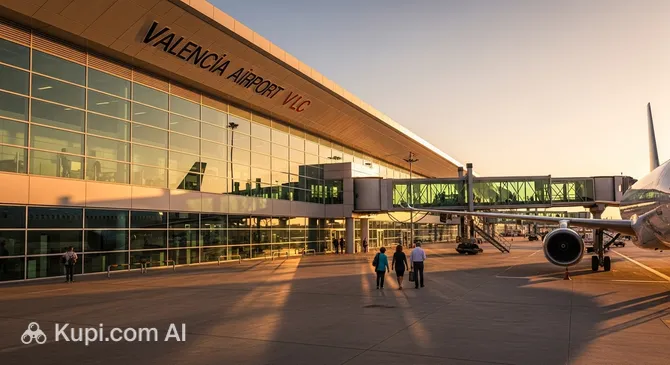
Valencia Airport. Source: Kupi.com Binoculars
Valencia Airport, also known as Manises, is not merely a transport hub but a sunny gateway to the very heart of the Mediterranean. From the very first moments, one can feel the relaxed atmosphere of the region here: the compact and cosy terminal eliminates the usual hustle and bustle of megacities, allowing you to get into a holiday mood even before collecting your luggage. Thanks to its remarkable proximity to the city, travellers can find themselves on lively streets or the beach just twenty minutes after landing. It is the perfect start to getting acquainted with the hospitable culture of Spain.
IATA Code VLC
ICAO Code LEVC
City Valencia
Distance to Centre 8 km
Status International
Passengers per Year approx. 10.8 million (2024)

Features and Advantages of the Airport:

Valencia Airport is renowned for its convenience and well-thought-out infrastructure, making arrival and departure as comfortable as possible.

  • Metro right in the terminal: One of the main highlights of the airport is that the metro stations (Lines 3 and 5) are located directly inside the building. This is the fastest and most budget-friendly way to reach the city centre or the port without traffic jams.
  • Compactness and clear navigation: The airport consists of one main terminal where everything is within walking distance. It is difficult to get lost here, and passing through security checks usually takes less time than in major hubs.
  • Waiting comfort: Passengers have access to the Joan Olivert VIP lounge, as well as various Duty Free shops where you can purchase local delicacies — from turrón to premium Spanish specialities — as last-minute souvenirs before your flight.

Contact Information

For your convenience, we have compiled the main contact information for Valencia Airport. We recommend checking the data for accuracy on the official website before your trip.

  • Official Website: Up-to-date information on flights, services, and regulations is available on the official portal of the Spanish airport operator Aena: www.aena.es/es/valencia.html
  • Information Service Phone: For information, you can call the general Aena number: (+34) 91 321 10 00.
  • Airport Address: Carretera del Aeropuerto, s/n, 46940 Manises, Valencia, España.
  • Email: A direct email address for general enquiries is usually not provided. For communication, it is recommended to use the feedback form on the airport's official website.
  • Social Media: Updates can be followed on the official Aena social media pages (e.g., on Twitter @aena).
  • Lost Luggage Information: If you have lost items within the terminal building, contact the Lost and Found office (Objetos Perdidos). If your luggage was lost during the flight, you must contact your airline's representative office directly.
  • Passenger Support Service: Information desks are located in the arrival and departure halls of the terminal. Staff are ready to assist with navigation and answer your questions.

How to Get to the Airport

You can reach Valencia Airport (VLC), located just 8 kilometres west of the city, in several convenient ways. The choice depends on your budget, amount of luggage, and the time you have available. The transport system connecting the airport with the centre of Valencia is well-developed and offers options for every preference.

Metro is one of the fastest and most convenient methods. Two lines, L3 (red) and L5 (green), directly connect the airport to the city centre and the seaport. The metro station is located right in the terminal building on the ground floor. The journey to the central station Xàtiva (next to the main railway station) will take approximately 20-25 minutes. The ticket cost is slightly higher than for city trips, as the airport is in a special fare zone. This is a reliable way to avoid traffic jams during rush hour.

Bus is the most budget-friendly option. Route No. 150 (MetroBus) runs between the airport and the centre of Valencia, making stops along the way in towns such as Mislata and Quart de Poblet. The trip takes about 40-45 minutes depending on traffic conditions. Buses run less frequently than metro trains, so it is worth checking the schedule in advance, especially if you have an early departure or late arrival. This is an excellent choice for economical travellers.

Taxis and Transfers ensure maximum comfort. The taxi rank is located right outside the arrivals area exit. A trip to the city centre will take about 20 minutes and will cost approximately €20-25, including the airport surcharge. You can also pre-book a private transfer, which is particularly convenient if you are travelling with children, a large amount of luggage, or simply want to be met with a name sign.

For those planning to actively explore the region, car rental is an excellent solution. Offices of all major international and local rental companies are located in the arrivals terminal. If you are arriving at the airport in your own or a rented car, several car parks are at your disposal — from express parking for quick passenger drop-off to long-term parking lots with more favourable rates.

Terminals and Map

Valencia Airport (VLC) is distinguished by a compact and clear structure, making it convenient for passengers. In fact, it consists of one large building that combines Terminal 1 (T1) and Terminal 2 (T2), as well as a separate regional terminal. Moving between T1 and T2 is possible on foot, as they are under one roof and flow seamlessly into one another.

The main airport building has a logical multi-level structure. Check-in counters are located on the first floor (P2). After receiving a boarding pass and checking in luggage, passengers descend to the ground floor (P1), where they pass through security control. This is where the main departure zone with shops, cafes, and boarding gates is located. The lower ground floor (P0) is the arrivals area, where baggage claim belts and the main exit to the city, taxi stands, bus stops, and the metro entrance are located.

The division into terminals is fairly nominal and mainly concerns check-in zones:

  • Terminal 1 (T1) handles the majority of international and domestic flights, including flights outside the Schengen area.
  • Terminal 2 (T2), which is the newer wing, is used primarily for low-cost carrier flights and some airlines within Schengen.
  • Regional Terminal is designed to service small aircraft flying short distances, for example, to the Balearic Islands.

Passing through check-in and security at Valencia Airport usually takes little time compared to giant hubs. Nevertheless, during peak hours and the height of the tourist season, it is recommended to arrive in advance — approximately 2–2.5 hours before an international flight departure and 1.5–2 hours before a domestic or Schengen flight. Navigation in the airport is intuitively clear thanks to distinct signs in Spanish, Valencian, and English. Follow the signs for "Salidas/Departures" or "Llegadas/Arrivals" to orient yourself easily.

Airport History

The history of Valencia Airport, also known as Manises Airport after the municipality where it is located, began long before the tourism boom. The official opening took place in March 1933, when the first flight on the Valencia – Madrid route was operated. Initially, the airport served mainly for postal and training purposes, but even then, it laid the foundation for the future development of air travel in the region.

The post-war years became a time of establishment. In 1946, the airport was opened to national and international traffic, which was an important step towards its integration into the European aviation network. Active construction took place in subsequent years: paved runways appeared, and by 1965, the first proper passenger terminal was built to cope with the growing number of tourists discovering the Costa de Valencia coast.

A key stage of modernisation occurred in 1983, when a new passenger terminal was inaugurated, designed to handle a significantly larger flow of passengers. This building, located south of the old one, became the core of the modern airport complex. It allowed the airport to meet new standards of comfort and safety, securing its status as a vital air gateway for the region.

A real breakthrough in infrastructure development occurred in the run-up to the 32nd America's Cup, held in Valencia in 2007. This prestigious event became a catalyst for large-scale reconstruction. A new terminal for regional flights was built, the main terminal area (T1) was significantly expanded and modernised, and the number of parking spaces was increased. A crucial innovation was the opening of metro stations directly linking the airport with the city centre, which significantly simplified logistics for millions of travellers.

Today, Valencia Airport is a modern and dynamically developing hub that constantly adapts to growing needs. It ranks among the top ten busiest airports in Spain and serves as a vivid example of how a historic airfield has transformed into a key transport infrastructure facility, contributing to the economic and tourist prosperity of the entire region.

Services and Amenities

Valencia Airport (VLC) offers passengers a wide range of services and amenities to make waiting for a flight as comfortable and pleasant as possible. Regardless of the purpose of your trip, you will find everything necessary for a peaceful journey here.

Numerous restaurants, cafes, and lounges are located within the terminal, where you can grab a quick snack or have a full meal. Establishments offering traditional Spanish cuisine, international fast-food chains, and cosy coffee shops are represented here. For shopping enthusiasts, there are Duty Free shops, as well as boutiques selling clothing, accessories, souvenirs, and local delicacies.

For those who value enhanced comfort, the Sala Joan Olivert VIP lounge operates at the airport, where you can relax in silence and enjoy snacks and beverages. Free Wi-Fi is available throughout the terminal, and numerous sockets and USB ports are provided for charging electronic devices.

Passengers can easily resolve financial matters thanks to the presence of ATMs and currency exchange points. In case of need, a first aid station operates around the clock at the airport. For travellers with children, special play areas and nursing rooms equipped with changing tables are available.

The airport is fully adapted for passengers with reduced mobility. An assistance service is provided (booking in advance is recommended), and there are special parking spaces, ramps, and equipped restrooms. Although there are no hotels or business centres directly inside the airport building, several hotels are located in the immediate vicinity of the terminal, reachable on foot or by shuttle. Many of them offer conference rooms for business meetings.

Where to Eat

At Valencia Airport (VLC), travellers will find plenty of options for a snack or a full lunch, capable of satisfying any taste and budget. Catering establishments are conveniently located both in the public zone and after passing security control, so you can spend your time comfortably while waiting for your flight.

The majority of cafes and restaurants are concentrated in the departure zone (airside), after passport control. Here you will find well-known international chains, such as Burger King for fast food lovers and Starbucks or Costa Coffee for coffee connoisseurs, as well as establishments with local flair. If you have enough time, you can settle into one of the restaurants offering Mediterranean cuisine. For a quick bite, sandwiches, pastries, and salads available in most cafes are ideal.

While in Valencia, do not miss the opportunity to try something from the local cuisine even at the airport. Look out for cafes serving traditional Spanish tapas or bocadillos (hearty baguette sandwiches). Some establishments also offer the famous Valencian drink — horchata, which is wonderfully refreshing before a flight. This is a great way to extend your gastronomic acquaintance with the region.

For those seeing off or meeting passengers, as well as for travellers arriving at the airport well in advance, there are several cafes in the public zone (landside). They are usually located in the arrival and check-in halls. Here you can drink a cup of coffee or have a light snack. The opening hours of most establishments are adapted to flight schedules, however, some cafes in the public zone may close earlier than those in the departure zone.

Travellers with specific dietary preferences will also find suitable options. Many restaurants feature vegetarian dishes on their menus, and fresh salads, fruits, and beverages with plant-based milk are always available in cafes. As for prices, they range from budget options at fast-food outlets to average and above-average checks in full-service restaurants. In general, everyone will be able to find an option that suits their pocket.

Travel Tips

To ensure your journey through Valencia Airport goes as smoothly as possible, take advantage of these proven tips. They will help save time, nerves, and even money, making the start or end of your trip more comfortable.

Arrival Time and Check-in: It is recommended to arrive at the airport at least 2 hours before departure for flights within the Schengen area and 3 hours for international destinations. During peak seasons (summer, holidays) and for morning flights, it is better to add another 30-40 minutes. To save time, complete online check-in and save your boarding pass on your phone. If you are travelling with hand luggage only, this will allow you to head straight to security control.

Passing Control and Seat Selection: The security checkpoint at Valencia Airport usually operates quickly, but be prepared in advance: pack all liquids (up to 100 ml each) in a transparent bag, and keep laptops and other large electronics accessible so they can be easily removed. When choosing a seat on the plane, remember: window seats are good for views, while aisle seats are for those who want to stretch their legs or get up frequently. Seats in the front part of the cabin will allow you to disembark faster upon arrival.

Hand Luggage: Standard rules prohibit carrying liquids in containers larger than 100 ml, sharp objects (scissors with blades shorter than 6 cm are usually allowed), explosives, and flammable substances. Always check your airline's rules, especially if it is a low-cost carrier, as they may have strict restrictions on the size and weight of hand luggage. Power banks and other batteries must be carried only in hand luggage.

Connecting Passengers and Customs: If you have a transfer in Valencia, ensure you have enough time between flights (minimum 1.5-2 hours). Check at registration whether you need to collect and re-check your luggage. Those arriving from non-EU countries will have to pass customs control. Follow the green channel if you have nothing to declare, or the red channel if you are carrying goods exceeding duty-free limits (usually this applies to tobacco and other high-value items).

Savings and Flight Delays: To save money, bring an empty reusable bottle and fill it with water after passing security control. Prices for food and drinks at the airport are traditionally higher, so you can bring a light snack with you. In case of a flight delay, first contact your airline representative for information. According to EU rules, for long delays, you may be provided with vouchers for food and drinks. Keep all receipts and documents — they may be needed to claim compensation.
Reached the end of the page?

That means the route is fully explored