Support

Ibiza Airport

About the Airport

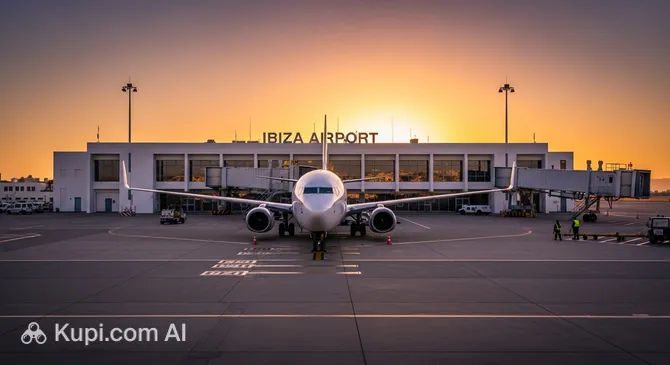
Ibiza Airport. Source: Kupi.com Binoculars

Ibiza Airport is not merely a transport hub, but a true gateway to a world of eternal summer, freedom, and music. Even upon landing, looking out the window at the turquoise waters of the Mediterranean Sea and the white outlines of the island, travellers feel that unique energy for which the "White Island" is famous. This is where the most vibrant adventures begin: from lively entertainment to peaceful relaxation in hidden coves, as the airport perfectly connects guests with both the bustling capital and quiet resorts.

IATA Code IBZ
ICAO Code LEIB
City Ibiza (Sant Josep de sa Talaia)
Distance to Centre ~7.5 km
Status International
Passengers per Year ~9.1 million (2024)

Airport Features and Advantages

Ibiza Airport is characterised by distinct seasonality: in summer, it operates around the clock, transforming into one of Europe's busiest hubs, while in winter it shifts to a quieter schedule (from 06:30 to 23:00). Despite having only one terminal, navigation here is intuitive, and the compact size allows for quick completion of all formalities.

For a comfortable wait before your flight, the Cap des Falcó VIP lounge is available to passengers of all airlines (for a fee or via loyalty cards). In the departure zone, you can find excellent Duty Free shops, which, in addition to the standard assortment, sell local specialities: the famous herbal beverage Hierbas Ibicencas, sweets, and handmade souvenirs. Transport connections are also excellent: the Line 10 bus will quickly and affordably take you directly to the city centre and the port, from where ferries depart for Formentera.

Contact Information

For your convenience, we have compiled the main contact information for Ibiza Airport (IBZ). We recommend checking the currency of the data on the official website, especially before your trip.

  • Official Website: Current information on flights, services, and airport regulations can always be found on the official portal of Spanish airports, Aena: www.aena.es/es/ibiza.html
  • Information Service Phone: For general enquiries, you can contact the Aena information service: (+34) 91 321 10 00.
  • Airport Address: 07817, Sant Josep de sa Talaia, Balearic Islands, Spain.
  • Email: For official enquiries, it is recommended to use the contact forms on the Aena website. The email address for general information enquiries is: `ibizainfo@aena.es`.
  • Lost Luggage and Personal Items: If your items were lost within the terminal building, contact the Lost and Found office (Objetos perdidos) by phone at (+34) 971 80 92 07 or by email at `ibizaobjetosperdidos@aena.es`. For issues regarding lost or damaged checked baggage, you must contact your airline's representative directly.
  • Passenger Assistance: To request assistance for passengers with reduced mobility (PRM), it is recommended to make a request via the Aena website or the general information phone number no later than 48 hours before departure.

How to Get to the Airport

Getting to Ibiza Airport (IBZ), located just 7 kilometres southwest of the island's capital, can be done in several convenient ways. The choice depends on your budget, amount of luggage, and comfort preferences. When planning your trip, especially during the high season, it is worth allowing extra time for the journey due to potential traffic.

Public Transport: Buses
This is the most economical way to reach the airport. Several bus routes connect it with key points on the island.

  • Route L10: Runs between the airport and the bus station in Ibiza town (Eivissa), as well as the port. This route operates year-round with intervals of approximately 20-30 minutes.
  • Route L9: Connects the airport with the popular resort of Sant Antoni. It is important to note that this is a seasonal route, operating only from 1 June to 30 September.
  • Route L24: Connects the airport with the resort of Santa Eulària and Cala Nova. This route is also seasonal and runs during the summer months.
The journey from the centre of Ibiza takes about 20-30 minutes, and the ticket cost is approximately €3-4. This is an excellent choice for light travellers.

Taxi and Transfers
A taxi is a fast and comfortable option. Taxi ranks are located directly outside the arrivals terminal exit. A trip to Ibiza town will take about 15 minutes and cost approximately €20-30, depending on the time of day and day of the week. For large groups or families with children, a pre-booked transfer can be a convenient solution. This guarantees a fixed price and the availability of a vehicle with the necessary capacity upon arrival.

Car Rental and Parking
If you plan to actively explore the island, renting a car is an ideal option. Many international and local rental companies have offices directly within the airport building. You can pick up the car immediately upon arrival and return it before departure. Next to the terminal is the official airport car park (P1), where you can leave a vehicle for both short and long periods. During peak season, it is recommended to book a parking space online in advance to secure a more favourable rate.

Terminals and Map

Ibiza Airport (IBZ) features a simple and clear structure, making navigation quite easy even for first-time visitors. A key feature of the airport is that it consists of one passenger terminal, which serves all domestic and international flights. This saves travellers from the need to move between different buildings.

The terminal is arranged logically and divided into two main levels:

  • Ground Floor (Floor 0) — This is the arrivals area. You arrive here after disembarking from the aircraft. Located here are the baggage claim belts, customs control, and the main hall for greeters. Also on this level are car rental desks, tourist information offices, and exits to taxi and bus stops.
  • First Floor (Floor 1) — This is the departures area. To fly out of Ibiza, you will need to go up to this level. Here you will find airline check-in counters and self-service kiosks. After checking in, passengers proceed to a single security screening area, after which they enter a spacious departure lounge with shops, restaurants, and boarding gates.

Since there is only one terminal, transitions between zones are done on foot within the single building. Navigation is intuitive thanks to numerous signs in Spanish, Catalan, English, and German. After passing security control, all boarding gates are located in one common area, which simplifies orientation.

The time required to pass formalities depends heavily on the season. During peak summer months (June to September), the airport can be extremely busy. During this period, it is recommended to arrive at least 3 hours before an international flight and 2-2.5 hours before a domestic one. Off-season, the airport is much quieter, and 1.5-2 hours is usually sufficient. To avoid stress, always monitor the information screens and proceed to your boarding gate well in advance, especially if it is located at the far end of the terminal.

Airport History

The history of Ibiza Airport is inextricably linked to the island's transformation into one of the Mediterranean's main tourism centres. Its journey began during the Civil War in Spain, when a temporary military airfield was established here in the 1930s. After the war ended, it was closed and forgotten for a time.

A revival occurred in 1949 when the airport was briefly opened to serve the first tourist flights, but the real turning point came in 1958. It was then, with a clear understanding of the tourism potential of Ibiza and neighbouring Formentera, that the airport was permanently opened to civil aviation. The first flights connected the island with Palma de Mallorca, Barcelona, and Madrid, marking the beginning of a new era in the island's history.

The rapid growth of Ibiza's popularity in the 1960s demanded immediate infrastructure development. By 1966, the airport received international status and began accepting direct flights from abroad. In 1973, a new terminal was opened, which was necessary to serve the constantly growing flow of travellers attracted by the island's unique atmosphere. In subsequent years, the runway was extended multiple times to accommodate larger aircraft.

In the 21st century, the airport continued to modernise to meet its status as one of the busiest in Spain, especially during the summer period. Significant work was carried out to expand the terminal, increase the number of check-in counters and boarding gates, and create new parking zones. Today, Ibiza Airport (IBZ) is a modern transport hub effectively handling the immense seasonal influx of tourists.

One of the most interesting facts about the airport is its pronounced seasonality. In peak summer months, such as August, passenger traffic can be dozens of times higher than in winter months, clearly demonstrating its key role in the island's tourism industry. The airport has witnessed all stages of Ibiza's development: from a haven for creatives to a global capital of music and entertainment.

Services and Amenities

Ibiza Airport offers passengers modern and convenient infrastructure, allowing for a comfortable time while waiting for a flight. Everything necessary for both relaxation and handling business matters is available here.

For those feeling hungry, the terminal features numerous restaurants, cafés, and lounges catering to various tastes: from fast dining establishments to restaurants serving local and international cuisine. After dining, you can go shopping. The airport has a large Duty Free shop, as well as fashion boutiques, souvenir stalls, and newsstands.

To stay connected, make use of the free Wi-Fi available throughout the airport. Numerous sockets and USB ports are provided for charging electronic devices. If you prefer to wait for your flight in a quieter environment, the Cap des Falcó VIP Lounge is at your service, offering guests snacks, beverages, fresh newspapers, and comfortable seating.

Financial matters are easily resolved at the airport: there are ATMs from various banks and currency exchange points. For emergency assistance, a medical centre is available to treat patients if necessary.

The airport is well-equipped for passengers with children: for young travellers, there are play areas, as well as nurseries for changing and feeding. For passengers with reduced mobility, a free assistance service is provided (recommended to book in advance through the airline), and the entire terminal infrastructure is adapted to their needs.

Although there are no hotels directly within the airport building, many accommodation options are located in the immediate vicinity and in the city of Ibiza. Specialised business centres and conference rooms are not provided in the airport, but the VIP lounge can offer a secluded space for work.

Where to Eat

Ibiza Airport offers a variety of dining options to brighten up the wait for your flight. Whether you are looking for a quick coffee or a hearty lunch, you will find establishments to suit every taste and budget. Most cafés and restaurants are concentrated in the departure area, after security control (airside), although there are a few outlets in the public area (landside).

For those in a hurry, coffee shops and fast-food establishments are the ideal choice. Here you can grab sandwiches, pastries, salads, and, of course, aromatic coffee to go. Such places usually open early in the morning and operate until the last flight. This is an excellent option to refresh yourself before boarding without spending much time.

If you have an hour or two to spare, you can settle comfortably in one of the restaurants or tapas bars. Here you will be offered dishes of both international and traditional Spanish cuisine. We recommend trying traditional Spanish sandwiches (bocadillos) or ordering a tapas platter to prolong the holiday feeling in Spain. In the lounges, you can enjoy refreshing beverages in a more relaxed atmosphere.

Prices in airport establishments are expectedly higher than in the city, which is standard practice for most tourist hubs. Regarding dietary preferences, many cafés offer vegetarian options, and gluten-free snacks can be found in some places. However, choices for vegans or people with specific dietary requirements may be limited, so it is best to check the ingredients with the staff. Travellers looking for Halal options should also enquire directly with restaurant staff regarding ingredients and preparation.

Tips for Travellers

To ensure your journey through Ibiza Airport goes as smoothly as possible, take advantage of these tips. The airport is particularly busy during the summer months, so good preparation will help avoid stress and unnecessary expenses.

Arrival Time and Check-in. In high season (June to September), arrive at the airport at least 2.5-3 hours before an international flight and 2 hours before a flight within Spain or to Schengen countries. To save time, always complete online check-in and download your boarding pass to your smartphone. If you are travelling without luggage, this will allow you to proceed straight to security control, where queues can also occur in summer.

Seat Selection and Hand Luggage. Want to take beautiful photos from the window? When flying out of the island, seats on the left (row A) often offer a view of the mystical rock of Es Vedrà. Seats on the right (row F) may provide a panorama of the island's capital. Carefully check your airline's hand luggage allowance, especially if flying with a low-cost carrier. Standard rules for liquids apply: containers up to 100 ml in a transparent bag with a volume of no more than 1 litre.

Transfers and Customs Control. Ibiza Airport is rarely used as a transit hub. If you do have a transfer planned, you will likely have to collect your luggage yourself and check it in for the next flight. Allow sufficient time for this. For flights within the Schengen area, there is no passport control; it is only required for flights to countries outside the agreement.

Saving Time and Money. The best way to save is to book transport from the airport in advance. This can be a private transfer or the bus (Route L10 to Ibiza town). Prices for food and drinks in the terminal are high, so consider bringing a light snack and an empty reusable bottle, which can be filled with water after passing security.

In Case of Flight Delay. If your flight is delayed, remain calm. Monitor information on the departure screens and the airline's website. Remember passenger rights (EU Regulation No 261/2004): for long delays, the carrier is obliged to provide you with drinks, meals, and, if necessary, accommodation. There are enough shops and cafés in the airport to pass the waiting time.

Reached the end of the page?

That means the route is fully explored