Support

Houari Boumediene Airport

About the Airport

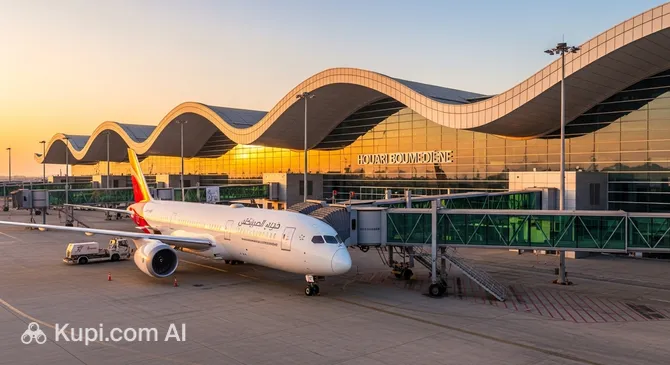
Houari Boumediene Airport. Source: Kupi.com Binoculars

Houari Boumediene International Airport is not merely the main transport hub of Algeria, but a true gateway to North Africa, where Eastern hospitality meets modern technology. The air hub impresses with its scale and architecture: vast, light-filled terminals with elements of traditional decor seem to invite travellers to immerse themselves in the atmosphere of the Maghreb immediately after landing. It is a strategically important hub connecting the African continent with Europe, the Middle East, and Asia, offering passengers a high level of comfort and safety.

IATA Code ALG
ICAO Code DAAG
City Algiers
Distance to City Centre 17 km
Status International
Annual Passengers Over 8 million (2023)

Features and Advantages of the Airport

Houari Boumediene Airport has undergone extensive modernisation in recent years, the jewel of which was the opening of the new West Terminal (Terminal 4) in 2019. This modern complex, serving international flights, features spacious halls, intuitive navigation, and advanced baggage handling systems. Natural lighting and the use of national motifs in the design create a pleasant and calm atmosphere inside the building.

An important advantage for tourists is the excellent transport accessibility. The airport is connected to the capital's centre by a railway line: trains depart from a dedicated station located within walking distance of the terminals, allowing you to reach the city quickly and without traffic jams. Furthermore, the terminal complex offers travellers comfortable business lounges, Duty Free zones, prayer rooms, and various cafes where you can enjoy a cup of Algerian coffee before your flight.

Contact Information

For your convenience, we have compiled the main contact information for Houari Boumediene Airport (ALG). We recommend checking the data on official resources before your trip.

  • Official Website: On the official portal www.alger-aeroport.dz, you will find the online flight board, terminal maps, and information about parking and services.
  • Information Service Phone: For immediate information, you can call: +213 (0) 21 20 60 00 or +213 (0) 21 20 71 52.
  • Airport Address: Dar El Beïda, BP 295, 16012, Algiers, Algeria.
  • Email: General inquiries can be sent to the management company SGSIA at: contact@sgisa.dz.
  • Social Media: The airport has official pages on social networks (e.g., Facebook) where important updates are published. Search for "Aéroport d'Alger".
  • Lost Luggage Information: If your luggage was lost during the flight, first contact your airline's Lost & Found counter. For items left within the terminal building, you can contact the airport's lost property service.
  • Passenger Support Contacts: For general support and enquiries, use the information service numbers listed above. Staff at the information desks in the terminals are also ready to assist.

Getting to the Airport

There are several ways to get to the main airport of Algiers, Houari Boumediene (ALG), located approximately 17 kilometres southeast of the city centre. The choice depends on your budget, amount of luggage, and the time you have available. Generally, when planning your trip, it is worth allowing extra time due to potential traffic congestion, especially during peak hours.

The most budget-friendly way to reach the airport is the specialised bus operated by ETUSA. It runs between the city centre (departure point — Place des Martyrs, with stops at key points including Place Maurice Audin) and the airport terminals. Buses run at regular intervals, approximately every 30–60 minutes. The journey takes between 40 to 70 minutes depending on traffic. This is an excellent option for economical travellers without a large amount of luggage.

For those who want to combine speed and economy, a combination of metro and bus is available. You can take the metro to one of the central stations, for example, Tafourah-Grande Poste, which is a major transport hub, and transfer to a bus to the airport from there. This helps avoid some of the city traffic and slightly reduce travel time compared to taking the bus from the starting point.

Taxi is the fastest and most comfortable option. A trip from the centre of Algiers to the airport without traffic will take about 30 minutes. Official taxis are easily recognisable by their yellow colour. It is recommended to insist on using the meter (compteur) or agree on the fare in advance to avoid misunderstandings. This is the ideal choice for travellers with bulky luggage or those who value personal comfort and are in a rush for their flight.

If you prefer independence in your movements, you can use a rental car. The airport is conveniently connected to the city by expressways, making the drive simple and straightforward. Both short-term and long-term parking facilities are available directly at the airport terminals, which is convenient if you are seeing someone off, picking someone up, or leaving your car for the duration of your trip.

Terminals and Map

Houari Boumediene Airport (ALG) in Algiers consists of several terminals, each with its own purpose, which is important to consider when planning your trip. Understanding the airport structure will help you orient yourself easily upon arrival or before departure.

There are three main passenger terminals in total:

  • Terminal 1 (T1), also known as Terminal Ouest (West Terminal), is the newest and most modern terminal, opened in 2019. It serves all international flights. The terminal is spacious, with clear navigation, numerous shops, cafes, and waiting lounges.
  • Terminal 2 (T2) is the former international terminal, which, after the opening of the new building, was repurposed to serve domestic flights within Algeria. It is smaller and more modest compared to T1, but fully functional.
  • Terminal 3 (T3) is used primarily for charter flights, as well as pilgrimage flights (Hajj and Umrah).

Navigation within the airport is quite simple. Arrivals zones are usually located on the lower levels of the terminals, where passport control and baggage claim areas are situated. Departures zones are on the upper floors and include check-in counters, security checkpoints, and boarding gates. Signage is provided in Arabic, French, and English.

To move between terminals, a free shuttle bus is available. Although the terminals are not located too far from each other, using the shuttle is the most convenient way to get from one to another, especially with luggage. Consider the transfer time if you have a connection scheduled from an international flight to a domestic one or vice versa.

It is recommended to allow at least 3 hours before departure for check-in and security screening at International Terminal 1, as queues are possible during peak hours. For domestic flights in Terminal 2, arriving 1.5-2 hours in advance is usually sufficient. The main advice for travellers is to always check in advance with your airline which specific terminal your flight departs from to avoid confusion and unnecessary rushing.

Airport History

The history of Houari Boumediene Airport, located in the city of Algiers, is inextricably linked with key events in the country's life. Its opening took place in 1924, and originally it was known as Maison Blanche Airport. In those years, it served as an important military and civil airfield, maintaining connections with Europe.

A new stage of development began after Algeria gained independence in 1962. The airport became the main transport hub of the young state and the base for the national carrier Air Algérie. A significant event was its renaming in 1979 in honour of Houari Boumediene, the country's second president, which highlighted its national significance.

The airport has been modernised repeatedly to meet global standards. A key transformation occurred in 2019 with the launch of the new ultra-modern international Terminal 1, also known as the West Terminal. This allowed the total capacity to increase to 10 million passengers per year. Following this, the terminal opened in 2006 was repurposed to become Terminal 2, which today serves primarily domestic flights.

The airport's history has also seen dramatic moments, such as the hijacking of an Air France flight in December 1994, which attracted worldwide attention. Today, Houari Boumediene is not only the largest airport in Algeria but also one of the most important aviation hubs in North Africa, continuing to grow and connect the continent with dozens of countries around the world.

Services and Amenities

In addition to the standard set of services, Houari Boumediene Airport offers a range of additional amenities making travel more organised. If you have a long layover, you can use the luggage storage to leave your bags and go for a short walk light-handed. Also, post offices operate within the terminals, where you can send a postcard or correspondence right before departure.

For the convenience of passengers, prayer rooms are provided throughout the airport, allowing for privacy to perform religious observances in a calm environment. To stay connected, you can use the Wi-Fi network, however, please note that connection conditions, such as time limits, may vary. For any questions, you can approach the information desks, and in case of lost personal items — the dedicated Lost and Found service.

The airport pays special attention to supporting passengers requiring assistance. The medical centre, operating around the clock, is ready to provide not only first aid for minor ailments but also respond to more serious situations. Comprehensive assistance is provided for travellers with reduced mobility. It is strongly recommended to notify your airline in advance about the need for special assistance so that airport staff can ensure your comfortable movement from the check-in counter to boarding the aircraft.

Dining

At Houari Boumediene Airport, passengers will find various options for a snack or a full meal, suiting different tastes and budgets. Most establishments are concentrated in Terminal 1 (West), which serves international flights, but other terminals also have basic food outlets.

For those in a hurry, coffee shops and fast food points operate in the departure zones both before and after security control (landside and airside). Here you can order sandwiches, pastries, coffee, and soft drinks. This is an ideal option for a quick bite before boarding your flight. In the arrivals zones, the choice is usually more modest and limited to small cafes.

If you have time, consider the restaurants with table service. In them, you can leisurely enjoy dishes of both international and local Algerian cuisine. We recommend trying traditional dishes if they are on the menu — this is a great opportunity to get acquainted with the country's gastronomy. As Algeria is a Muslim country, all food at the airport is generally Halal. Finding vegetarian options is possible, though the choice may be limited to salads and side dishes. Specialised vegan or gluten-free dishes are rarely found.

Prices in airport establishments are higher than in the city, which is standard practice. The opening hours of most cafes and restaurants are tied to the flight schedule, so the main outlets are open from early morning until late evening. However, only some vending machines or small kiosks may operate 24 hours a day.

Travel Tips

To ensure your journey through Houari Boumediene Airport is comfortable, it is worth arranging connectivity immediately upon arrival. You can purchase a local SIM card from operators Djezzy or Ooredoo in the arrivals hall, which will provide you with stable mobile internet. Although there is Wi-Fi in the terminals, it can work intermittently, so your own SIM card is a more reliable option. Also, do not forget that Algeria uses European-type sockets (C and F), so a universal adapter will be very useful.

To save time, use online check-in if your airline provides this option. At security control, be ready to present your passport and boarding pass. Hand luggage rules are standard: liquids in containers no larger than 100 ml must be packed in a transparent bag, and all electronic devices, including power banks, must be carried in hand luggage, not in checked baggage. When choosing a seat on the plane, note that excellent views of the coast often open up on the left side during take-off and on the right side during landing.

If you have a transfer in the capital of Algeria, carefully follow the "Transit/Correspondances" signs. Ensure you have enough time between flights, especially if a change of terminal is required. When passing through customs control in Algiers, if you have no goods to declare, proceed through the "green channel". It is better to declare large sums of foreign currency to avoid misunderstandings upon departure.

Regarding savings, a pre-booked transfer to the city may turn out to be cheaper than a taxi taken on the spot. Withdrawing local dinars from an ATM in the arrivals hall is often more favourable than exchanging cash at exchange bureaus. In case of a flight delay, first contact your airline representative. They are obliged to provide information about the new departure time, and in case of a long wait — vouchers for food and drinks.

Reached the end of the page?

That means the route is fully explored