Support

Barcelona-El Prat Airport

About the Airport

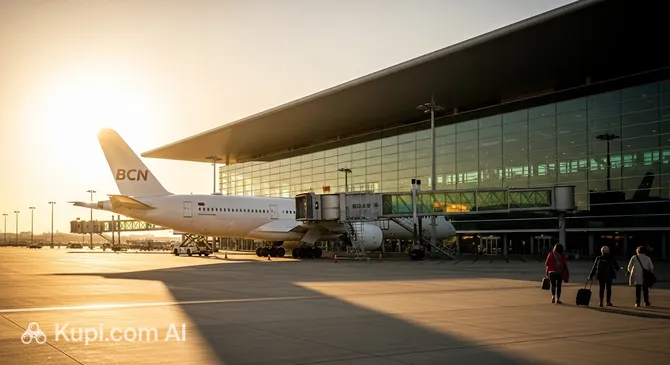
Barcelona-El Prat Airport. Source: Kupi.com Binoculars

Barcelona-El Prat Airport (Josep Tarradellas Barcelona-El Prat) is not merely a transport hub, but a stylish and sunlit gateway to the capital of Catalonia. Even here, amidst the bright spaces and panoramic windows of the terminal, one can feel the relaxed atmosphere of the Mediterranean and the anticipation of encountering architectural masterpieces. The airport successfully combines futuristic design with Spanish comfort, offering travelers the most comfortable start to exploring one of Europe's most vibrant cities.

IATA Code BCN
ICAO Code LEBL
City Barcelona
Distance to center ~12-15 km
Status International
Passengers per year Over 55 million (2024)
Schedule 24 hours

Features and Advantages of the Airport

El Prat consistently ranks among the best airports in Europe thanks to its logistics and aesthetics. Its main Terminal 1 (T1), designed by the famous architect Ricardo Bofill, resembles a giant silver sword and is renowned for its abundance of natural light.

  • Transport Accessibility: The airport is located very close to the city limits. You can reach Plaza Catalunya in just 25–35 minutes via the convenient blue express bus Aerobús, as well as by metro (line L9 Sud) or the R2 Nord suburban train.
  • Shopping and Gastronomy: While waiting for your flight, you can enjoy a full shopping tour of famous Spanish brands such as Zara, Mango, or Desigual. The gastronomic zone offers an excellent selection of tapas bars and cafes serving fresh delicacies and local cuisine.
  • Ease of Navigation: Despite the impressive passenger flow, the terminals have a clear structure, making it easy to navigate between check-in zones, security checks, and boarding gates.
  • Open Spaces: One of the pleasant features of the airport is the open terraces in some lounge zones and cafes, where you can enjoy fresh air and the last rays of the Spanish sun before departure.

Contact Information

  • Official Website: You can always find up-to-date information on flights, services, and airport rules on the official Aena website: www.aena.es/es/barcelona-el-prat.html
  • Information Service Phone: For information by phone, you can call (+34) 913 211 000.
  • Airport Address: Aeropuerto de Barcelona-El Prat, 08820 El Prat de Llobregat, Barcelona, España.
  • Email: The airport does not provide a general email for inquiries. You can contact various departments via online forms on the official website.
  • Social Media: Follow airport news and updates on the official Aena operator accounts on social media, for example, on X (formerly Twitter) @aena.
  • Lost Luggage Information: In case of lost checked baggage, you must contact your airline's Lost and Found service directly. If you have lost personal items within the terminal, contact the airport's Lost Property office (Objetos Perdidos).
  • Passenger Support Contacts: Assistance for passengers, including people with reduced mobility (Sin Barreras service), can be requested via the official website or the general information phone number. Information desks are also located in both terminals.

How to Get to the Airport

Getting to Barcelona-El Prat Airport (BCN) from the center of Barcelona is possible via several convenient methods suitable for any budget and schedule. The airport is well-connected to the city, so the journey will not take much time, averaging from 25 to 45 minutes depending on the chosen transport and traffic conditions.

Public Transport is the most popular and economical way. You have several options:

  • Aerobús: This is a special express bus running between the city center (Plaza Catalunya) and both airport terminals (A1 to T1 and A2 to T2). Buses depart every 5-10 minutes. The trip takes about 35 minutes. It is slightly more expensive than regular city transport, but faster and more convenient if you have a lot of luggage.
  • TMB City Buses: During the day, route No. 46 runs to both terminals from Plaza de España. At night, buses N17 (to T1) and N18 (to T1 and T2) run from Plaza Catalunya. This is the most budget-friendly option, but the trip will take longer.
  • Metro: Line L9 Sud connects the airport to the metro network. There are stations in both terminals — Aeroport T1 and Aeroport T2. Note that a special, more expensive ticket is required for travel to the airport. Standard travel cards usually do not apply.
  • RENFE Train: The suburban train line R2 Nord departs from major stations such as Sants and Passeig de Gràcia and arrives at the station near Terminal T2. If you need Terminal T1, use the free shuttle that runs between the terminals. The train journey takes about 25 minutes.

Taxi and Private Transfer are the most comfortable, but also the most expensive methods. Official Barcelona taxis (black and yellow) can be easily found anywhere in the city. A trip from the center will cost approximately 30-40 Euros and take 20-30 minutes excluding traffic jams. You can also pre-book a private transfer — this is convenient for large groups or for travel at night, as the cost will be fixed.

If you are traveling around Spain by car, you can easily reach the airport via the C-31 highway. Both short-term and long-term parking are available at the airport near both terminals. To save money, it is recommended to book a parking space online in advance, especially if you plan to leave the car for several days.

Terminals and Map

Barcelona-El Prat Airport (BCN) consists of two main terminals: Terminal 1 (T1) and Terminal 2 (T2). It is important to check in advance which terminal your flight departs from, as they are located at a significant distance from each other and serve different airlines.

Terminal 1 (T1) is a modern and large complex opened in 2009. It serves the majority of scheduled flights, including long-haul routes and flights of major airlines from the Oneworld, Star Alliance, and SkyTeam alliances. The architecture of the terminal is designed for passenger convenience: spacious halls, clear navigation, and logical zoning. The check-in area is on the upper level, and arrival areas are on the lower level. After passing security control, you enter the huge Sky Centre shopping area with numerous shops, cafes, and restaurants, from which the boarding gates radiate outwards.

Terminal 2 (T2) is historically older and consists of three interconnected sectors: T2A, T2B, and T2C. This terminal is mainly used by budget and some charter airlines, such as Ryanair, Wizz Air, and EasyJet. Although it is less modern than T1, navigation here is also straightforward. Departure and arrival zones are clearly marked, but the space is more compact. Sector T2B is the central area where the bulk of check-in counters and security checkpoints are located.

A free shuttle bus (green color) runs between the terminals. It operates around the clock with intervals of 5-7 minutes during the day and every 20 minutes at night. The trip between T1 and T2 takes approximately 10-15 minutes. Shuttle stops are easy to find by following the signs in the T1 arrival area and opposite T2.

It is recommended to allow enough time for check-in and security control. In Terminal 1, especially during peak season, queues can be significant, so it is worth arriving at the airport 2.5-3 hours before an international flight. In Terminal 2, procedures usually go a bit faster, but arriving less than 2 hours before departure is still not recommended. For comfortable navigation, always follow the signs and information boards, which are duplicated in English.

Airport History

The history of Barcelona "El Prat" Airport is a journey from a modest airfield to one of Europe's largest aviation hubs. It all began in 1916 with the opening of a small flying field in El Remolar. However, in 1918, the airfield moved to its current location in the municipality of El Prat de Llobregat, which gave it its modern name.

The first steps in commercial aviation were taken in 1927 when Iberia launched a regular flight on the Barcelona — Madrid route. In the 1930s, the airport even hosted Zeppelin airships on their way to South America. Significant growth began after World War II: in 1948, the first runway and the first passenger terminal building, which is now part of Terminal 2B, were built.

A key moment in the airport's history was the 1992 Olympic Games. This event served as a powerful impetus for radical modernization. Under the guidance of the famous architect Ricardo Bofill, two new terminal wings (current T2A and T2C) were built, which significantly increased capacity and prepared the city to welcome guests from all over the world.

The recent history of "El Prat" is linked to unprecedented expansion in the 21st century. In 2009, the grand opening of Terminal 1 (T1) took place, also designed by Ricardo Bofill. This modern building covering more than 500,000 square meters doubled the airport's capacity and took it to a new level, strengthening its status as the second busiest air gateway in Spain and one of the most important transit hubs in the Mediterranean.

Services and Amenities

Barcelona-El Prat Airport (BCN) is a modern and well-equipped complex offering passengers a wide range of services for a comfortable wait. Everything here is thought out to the smallest detail so that your journey begins or ends as pleasantly as possible.

For gourmets and shopping lovers, the airport is a true paradise. You can have a snack in one of the numerous cafes and restaurants offering both international cuisine and local Catalan delicacies. Afterwards, you can go shopping in the spacious duty-free zone, where perfumes, cosmetics, and other goods are presented, or visit boutiques of famous world brands.

For those who prefer to wait for their flight in a quieter atmosphere, comfortable VIP lounges are available. Here you can relax, work, and enjoy complimentary snacks and beverages. Free Wi-Fi is available throughout the airport, and numerous charging stations will keep your gadgets powered up.

Practical issues can also be easily resolved in the terminals: passengers have access to bank branches, ATMs, and currency exchange points. In case of illness, you can contact the 24-hour first aid centers.

Travelers with children will appreciate the presence of special play areas and mother-and-child rooms equipped with everything necessary. For passengers with reduced mobility, a special support service is provided (booking in advance is recommended), and the entire airport infrastructure, including elevators, ramps, and restrooms, is fully adapted to their needs.

If you have a long layover or an early flight, you can stay in one of the hotels located directly on the airport grounds or in the immediate vicinity. And for business travelers, modern business centers and conference rooms are equipped where you can hold a meeting or work in silence.

Where to Eat

Barcelona-El Prat Airport (BCN) offers travelers an impressive variety of establishments for every taste and budget. Whether you are looking for a quick snack before departure or want to enjoy a full lunch in a quiet setting, you will easily find a suitable option in both terminals.

Terminal T1, being more modern and larger, boasts the widest selection. In the departure zone (airside), after passing security control, you will find:

  • High Cuisine Restaurants: Establishments like Porta Gaig offer Catalan cuisine from Michelin-starred chefs. This is an excellent choice for those who want to enjoy a final taste of Spain before flying.
  • Tapas Bars: Numerous bars offer classic Spanish snacks — jamón, cheeses, olives, and much more. This is an ideal format for a light lunch with a refreshing drink.
  • Cafes and Coffee Shops: Here you will find both world-famous chains (Starbucks) and local confectioneries, for example, Escribà, where you can try exquisite desserts.
  • Fast Food: For a quick bite, McDonald’s, Burger King, and the Spanish sandwich chain Pans & Company are available.

Most establishments in T1 are located in the departure zone. In the public area (landside), the choice is more modest and mainly represented by coffee shops.

Terminal T2, serving mainly low-cost carriers, offers more democratic but no less diverse dining options. Here, the following predominate:

  • Cafes and Fast Food: The main selection is concentrated in the departure zone (airside). Here you will find Burger King, Pans & Company, as well as several pizzerias and cafes offering sandwiches, salads, and pastries.
  • Dining Bars: You can find several bars serving beverages and simple snacks.

The choice in the public area of T2 is limited, so it is better to plan your meal after passing security.

What to try? Be sure to pay attention to local cuisine dishes. Order a sandwich with authentic Iberian jamón (bocadillo de jamón ibérico), try various tapas, or enjoy a cup of aromatic coffee with a Catalan dessert. This is a wonderful opportunity to prolong the gastronomic pleasure of your trip to Barcelona.

For passengers with special dietary needs, many restaurants and cafes offer vegetarian, vegan, and gluten-free options. Menus often contain corresponding labels, which simplifies the choice. Regarding Halal food, specialized establishments are few, but in some cafes, you can find suitable dishes made from vegetables or fish.

Regarding prices, the airport offers options for different budgets. A light snack (coffee and pastry) will cost 10–15 Euros, lunch in a fast-food format — about 15–20 Euros, and a full dinner in a restaurant with service — from 30–40 Euros and up per person. Most establishments open early in the morning and work until the last flights depart late in the evening, but there are practically no 24-hour cafes.

Traveler Tips

To ensure your journey through Barcelona — El Prat Airport (BCN) goes as smoothly as possible, use these tips. The airport consists of two terminals, T1 and T2 (which, in turn, is divided into T2A, T2B, and T2C), with a free shuttle running between them. Be sure to check in advance which terminal your flight departs from.

Arrival Time and Check-in: It is recommended to arrive at the airport at least 2.5-3 hours before international flights and 2 hours before flights within the Schengen zone, especially during the peak season (June to September). To save time, complete online check-in and print your boarding pass or save it on your phone. Baggage drop-off counters and security checks can be busy, so it is better to have extra time.

Hand Luggage and Seat Selection: Hand luggage rules in Spain comply with EU standards. All liquids must be in containers of no more than 100 ml and packed in a single transparent bag with a volume of up to 1 liter. Sharp objects, weapons, and explosive substances are prohibited. When choosing a seat on the plane, if you are flying out of Barcelona, try to take a window seat on the right side — upon takeoff in good weather, magnificent views of the coast open up.

Transfers and Customs: If you have a connecting flight, pay attention to the transfer time. Moving between terminals T1 and T2 takes about 15-20 minutes by shuttle. If your flight is within the Schengen zone and the same terminal, the process will be quick. Passengers arriving from non-EU countries must pass customs control. Follow the green channel if you have nothing to declare, or the red channel if you have goods subject to declaration.

Savings and Life Hacks: To save money, use public transport to travel to or from the airport — Renfe trains and Aerobús buses are a convenient and inexpensive alternative to taxis. Bring an empty water bottle with you and fill it at drinking fountains after passing security control. Also, a pre-booked parking space may cost less.

In Case of Flight Delay: If your flight is delayed, first contact your airline representative for information. In accordance with EU Regulation 261/2004, for long delays, you are entitled to meals, drinks, and, if necessary, hotel accommodation. El Prat Airport has many cafes, shops, and rest areas where you can comfortably spend time waiting for your flight.

Reached the end of the page?

That means the route is fully explored