Support

Adolfo Suárez Madrid-Barajas Airport

Airports in the city

About the Airport

Adolfo Suárez Madrid-Barajas Airport. Source: Kupi.com Binoculars

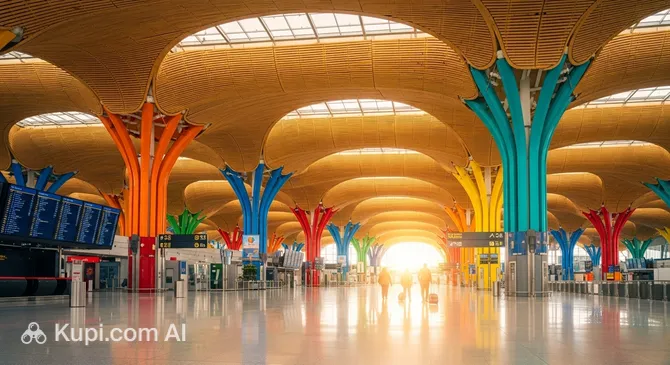
Adolfo Suárez Madrid-Barajas Airport is not just a transport hub, but a true architectural gateway to sunny Spain. Its famous Terminal 4, with its undulating bamboo roof and natural lighting, turns waiting for a flight into an aesthetic pleasure, resembling a modern art museum rather than a station. It is the country's main hub and a key link between Europe and Latin America, where the journey begins with a sense of spaciousness, light, and Spanish hospitality.

IATA Code MAD
ICAO Code LEMD
City Madrid
Distance to centre ~13 km
Status International
Annual Passengers over 60 million (2023)

Features and Advantages of the Airport:

Architectural Masterpiece. Terminal 4 (T4) and its satellite T4S are the airport's calling card. Designed by renowned architects Antonio Lamela and Richard Rogers, the building features a unique design that uses natural light to reduce passenger stress.

Transport Accessibility. Barajas is perfectly integrated into the city's transport network. Getting to the centre of Madrid is quick and budget-friendly: the metro line (L8) runs here, express buses operate around the clock, and there is a railway connection (Cercanías) to the main Atocha and Chamartín stations.

Shopping and Gastronomy. The airport offers a huge selection of Duty Free shops and boutiques of famous brands. Lovers of Spanish cuisine can start their gastronomic journey right here — in numerous tapas bars and restaurants offering traditional delicacies and local specialities.

Transit Convenience. Thanks to well-thought-out logistics and a free automated train between terminals T4 and T4S, transfers are comfortable even with long distances between gates. For long layovers, comfortable business lounges and relaxation zones are provided.

Contact Information

For your convenience, we have gathered the main contact information for Adolfo Suárez Madrid-Barajas Airport (MAD).

  • Official Website: You can always find the most complete and up-to-date information on the official website of the Spanish airport operator Aena: www.aena.es
  • Help Desk Phone: For calls from Spain and other countries: (+34) 91 321 10 00.
  • Airport Address: Avda. de la Hispanidad, s/n, 28042 Madrid, España.
  • Email: A direct email address for general inquiries is usually not published. It is recommended to use the special contact forms on the official airport website for communication.
  • Social Media: You can follow airport news through official Aena accounts on major social networks (e.g., X/Twitter: @aena).
  • Lost Luggage Information: If your items were lost on board the aircraft, you should contact your airline directly. If you lost something within the airport terminal, you must contact the Lost and Found office (Oficina de Objetos Perdidos), contact details for which are listed on the official website.
  • Passenger Support Contacts: For general information and assistance, use the main help desk phone number. The airport also operates a support service for passengers with reduced mobility (Servicio Sin Barreras), which must be booked in advance through the airline or the Aena website.

How to Get to the Airport

Planning your route to Madrid-Barajas Airport is simple, but knowing a few life hacks will help you save time, money, and stress. Instead of just listing options, let's look at the details: where to find the right stop, how to buy a ticket correctly, and how not to overpay for a taxi.

Metro: The fastest way is the pink line No. 8. Stations are located in all terminals: on level -1 in the modern terminal T4 and on the 1st floor in the connector linking terminals T1-T2-T3. Key point — buying a ticket. A trip to the airport requires a special surcharge (suplemento aeropuerto). At the ticket machine, first select the ticket you need (single trip or 10-trip pass), and then add the "Airport Supplement" option. It is easiest to immediately buy a combined "Single ticket + Supplement" so you don't have to deal with the surcharge at the turnstiles.

Express Bus (Línea Exprés Aeropuerto): This bright yellow bus is a real lifesaver for those with night flights, as it runs 24/7. Its stops are easy to find — they are located right at the exits of the arrival zones of terminals T1, T2, and T4. The fare is a fixed 5 Euros. You can pay with a contactless card or cash directly to the driver, which is very convenient if you haven't yet bought a Madrid transport card.

Suburban Trains (Cercanías): Lines C-1 and C-10 are the ideal choice if you are coming from other cities in Spain or if your accommodation is near the major stations Atocha or Chamartín. Important: the Cercanías train station is only in terminal T4 (on level -1, next to the metro). If your flight is from terminals T1, T2, or T3, you will have to use the free shuttle running between the terminals.

Taxi and Transfer: To avoid scams, always use official taxi ranks located at the terminal exits. Ignore offers from private individuals inside the airport building. For trips to the city centre (within the M-30 ring road), there is a fixed fare of 30 Euros. This price is final and includes luggage. Regarding services like Uber or Cabify, they have special waiting areas (Punto de encuentro VTC); follow the signs in the airport and instructions in the app. Their price may be lower during low demand but higher during peak hours compared to official taxis.

Car Rental and Parking: You will find counters for all major rental companies in the arrival halls of terminals T1 and T4. If you plan to leave your own car at the airport, it is strongly recommended to book a parking space in advance via the official AENA website (Spanish airport operator). This will allow you to get a significant discount compared to paying on the spot, especially for long-term parking.

Terminals and Map

Adolfo Suárez Madrid-Barajas Airport (MAD) is one of the largest and busiest in Europe. Its structure may seem complex at first glance, but with advance planning, navigation will not cause difficulties. The airport consists of four main terminals — T1, T2, T3, T4 — and one satellite terminal T4S.

Structure and Purpose of Terminals

The airport terminals are functionally divided into two large groups:

  • Terminals T1, T2, and T3: These are the older terminals, located in one building and connected by pedestrian walkways. T1 mainly serves international flights for airlines not part of the Oneworld alliance (e.g., SkyTeam and Star Alliance members). T2 and T3 are mainly used for domestic and Schengen flights.
  • Terminals T4 and T4S: This is a modern and huge complex, opened in 2006. It serves as the main hub for Iberia and its partners in the Oneworld alliance. Terminal T4 serves domestic and Schengen flights, while the satellite terminal T4S, connected to T4 by an underground automated train, is designed for long-haul international (non-Schengen) flights.

Transfers Between Terminals

Moving between terminals T1, T2, and T3 is possible on foot. However, to get from the T1-T2-T3 complex to terminal T4 (and back), you must use the free shuttle bus, which runs 24/7. The trip takes about 10-15 minutes. It is critically important to factor this time into your route when transferring. Access to the satellite terminal T4S is only possible from terminal T4 after passing passport control via the automated train (APM), a ride on which takes about 3 minutes.

Departure, Arrival Zones, and Security Checks

Each terminal has standard zones: check-in counters on the upper levels, security screening zones, and boarding gates. Arrival zones with baggage claim belts and customs control are on the lower levels. Terminal T4 is notable for its scale — the walk from the security zone to some gates can take up to 20-25 minutes. It is recommended to arrive at the airport in advance: 2-3 hours before a Schengen flight and at least 3-4 hours before an international long-haul flight, especially if you are flying from T4 or T4S.

Navigation Recommendations

The most important advice is to check your terminal number in advance on your ticket or the airline's website. Mistaking the terminal in Madrid means risking missing your flight. Inside the airport, there is excellent signage in Spanish and English. Follow the signs; they will clearly direct you to shuttles, trains, control zones, and boarding gates. If you are flying from T4 on an international flight, ensure your gate is in the main building (gates H, J, K) or in the satellite T4S (gates S), and follow the corresponding signs to the APM train.

Airport History

The history of Adolfo Suárez Madrid-Barajas Airport is a chronicle of the rapid development of aviation and the transformation of Spain into one of the world's main tourist centres. Construction began in 1928 on barren land near Madrid, and on April 22, 1931, Barajas airfield was officially opened for national and international air traffic. In the early years, it was a modest facility with one grass field for take-off and landing, serving only a few dozen passengers a day.

Real growth began in the 1950s with the arrival of the jet age and the tourism boom. The airport expanded constantly: new runways were built, and in 1955, the terminal known today as Terminal 2 was opened. In subsequent decades, Barajas turned into the country's main hub, linking Europe with Latin America. By the end of the 20th century, it became obvious that the existing infrastructure was insufficient for the growing passenger traffic.

The most ambitious stage in the airport's history was its modernization in the early 2000s. The culmination of this process was the opening in 2006 of Terminal 4 and its satellite T4S. This project, designed by architects Richard Rogers and Antonio Lamela, instantly became a calling card of modern Madrid. Thanks to its unique undulating bamboo roof and vast space flooded with light, T4 received numerous architectural awards and allowed the airport to double its capacity, bringing it to the forefront of European aviation hubs.

Throughout its long history, the airport has also experienced significant events. In 2006, its infrastructure underwent a serious test due to an explosion in the Terminal 4 car park, which led to strengthened security measures. An important moment was the renaming in 2014: the airport received the name of Adolfo Suárez, Spain's first democratically elected Prime Minister after the Franco era. This decision immortalized the memory of a key figure in the country's modern history.

Among interesting facts, it is worth noting that initially, the airport was designed to serve 30,000 passengers a year — today it serves that amount in just a few hours. Barajas has repeatedly set records for passenger traffic and cargo volume in Spain, firmly securing its status as the country's main air gateway and one of the busiest airports in Europe.

Services and Amenities

Adolfo Suárez Madrid-Barajas Airport (MAD) is not just a transport hub, but a whole city with developed infrastructure where every traveller will find everything necessary for a comfortable stay. Being the main air gateway to Spain, it offers a wide range of services to make your wait for a flight as pleasant as possible.

The gastronomic and shopping opportunities at Barajas are impressive. Here you will find a huge selection of establishments: from coffee shops and fast food outlets to à la carte restaurants offering dishes of Spanish and world cuisine. Duty Free shops, boutiques of famous clothing brands, cosmetics, and accessories, as well as stalls with local delicacies and souvenirs, will allow you to spend time profitably before departure.

For comfortable rest while waiting for a flight, passengers can use the services of VIP lounges, which offer complimentary beverages, snacks, press, and a calm atmosphere for work or relaxation. Free unlimited Wi-Fi is available throughout the airport, and numerous stands and sockets for charging gadgets will help you stay connected.

Financial matters are easily solved thanks to many ATMs, bank branches, and currency exchange points located in all terminals. The airport also has pharmacies and medical points where, if necessary, you can receive first aid or specialist consultation.

Madrid Airport is well-equipped for passengers with children: there are special play areas and nursing rooms for infant care. For passengers with reduced mobility, a free assistance service (Servicio de Asistencia Sin Barreras) is provided, which is recommended to be booked in advance through the airline.

If you have a long layover or an early flight, hotels are at your service, located both within the airport (e.g., Air Rooms in Terminal 4) and in the immediate vicinity, with convenient transfers. For business travellers, business centres and conference rooms are equipped where you can hold a meeting or work in silence.

Where to Eat

Madrid-Barajas Airport offers a huge selection of establishments for every taste and budget, allowing passengers to grab a quick snack before departure or enjoy a full lunch or dinner in a calm atmosphere. Dining options are conveniently distributed across all terminals, both in the public zone (landside) and in the departure zone after passing security control (airside).

Terminals T4 and T4S: Flagships of Gastronomy

The most modern terminals of the airport, T4 and its satellite T4S, boast the greatest variety of restaurants and cafes. Here you will find everything: from world-famous fast food chains such as McDonald's and Burger King to prestigious restaurants.

  • For connoisseurs of local cuisine: Be sure to visit one of the tapas bars, for example, Enrique Tomás, where you can try famous Iberian delicacies, or Mahou Sports Bar, to enjoy a beverage with traditional snacks. This is a great option for leisurely waiting for a flight.
  • For a full lunch: Restaurants such as La Mary offer Mediterranean cuisine in an elegant setting. Prices here are above average, but the quality and atmosphere are worth it.
  • Quick snack: Numerous coffee shops, including Starbucks and Paul, offer fresh pastries, sandwiches, and coffee. This is the ideal choice if you are short on time.

Terminals T1, T2, and T3: Classics and Convenience

In the older terminals, the selection is also quite wide, although not as diverse as in T4. Cafes, pizzerias, and fast food establishments predominate here. Most of them are located in the departure zone (airside).

  • Quick and simple: You will always find familiar fast food chains here, as well as local cafes where you can order a bocadillo (Spanish sandwich) or pastries.
  • Restaurants: In the departure zones of T1 and T2, there are several à la carte restaurants offering both Spanish and international cuisine. They are perfect for a more relaxed meal.

Special Diets and Useful Information

Many establishments at Madrid Airport cater to passengers with special dietary needs. In the menus of large chains and specialized healthy food cafes, such as Deli&Cia, you can often find vegetarian, vegan, and gluten-free options. Information regarding Halal dishes is best checked directly with the staff at the establishment. Most venues in the departure zones are open from early morning until late evening, adjusting to flight schedules, and some points are open 24/7.

Travel Tips

When planning a trip through Adolfo Suárez Madrid-Barajas Airport (MAD), one of the largest and busiest in Europe, use our tips to make your journey as comfortable as possible and avoid unnecessary stress.

Arrival Time and Check-in. The airport is huge, so arrive in advance. For flights within Spain and the Schengen area, it is recommended to be at the airport 2-3 hours before departure, and for international flights — 3-4 hours. Be sure to check your terminal number (T1, T2, T3, T4, or satellite T4S), as moving between them takes time. To speed up the process, check in for your flight online and save the boarding pass on your phone.

Security and Hand Luggage. At security control, be prepared to present all liquids in containers up to 100 ml, packed in a single transparent bag. Large electronics, such as laptops and tablets, must be removed from your bag. Following these simple rules will help you pass screening faster. As for seat selection on the plane, everything is standard: a window seat will offer beautiful views of Madrid upon takeoff, while an aisle seat provides more legroom and the ability to exit first after landing.

Transit Passengers and Customs. If you have a connecting flight, pay special attention to the departure terminal. Moving between the main T4 building and its satellite T4S is done via an automated train and can take up to 20 minutes including waiting time. Allow at least 90 minutes for the transfer. When flying outside the EU, do not forget to process Tax-Free. Customs counters for VAT refunds are located in the departure zone before passport control. Do this before you check in your luggage if the purchases are inside it.

Saving Time and Money. To save money, bring an empty water bottle and fill it at drinking fountains after passing security control. The fastest and often cheapest way to get to the city centre is the Cercanías suburban trains (lines C1 and C10), which depart from terminal T4.

In Case of Flight Delay. If your flight is delayed, contact an airline representative for information and possible compensation (e.g., food vouchers). Barajas Airport, especially Terminal 4, offers many shops, cafes, and relaxation areas where you can comfortably spend time. You can also use the services of paid business lounges for a more comfortable wait.

Reached the end of the page?

That means the route is fully explored