Support

Bilbao Airport

About the Airport

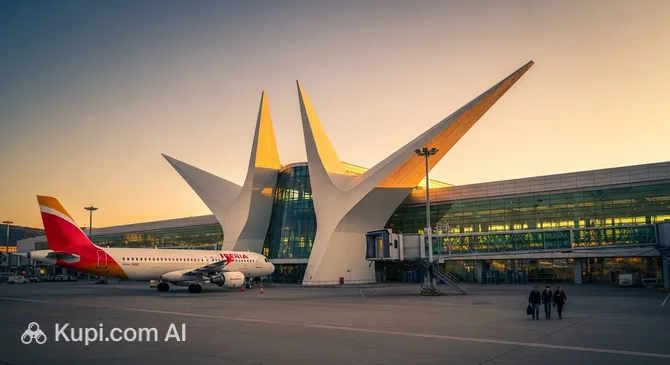
Bilbao Airport (BIO), known as "La Paloma" or "The Dove," is not merely a transport hub but a true architectural gateway to the Basque Country. Its futuristic terminal, designed by the renowned Spanish architect Santiago Calatrava, resembles a bird taking flight and has become one of the symbols of the revitalised Bilbao. Opened in 2000, this airport is the largest in the northern part of Spain and serves as a perfect introduction to the city's avant-garde spirit.

Bilbao Airport. Source: Kupi.com Binoculars

For the convenience of travellers, essential information about the airport is provided below.

IATA Code BIO
ICAO Code LEBB
City Bilbao
Distance to Centre Approx. 12 km
Status International
Annual Passengers Over 6.3 million (2023)
Popular Airlines Vueling, Iberia, Volotea
Schedule "Bilbao Airport" Online Board

Beyond its impressive architecture, Bilbao Airport is renowned for its functionality and comfort. Spacious and bright halls create a pleasant atmosphere, while well-thought-out signage allows for easy navigation. Despite its relatively modest size, it has everything necessary for passengers: cafés serving Basque cuisine, shops, car rental desks, and comfortable waiting lounges. The airport is connected to the city centre by a regular bus service, with the journey taking approximately 20 minutes.

Contact Information

If you need to contact the administration of Bilbao Airport (BIO) or require further information, please use the following contact details:

  • Official Website: www.aena.es/es/bilbao.html
  • Helpline: (+34) 91 321 10 00. This is the general line for the entire Aena network, where they will provide information regarding your query.
  • Address: 48180 Loiu, Bizkaia, Spain.
  • Email for General Enquiries: bioinfovuelos@aena.es
  • Social Media: You can follow news from all airports in the Aena network, including Bilbao, on their official pages on X (Twitter) (@aena), Facebook, and Instagram.
  • Lost Luggage: If your enquiry concerns lost checked baggage, you should first contact your airline's representative. If you have lost personal items within the terminal (at security checkpoints or waiting areas), contact the airport's Lost and Found service via email: bio.objetosperdidos@aena.es.
  • Passenger Support Service: For general questions, use the main telephone number. For passengers with reduced mobility, the "Sin Barreras" (Without Barriers) support service is available, which is recommended to be booked in advance via the Aena website or by phone.

How to Get to the Airport

Getting to Bilbao Airport (BIO) from the city centre is quite simple, with several convenient methods available. The best choice depends on your budget, available time, and the amount of luggage you are carrying.

Public Transport: Bizkaibus A3247
The most economical and popular method is the dedicated express bus line A3247. It connects the city centre with the airport, departing from the main Termibus station and making key stops at Plaza Moyúa and Gran Vía. Buses run approximately every 15-20 minutes throughout the day. The journey to the airport takes about 20-25 minutes depending on traffic conditions. This is an ideal option for solo travellers and couples with light luggage.

Taxi and Private Transfer
For maximum comfort and speed, you can take a taxi. The trip from the centre of Bilbao to the airport will take approximately 15-20 minutes. The cost is usually around 25-30 Euros. A taxi is an excellent choice if you are travelling with children, a large number of suitcases, or simply prefer not to rely on public transport schedules. You can also book a private transfer service in advance, which guarantees a fixed price and timely vehicle arrival.

Car Rental and Parking
If you prefer to travel in your own or a rented car, the route to the airport is straightforward thanks to clear signage and good roads. Bilbao Airport has several parking zones. For quick drop-offs or pick-ups, the short-term parking P1, located directly at the terminal, is suitable. For those leaving their car for the duration of their trip, long-term car parks with more favourable rates are provided. In the arrivals area, you will also find counters for all major rental companies, where you can easily hire or return a vehicle.

Terminals and Map

Bilbao Airport (BIO) features a well-designed and modern structure that makes navigation extremely simple for passengers. Its main feature is the existence of a single main passenger terminal, which eliminates confusion and the need to transfer between different buildings. The architectural project, developed by the famous Santiago Calatrava, is not only functional but aesthetically appealing — due to its shape resembling a bird in flight, the terminal has been nicknamed "La Paloma" (The Dove).

The terminal structure is logically divided into levels. The Departures Zone is located on the upper floor. Here you will find the Check-in counters, after which passengers pass through a single security control point. Once through security, you enter a spacious gallery with shops, cafés, and boarding gates. The Arrivals Zone is located on the lower, ground floor. Passengers arrive here after disembarking; this area also houses the baggage reclaim belts and the exit to the main hall, where you can meet arriving passengers, find car rental offices, and access public transport stops.

Since there is only one terminal, the issue of transfers between terminals is not relevant. All navigation takes place within a single building. The airport layout is intuitive, with clear signage in Basque, Spanish, and English installed everywhere. Movement between the arrivals and departures zones is facilitated by lifts and escalators.

The time required to complete formalities is generally short. Bilbao Airport is not a massive hub, so queues here are rarely critical. On average, check-in and security checks take between 30 and 60 minutes. Nevertheless, during the peak tourist season or morning rush hours, it is recommended to arrive at the airport in advance — 2 hours before an international flight and 1.5 hours before a domestic one, to avoid rushing.

Airport History

The history of Bilbao Airport is closely intertwined with the history of the city itself — a journey from a modest regional airfield to one of the most recognisable and modern transport hubs in Spain. The first steps towards creating an air harbour were taken back in the 1930s, but the project was frozen due to the Spanish Civil War. Full-scale operation of the airport began on September 19, 1948, when the first commercial flight to Madrid was operated. At that time, it was a small airfield with a simple terminal.

Real growth began in the second half of the 20th century. In 1955, the first proper passenger terminal was opened, and the runway was gradually lengthened to accommodate larger aircraft. A significant milestone was the construction of a new, longer runway in 1977 and the installation of an Instrument Landing System (ILS), which allowed flights to be received in the complex weather conditions characteristic of the Basque Country. The old terminal, which served faithfully for decades, is used today for cargo operations.

A key moment in the airport's history was the opening on November 19, 2000, of the new terminal designed by the world-famous architect Santiago Calatrava. This event became a symbol of the regeneration of Bilbao and its transformation into a major cultural and tourist centre. Thanks to its elegant design resembling a soaring bird, the terminal received the unofficial nickname "La Paloma" (The Dove). The new building not only multiplied the capacity but also became an architectural landmark in its own right. The rapid growth in passenger traffic after 2000 led to further expansions, including the modernisation of arrivals and check-in areas, to match the status of one of the busiest airports in the north of the country.

Services and Amenities

Bilbao Airport offers passengers modern and convenient infrastructure, thought out to the last detail, to make waiting for a flight as comfortable as possible. Here you will find everything necessary, from various dining establishments to practical services. The terminal features a wide selection of cafés, lounges, and restaurants, where you can grab a quick sandwich or enjoy a full meal featuring Basque cuisine. Numerous shops, including Duty Free, offer souvenirs, local products, fashion apparel, and accessories.

For those who value privacy and enhanced comfort, a VIP lounge operates at the airport. Here you can relax in a calm environment, enjoy complimentary snacks and beverages, and work in silence. Free Wi-Fi is available throughout the terminal, and numerous charging stations for electronic devices ensure you stay connected. For financial matters, ATMs and currency exchange points are provided.

The airport caters to all categories of travellers. For passengers with children, mother and child rooms and play areas are equipped so that young tourists can have a fun time before the flight. Special attention is paid to passengers with reduced mobility: a dedicated support service is available for them (which can be booked in advance), as well as ramps, lifts, and equipped restrooms. A medical point is available if needed.

For business travellers, conference rooms equipped with everything necessary for meetings and negotiations are available. Although there are no hotels directly inside the terminal building, several hotels are located just a few minutes' drive away, easily accessible by taxi or special shuttle, making Bilbao Airport a convenient point for transit stops and business trips.

Where to Eat

While waiting for your flight at Bilbao Airport (BIO), you certainly won't go hungry. There are options to suit every taste and budget, from a quick coffee with pastries to a leisurely lunch. Most establishments are concentrated in the main passenger area of the terminal, both before and after security control.

Once in the Basque Country, it is worth trying local gastronomic hits even at the airport. Pay attention to the counters offering pintxos — famous Basque mini-snacks on skewers. This is an excellent way to get acquainted with local cuisine without spending too much time. Usually, they are displayed on the counter, and you can choose whatever you like. They are traditionally enjoyed as a light appetiser.

In the public area (before security control), there are coffee shops and several fast-food outlets where it is convenient to have a snack if you have arrived early or are seeing someone off. The main selection awaits passengers in the "airside" zone, after security. Here you will find cafés, tapas counters, and restaurants with a more substantial menu, where you can order hot dishes, salads, and desserts. The opening hours of most establishments are tied to the flight schedule, but they are generally open from early morning until the last flight departs.

For a quick snack, the numerous cafés offering sandwiches, bocadillos (Spanish baguettes with fillings), and fresh pastries are ideal. If you have time for a full lunch or dinner, visit one of the restaurants serving both Spanish and international cuisine. Regarding special dietary needs, vegetarian options, such as salads or sandwiches with cheese and vegetables, are available almost everywhere. For gluten-free or vegan dishes, the selection may be limited, so it is recommended to check availability directly with the staff at the establishment.

Travel Tips

Travelling through Bilbao Airport (BIO), designed by the famous architect Santiago Calatrava, usually proceeds smoothly and comfortably. To ensure your trip begins and ends without unnecessary stress, use these proven tips.

Arrival Time at the Airport. Bilbao Airport is modern and well-organised, but it can be busy during peak hours (early mornings and holiday periods). For international flights outside the Schengen zone, it is recommended to arrive 2.5-3 hours before departure. For domestic flights within Spain and to Schengen countries, arriving 1.5-2 hours in advance is sufficient. This time is enough to check in luggage, pass through security, and reach the boarding gate without rushing.

Check-in and Security Control. The fastest way to save time is to complete online check-in for your flight, which is offered by almost all airlines. If you are travelling with hand luggage only, you can proceed directly to security with a printed or mobile boarding pass. The security procedure is standard: prepare liquids in advance (in containers up to 100 ml, packed in a transparent bag) and remove electronics from your bag.

Choosing a Seat on the Plane. When departing from or landing in Bilbao, you can enjoy picturesque views. If you want to see the green hills of the Basque Country and the curves of the Bay of Biscay coastline, choose a window seat. If comfort and the ability to stand up freely during the flight are more important to you, your choice is an aisle seat.

Hand Luggage. Remember standard European restrictions: sharp objects are prohibited, and the total volume of liquids must not exceed 1 litre (in containers of no more than 100 ml each). Be sure to check the weight and dimension allowances for hand luggage with your airline, as budget carriers can be very strict. Always keep valuables, documents, and medication with you in your hand luggage.

Transfer Passengers. Bilbao Airport has one passenger terminal, making transfers quite simple. If you are transiting within the Schengen zone, you will not need to pass through passport control again. When transferring from an international flight to a domestic one (or vice versa), allow extra time for border control.

Customs Control. When arriving from a country outside the EU, follow the "green" and "red" channel system. If you have no goods to declare, proceed through the "green" channel. For travellers within the EU, there is no formal customs control, but random checks are possible.

Saving Time and Money. Book your airport transfer in advance or check the public transport schedule — the Bizkaibus A3247 bus is the most budget-friendly way to get to the city centre. Bring an empty water bottle with you and fill it at drinking fountains after passing security to avoid spending money on drinks. Food prices at the airport are typically higher, so it is better to bring a light snack with you.

In Case of Flight Delay. First, contact your airline representative for information on the flight status and your rights. According to EU regulations, for long delays, passengers are entitled to drinks, meals, and sometimes hotel accommodation. Keep all receipts for unforeseen expenses if you have travel insurance. While waiting for your flight, you can visit shops, cafés, or simply relax in the spacious waiting lounges.

Reached the end of the page?

That means the route is fully explored