Support

San Sebastian Airport

About the Airport

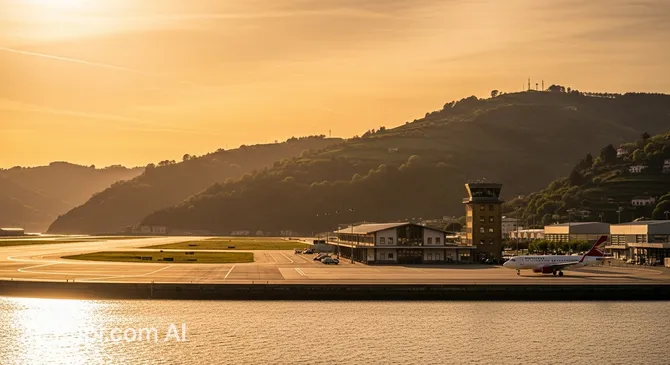
San Sebastian Airport. Source: Kupi.com Binoculars

San Sebastian Airport (EAS), located on the very border with France, is the air gateway to the famous Basque Country and the elegant resort of San Sebastian. Despite its compact size, this airport plays an important role in the transport system of northern Spain, offering travellers a quick and convenient start to exploring the region. Its unique location on the banks of the Bidasoa River treats passengers to scenic views of the runway right during landing and takeoff.

IATA Code EAS
ICAO Code LESO
City San Sebastian
Distance to centre about 22 km
Status international
Annual passengers 482,662 (2023)
Popular Airlines Iberia, Vueling, Volotea
Schedule online flight board "San Sebastian Airport"

The main advantage of San Sebastian Airport is its compactness and efficiency. Thanks to its small size, all procedures from check-in to boarding are very quick here, without long queues or hustle, which is especially appreciated by tourists. The airport offers basic amenities, including free Wi-Fi and small cafes where you can relax before your flight. Convenient transport connections to the city are provided by regular bus routes and taxi services, allowing you to reach the centre of San Sebastian or neighbouring resorts without unnecessary hassle.

Contact Information

  • Official website: You can always find the most up-to-date information on flights, services, and airport regulations on the official website of Aena (the Spanish airport operator): www.aena.es/es/san-sebastian.html
  • Information desk phone: For information, you can call the general Aena number: (+34) 91 321 10 00.
  • Airport address: Gabarrari Kalea, 22, 20280 Hondarribia, Gipuzkoa, Spain. Please note that the airport is geographically located in the town of Hondarribia, which is in the immediate vicinity of San Sebastian.
  • Email: A direct email address for general inquiries is not provided. It is recommended to use the contact forms on the official website for communication.
  • Social media: You can follow news from the operator Aena on social networks, for example, on X (formerly Twitter) via the account @aena.
  • Lost luggage information: If your luggage has been lost by the airline, you should contact your airline's representative or their handling agent at the airport. If you have lost personal items within the terminal, contact the Lost and Found office (Objetos Perdidos) of the airport via the information on the official website.
  • Passenger support contacts: The main support channel is the telephone line (+34) 91 321 10 00 and the help section on the official airport website.

How to Get to the Airport

San Sebastian Airport (EAS), located in the neighbouring municipality of Hondarribia, is approximately 22 km from the city centre. You can get there in several ways, each having its own advantages depending on your budget, time, and preferences.

Public Transport: Bus
The most economical way to get to the airport is to use Lurraldebus buses. Route E21 directly connects the centre of San Sebastian (Gipuzkoa Plaza) with the airport. The trip takes about 30 minutes, and the ticket cost is just a few euros. Buses run at regular intervals throughout the day. This is an excellent choice for travellers without a large amount of luggage.

Taxi and Transfer
For greater comfort and speed, you can choose a taxi. The trip from the city centre to the airport will take approximately 20-25 minutes, and the cost will be around 30-40 euros. Taxis can be found at designated stands or called by phone. Another convenient option is to book a private transfer in advance. This is especially beneficial for groups or families with children, as the price is fixed, and the driver will meet you at the specified location.

Car Rental and Parking
If you plan to actively travel around the Basque Country in Spain, renting a car will be the ideal solution. Many rental companies have offices both in the city and directly at the airport. This gives freedom of movement and allows you to explore the surroundings at your own pace. San Sebastian Airport has official parking where you can leave your car for a short or long term.

Alternative Airports
It is worth noting that San Sebastian Airport mainly serves domestic flights. Many travellers arrive at larger neighbouring airports. The nearest international one is Biarritz Airport (BIQ) in France, just 25 km away. Also a popular choice is the large Bilbao Airport (BIO), located approximately 90 km away, from where San Sebastian can be easily reached by bus in a little over an hour.

Terminals and Map

San Sebastian Airport (EAS) is a small and very compact airport, making it extremely convenient for passengers. There is only one passenger terminal here, which handles all flights — both arrivals and departures. Thanks to this, you do not have to worry about transfers between terminals or a long walk to the boarding gate: everything is in one building and within walking distance.

The airport layout is extremely simple and intuitive. On the ground floor, there are check-in counters, the arrivals area with baggage claim belts, and car rental offices. After checking in, passengers proceed to the first floor, where the security checkpoint is located. Immediately behind it is a small but comfortable departure lounge with several boarding gates.

Due to the modest size of the airport, completing all pre-flight formalities usually takes a minimum amount of time. On average, check-in and security screening take no more than 20-30 minutes even during peak hours. Nevertheless, it is recommended to arrive at the airport 1.5–2 hours before departure to check in luggage, pass through control, and have a coffee before the flight without rushing.

Navigation in the terminal will not cause any difficulties. Signs are clear and understandable, and staff are always ready to help. The main advice for travellers flying from this airport in Spain is simply to follow the standard procedure: check-in on the ground floor, security check and waiting for the flight on the first floor. This is the ideal airport for those who value their time and dislike the hustle of large aviation hubs.

Airport History

San Sebastian Airport (EAS), officially opened on August 22, 1955, has a rich history closely linked to the development of tourism in the Basque Country. Located in the municipality of Hondarribia, it was originally intended to serve the growing flow of travellers wishing to visit the famous resorts of San Sebastian. The first scheduled flights to Madrid were operated by the airline Aviaco, marking the beginning of air connections between the region and the capital of Spain.

The first decades of the airport's operation were a time of active growth. Already in 1957, the runway was extended to 1,500 metres, and by 1961 to 1,754 metres, which allowed for the reception of larger aircraft. In the mid-1960s, a control tower was built, and the apron was expanded. An important milestone was the opening of a new passenger terminal in 1967 and equipping the airport for night flights in 1969, which significantly expanded its operational capabilities.

Despite constant modernization, the history of San Sebastian Airport is also a history of overcoming unique geographical limitations. Its runway is bounded on one side by the city and on the other by the Bidasoa River, which is the state border with France. This circumstance has always made further runway expansion a difficult task and the subject of numerous discussions. Nevertheless, the airport continued to develop, and in the early 2000s, it underwent another modernization to meet modern comfort and safety requirements.

One interesting fact is that, despite its official name, the airport is often called by its actual location — Hondarribia Airport (Fuenterrabía). Throughout its history, it has not set records for passenger traffic on a national scale, but its main achievement is stable and reliable transport service for the province of Gipuzkoa and one of Europe's most prestigious resorts. It remains a key air gateway for thousands of tourists and business travellers heading to this picturesque corner of Spain.

Services and Amenities

San Sebastian Airport (EAS), despite its compact size, provides passengers with all necessary services for a comfortable wait for their flight. The terminal has a café where you can have a snack, drink coffee, or purchase light refreshments. There is also a small shop offering travel goods, press, and souvenirs. For the convenience of travellers, free Wi-Fi from the Aena network is available throughout the airport, and charging stations for electronic devices are installed in the waiting areas.

ATMs for cash withdrawal are located in the terminal building. There may not be currency exchange offices at the airport, so it is recommended to take care of exchanging money in advance. For passengers with special needs, an assistance service (Sin Barreras) is provided, which should be booked at least 48 hours before departure. The airport is fully equipped for the comfortable movement of people with disabilities. Travellers with small children can use mother and child rooms with changing tables located in the restrooms.

Although there are no hotels within the airport itself, there are many accommodation options in the immediate vicinity, in the towns of Hondarribia and Irun. There are no specialized VIP lounges or business centres at San Sebastian Airport due to its small size. However, business travellers can find necessary conference rooms and business services in nearby hotels.

Dining

San Sebastian Airport (EAS) is a compact regional airport, so the choice of dining establishments here is limited but quite sufficient to comfortably pass the time before departure. The main options are concentrated in the public zone before security control, accessible to both departing passengers and those seeing them off.

The main place for a snack is the café-restaurant located in the terminal building (landside). Here, passengers are offered a standard set of dishes and beverages: coffee, tea, juices, fresh pastries, sandwiches, and salads. Given the location in the Basque Country, known for its gastronomy, local specialties can be found on the menu. Look out for "bocadillos" (Spanish sandwiches) with Spanish cured meat or local cheese and, perhaps, several types of "pintxos" — famous Basque snacks. This is a great chance to enjoy local flavours one last time before departure.

For those looking for a quick snack, coffee with a croissant or a ready-made sandwich is perfect. If you have time for a more substantial lunch, you can order a set meal ("plato combinado"). Prices at the airport are generally higher than in the city. Regarding special dietary needs (vegetarian, gluten-free, halal), the choice may be limited to ready-made salads or fruits; it is better to check the ingredients of dishes with the staff.

The café opening hours are usually tied to the flight schedule: it opens before the first departure and closes after the last plane leaves. After passing security control (airside), vending machines with drinks and snacks may be installed in the departure area, but the main establishment is located in the public zone.

Travel Tips

Travelling through San Sebastian Airport can be an easy and pleasant start or end to your trip to the Basque Country. To ensure everything goes smoothly, use these tips. The airport is small, but it can be busy during peak season, so arrive in advance — approximately 2 hours before departure. This time is enough to check in for the flight, drop off luggage, and pass security control without rushing.

To save time, complete online check-in for your flight and save the boarding pass on your phone. At the security check stage, be prepared in advance: pack all liquids (up to 100 ml each) in a transparent bag, and remove laptops and other large electronics from your bag into a separate tray. Thanks to the compactness of the airport, queues here are usually shorter than in major hubs.

When choosing a seat on the plane, if possible, prefer a window seat. During takeoff and landing, scenic views of the Bay of Biscay and the coast may open up to you. Regarding hand luggage, remember the standard rules: sharp objects are prohibited, and there is a 100 ml limit per container for liquids. Always check the weight and size limits for hand luggage set by your airline to avoid extra charges at the airport.

San Sebastian Airport mainly handles direct flights and is rarely used as a transit hub. If you do have a transfer planned, make sure your luggage is checked through to the final destination. Customs control for those arriving from Schengen zone countries is usually absent. For passengers from other countries, standard customs rules of Spain and the EU apply.

If your flight is delayed, stay calm. First, find the information board for updates. There is a café in the small terminal where you can wait. Do not hesitate to contact your airline representatives to clarify information about the flight status and your rights as a passenger, including the possible provision of food and beverages in accordance with EU regulations.

Reached the end of the page?

That means the route is fully explored