Support

Vitoria Airport

About the Airport

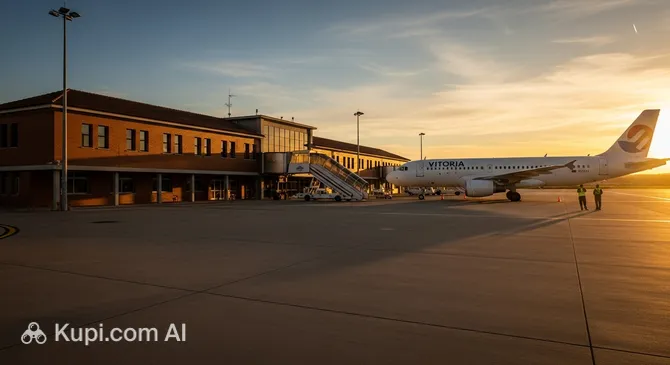
Vitoria Airport. Source: Kupi.com Binoculars

Vitoria-Gasteiz Airport, often referred to by locals as Foronda, is not just a transport hub, but a true "green gateway" to the heart of the Basque Country. Unlike crowded tourist hubs, an atmosphere of exceptional calm and organization reigns here, turning the start of a journey into a pleasant walk rather than a stressful marathon. This airport, famous throughout Europe as a giant of cargo transportation, remains a cosy haven for passengers, where modern technologies are combined with domestic comfort and speed of service.

IATA Code VIT
ICAO Code LEVT
City Vitoria-Gasteiz
Distance to Centre 8 km
Status International
Passengers per Year Over 300,000 (based on 2023 data)

Features and Advantages of the Airport:

The main advantage of Vitoria Airport is its compactness and efficiency. Thanks to the small passenger terminal, the check-in, security screening, and boarding processes are lightning-fast. There are practically no queues here, which are typical of major hubs, allowing travellers to arrive at the airport a little later than usual and save significant time.

From a technical point of view, the airport possesses one of the most impressive infrastructures in the region. Its runway is one of the longest in Spain (3.5 km), which ensures the highest level of safety and allows for the reception of aircraft of any type and size under any weather conditions. This inspires additional confidence in passengers flying from Foronda.

Furthermore, the airport is renowned for its transport accessibility. It is located next to key motorways linking the Basque Country with the rest of Spain and France. This makes it an ideal starting point for those planning to rent a car and set off on a journey through the scenic vineyards of the Rioja Alavesa region or the picturesque coast, bypassing the complex traffic of big cities.

Contact Information

To obtain the most up-to-date information regarding the operation of Vitoria Airport (VIT), it is recommended to use official communication channels. Below are the main contact details that travellers may require.

  • Official Website: The most complete and fresh information about flights, services, and airport regulations can be found on the official Aena network website: www.aena.es/es/vitoria.html.
  • Information Service Telephone: For information, you can call the general number of the Aena airport network: (+34) 91 321 10 00.
  • Airport Address: Ctra. Vitoria-Aranguiz, s/n, 01191 Antezana/Andetxa, Álava, Spain.
  • Email: A direct email address for general enquiries is not published. For communication, it is recommended to use the feedback form on the official website.
  • Social Media: News and updates can be tracked on the official pages of the Aena network on social media.
  • Lost Luggage Information: If your luggage has been lost or damaged during the flight, you must immediately contact the Lost & Found service of your airline. If you have lost personal items within the terminal building, please contact the airport information desk.
  • Passenger Support Contacts: For general support and answers to questions, please contact the information service by phone or speak to staff at the information desks directly in the airport terminal.

How to Get to the Airport

Vitoria Airport (VIT) is located approximately 11 kilometres northwest of the city centre of Vitoria-Gasteiz, making the journey there quick and convenient. The most economical way to get to the airport is to use the special bus route, which connects the air harbour with key points in the city, including the central bus station. The bus schedule is usually coordinated with flight arrival and departure times. The trip takes about 20-30 minutes, and the ticket price is the most affordable compared to other modes of transport. This is an excellent choice for budget travellers and those travelling light.

For those who value comfort and speed, a taxi is the optimal option. A trip from the centre of Vitoria-Gasteiz to the airport will take just 15-20 minutes depending on traffic conditions. The cost of the trip is generally around 20–25 Euros, but may vary. Taxis can easily be found in the city or ordered by phone. A pre-booked transfer service is also available, which is particularly convenient for families with children, large groups, or travellers with bulky luggage.

If you plan to travel actively around Spain and the Basque Country, car rental will be an excellent solution. Several rental company offices are represented at Vitoria Airport. You can reach the city by car via the N-624 and N-622 highways. For those arriving at the airport in their own or a rented vehicle, convenient parking is provided. The territory has zones for both short-term and long-term parking, allowing you to leave the car for the duration of your journey.

It is worth noting that Vitoria Airport mainly serves domestic and cargo flights. For a wider choice of international destinations, many travellers use neighbouring airports. The largest of these is Bilbao Airport (BIO), located less than 50 km away. Other popular alternatives include San Sebastián Airport (EAS) and Santander Airport (SDR). You can get from these airports to Vitoria-Gasteiz by intercity bus or rental car.

Terminals and Map

Vitoria Airport (VIT), serving the city of Vitoria-Gasteiz and the province of Álava in Spain, represents a small and convenient aviation hub. Its main feature is the presence of only one passenger terminal, which makes orientation within it extremely simple even for first-time visitors. All zones — from check-in to baggage claim — are located in one compact building.

The structure of the terminal is intuitive. Upon entry, you immediately find yourself in the public area where airline check-in counters are located. After receiving a boarding pass, passengers proceed to pre-flight security screening, which leads to the secure area — a small departure lounge with several boarding gates. Departure and arrival zones are located on the same level but are separated for passenger flow convenience. The arrival zone includes a baggage claim belt and customs control, after which passengers exit into the same general hall.

Since there is only one terminal, there is no need for transfers between buildings. This significantly saves time and eliminates unnecessary movement. Thanks to its compactness and low passenger traffic, completing all formalities, including check-in and security screening, rarely takes much time — usually, it can be done in 20-30 minutes. Nevertheless, the standard recommendation is to arrive at the airport 1.5–2 hours before your flight's departure.

To navigate the terminal, it is sufficient to follow the few signs available. It is practically impossible to get lost here. Inside the terminal, there are basic amenities, including a small cafe where you can have a snack before departure, and car rental desks. Simplicity and efficiency are the key characteristics of Vitoria Airport, making it a comfortable point for starting and ending a journey through the Basque Country.

Airport History

The history of Vitoria-Gasteiz Airport (VIT), also known as Foronda Airport, is primarily a story of strategic success in the field of air cargo transportation. The airport was officially opened in February 1980 to replace the old and small General Álava airfield and to meet the region's growing needs for modern aviation infrastructure. From the very beginning, it was designed with the intention of accommodating large aircraft, which determined its future destiny.

A key turning point in the airport's development occurred in the 1990s. Thanks to its advantageous geographical location, long runway, and round-the-clock operation, it attracted the attention of major logistics companies. Vitoria Airport became an important cargo hub for the Iberian Peninsula, transforming into one of the leaders in cargo volume in Spain. This allowed it to occupy a unique niche, while neighbouring airports focused more on passenger flights.

To maintain its status as a leading cargo node, the airport has been modernized repeatedly. One of the most significant improvements was the extension of the runway from 3,000 to 3,500 metres, making it one of the longest in the country and allowing it to accept the largest transport aircraft, such as the Boeing 747 and An-124 "Ruslan", without restrictions. In parallel, cargo terminals and aircraft parking aprons were expanded.

An interesting fact: despite its reputation as a "cargo giant", the airport also serves passenger transport, although its volume has historically been more modest and variable. Its main achievement is consistently maintaining a position in the top 5 airports in Spain by volume of processed cargo. Thus, the history of Vitoria Airport is an example of successful specialization and far-sighted planning, allowing it to become a crucial link in the European logistics chain.

Services and Amenities

Vitoria Airport (VIT), serving the Basque Country capital of Vitoria-Gasteiz, is a modern and functional terminal that offers passengers all necessary services for a comfortable wait for their flight. Despite its compact size, the airport is well-equipped to meet the basic needs of travellers.

You can have a snack before departure or drink a cup of coffee in the cafeteria located in the public zone of the terminal. There is also a shop here selling press, souvenirs, snacks, and travel goods. This is a convenient place to pass the time and purchase something as a memento of your trip to Spain.

For those for whom staying connected is important, free Wi-Fi access is provided throughout the airport. Charging zones for electronic devices are also equipped in the waiting halls. Although there are no separate VIP lounges in the airport, the general waiting areas are sufficiently comfortable. Financial services are represented by ATMs where cash can be withdrawn. Currency exchange points may be absent in small regional airports, so it is recommended to take care of money exchange in advance.

Vitoria Airport is fully adapted for passengers with special needs. Within the framework of the pan-European programme, free assistance for people with reduced mobility is provided. It is recommended to book this service in advance, at least 48 hours before departure. For travellers with small children, changing tables are provided in the restrooms. In case of necessity, passengers can always seek medical assistance from the airport staff.

Although there are no hotels within the airport territory itself, many accommodation options can be found just a few minutes' drive away, both in the immediate vicinity of the airport and in the city of Vitoria-Gasteiz itself. Specialized conference rooms or business centres are not provided in the terminal, however, business travellers can utilize appropriate services in the city's hotels and business centres.

Where to Eat

Vitoria Airport (VIT), being a compact regional airport, offers passengers several convenient options for a snack or a full lunch. The main dining points are concentrated in the single terminal, making navigation very simple.

The main place to satisfy hunger here is the cafeteria-restaurant, located in the public area (landside), before passing security control. This means you can have a snack here both before departure and immediately upon arrival, or even if you are simply seeing someone off or meeting them. The establishment's opening hours are usually linked to the flight schedule, opening a few hours before the first departure and closing after the last departure.

In the menu, you will find Spanish cafe classics: aromatic coffee, fresh pastries, sandwiches (bocadillos) with various fillings, and, of course, Basque-style light snacks, such as pintxos. For a more substantial lunch, daily hot dishes (menú del día) are offered, representing a good balance of price and quality. The price range here is average for airports, slightly higher than in the city, but quite acceptable.

Regarding special dietary needs, the choice may be limited. Vegetarians will easily find cheese or vegetable sandwiches. However, for vegans, as well as those looking for gluten-free or Halal dishes, the selection is likely to be minimal. If you have strict dietary restrictions, it is recommended to bring food with you. For a quick snack, a coffee with a croissant is perfect, and for a leisurely wait for a flight, a full lunch in the restaurant area of the cafeteria is suitable.

Travel Tips

To ensure your journey through the airport of Vitoria-Gasteiz goes as smoothly as possible, take advantage of these useful tips. Planning in advance will help save time, money, and stress, making the start of your trip pleasant and calm.

Arrival Time and Check-in. Vitoria Airport (VIT) is not among the largest in Spain, however, arriving early is always a good idea. For international flights, it is recommended to arrive 2-3 hours before departure, and for domestic flights or flights to Schengen zone countries — 1.5-2 hours. To save time, complete online check-in on your airline's website and save the boarding pass on your mobile device. If you only have hand luggage, this will allow you to proceed directly to security.

Security Control and Hand Luggage. At the security checkpoint, be prepared in advance: remove all metal items from your pockets, and take off your outer clothing and belt. Laptops, tablets, and other large electronics must be taken out of bags. Remember the rules for carrying liquids: they must all be in containers with a volume of no more than 100 ml and packed in a single transparent resealable bag with a volume of up to 1 litre. It is prohibited to carry sharp objects, weapons, and flammable substances in hand luggage.

Seat Selection and Savings. When choosing a seat on the plane, consider your preferences: a window seat will offer beautiful views during takeoff and landing, while an aisle seat will allow you to stand up freely without disturbing neighbours. Seats at emergency exits often offer more legroom but may cost more. To save money, take an empty water bottle with you — it can be filled at drinking fountains after passing security control. You can also bring light snacks to avoid spending money on food at the airport.

Transfers and Customs. If you have a connecting flight, check with the airline whether you need to collect your luggage and check it in again. In most cases, luggage is checked through to the final destination. For flights within the Schengen zone, passport control is usually absent. Customs control for those arriving from countries outside the EU follows the standard procedure with green (nothing to declare) and red channels.

In Case of Flight Delay. If your flight is delayed, first of all, monitor the information on the departure boards and announcements. Contact your airline representative for clarification. Remember that according to EU regulations, during long delays, passengers are entitled to drinks, meals, and in some cases — hotel accommodation. Keep all receipts and documents that may be needed to claim compensation.

Reached the end of the page?

That means the route is fully explored