Support

Agoncillo Airport

About the Airport

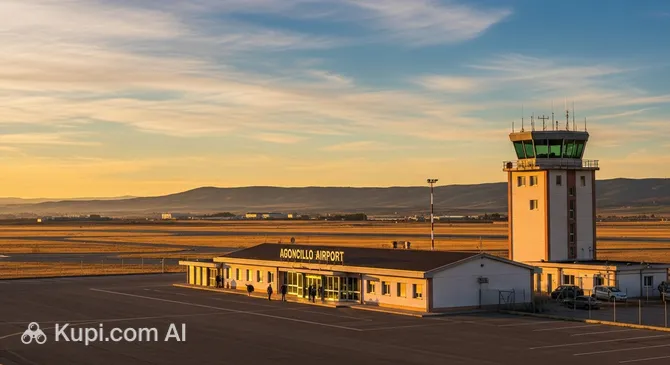
Agoncillo Airport. Source: Kupi.com Binoculars

Logroño-Agoncillo Airport is not just a transport hub, but a cozy and peaceful gateway to the famous La Rioja region. Here, you will not find the hustle and endless queues typical of giant international hubs; instead, the terminal offers an intimate atmosphere where your journey begins without stress. Located amidst picturesque landscapes, this small airport is ideal for those wishing to start their acquaintance with the gastronomic capital of Spain immediately upon landing. Thanks to the modern yet compact terminal, all procedures here are completed as quickly and comfortably as possible.

AirportAgoncillo Airport
IATARJL
ICAOLERJ
CityLogrono
TimezoneEurope/Madrid
ScheduleOnline board

Features and Advantages of the Airport:

The main advantage of this air harbour is the exceptional speed of service. Thanks to the low passenger flow and the compact size of the terminal, the journey from the building entrance to the boarding gate takes mere minutes, creating the sensation of flying on a private jet.

The airport serves as a strategic access point to the scenic routes of La Rioja. Travellers can rent a car right on the spot and find themselves in the centre of Logroño or at one of the region's famous estates within 15-20 minutes.

The terminal building, opened in 2003, is distinguished by its modern architecture and functionality. Despite its modest size, it has everything necessary for a comfortable wait, including a café and a relaxation area, and navigation is intuitive even for first-time visitors.

Contact Information

  • Official Airport Website: www.aena.es
  • Information Service Phone: (+34) 913 211 000 (Aena general information line), (+34) 941 277 400 (local administration number)
  • Airport Address: Ctra. Logroño-Zaragoza (N-232), km 14, 26160 Agoncillo, La Rioja, Spain
  • Email: aeropuertodelogrono-agoncillo@aena.es (for general inquiries) or via the feedback form on the website
  • Social Media: Official Aena accounts on X (Twitter), Facebook, and Instagram (@aena)
  • Lost Luggage Information: Office on the 1st floor of the terminal or the airline counter (usually Iberia Handling: +34 901 111 342)
  • Passenger Support Contacts: Information desk in the central hall of the terminal and the Aena online portal

How to Get to the Airport

Thanks to its compact size and close proximity to the regional capital, getting to Agoncillo Airport (RJL) is quite simple and fast. However, it is worth noting that due to the low passenger volume, the choice of transport options here is limited compared to major international hubs.

Taxi and Transfer

This is the most popular, reliable, and essentially the only way to get to the terminal for those without a personal vehicle. The trip from the city centre of Logroño takes just 10–15 minutes (distance about 12–14 km). The taxi rank is located directly in front of the arrivals hall exit.

The fare is usually fixed by the meter, but the estimated price for a trip from the city centre is between 20 and 25 Euros. On weekends, holidays, and at night, the tariff may be slightly higher. It is recommended to carry cash, although most cars are equipped with card terminals. Since the airport is small, taxis do not always wait at the entrance, so it is wise to book a car in advance by phone or via apps.

Public Transport

It is important to know that there is currently no direct regular bus service or metro line connecting the airport to the city. The train station is located in Logroño itself, and trains do not stop at the airport. Tourists should plan their budget considering the need to use a taxi or a rental car.

Car Rental

For travelling around the picturesque La Rioja region, a car is the ideal solution. Counters of international rental companies are located in the arrivals area. The road to the airport runs along the N-232 highway (Zaragoza — Logroño). This is a fast and scenic route that is hard to miss thanks to clear signage.

Airport Parking

Directly opposite the terminal is a convenient public car park. It is within walking distance of the entrances, so no transfer is required. The parking lot has sufficient capacity, and typically, there are no issues finding a space. The first 15 minutes are often provided free of charge (check current conditions at the entrance), which is convenient for dropping off passengers.

Alternative Arrival Options

Since the number of flights to Logroño is limited (often only flights from Madrid), many tourists prefer to fly into neighbouring, larger airports and then travel to La Rioja by rental car or bus. Distances to the nearest air hubs are quite comfortable for a road trip:

  • Vitoria Airport — the nearest neighbour, located less than 60 km away.
  • Pamplona Airport — located approximately an hour's drive away (65 km).
  • Bilbao Airport — the largest hub in the north, located 105 km away. This is a popular choice due to the large number of international flights.
  • San Sebastián Airport — located slightly further, 108 km away, on the border with France.
  • Biarritz Airport — a French airport located 130 km away, which can also be a convenient entry point for travelling across northern Spain.

Terminals and Map

Logroño-Agoncillo Airport (RJL) is an example of ideal compactness and functionality. It is impossible to get lost here, and the complex structure is designed to minimize stress and the time passengers spend in queues. The entire airport consists of a single passenger terminal, making navigation intuitive and simple.

Terminal Structure and Service Zones

The terminal building is a modern single-story structure covering an area of about 4,000 square meters. All key zones are on the same level, which is particularly convenient for passengers with luggage or travellers with reduced mobility.

  • Public Hall: This is the central space passengers enter immediately from the street. Here you will find check-in counters, car rental offices, an information desk, and a cafeteria. This is also the meeting point for arriving passengers.
  • Departure Zone: After checking in, passengers proceed to the security checkpoint located in immediate proximity. The "Airside" (departure lounge) is compact but equipped with everything necessary: restrooms, vending machines, and comfortable seating. There are two boarding gates here, which fully cover the needs of the current traffic.
  • Arrival Zone: Arriving passengers enter the baggage claim hall, equipped with conveyor belts. The exit from this zone leads directly to the public hall and the car park.

Navigation and Connections

Since the airport has only one terminal, there are no transfers between buildings. You will not need shuttles, trains, or long walks. The distance from the airport entrance to the furthest point (boarding gate) is no more than 100–150 meters.

Navigation inside the building is extremely simple: all processes are arranged linearly. Signs are duplicated in English and Spanish, but thanks to the open layout and direct visibility of most zones, one can orient themselves even without them.

Speed of Procedures

One of the terminal's main "attractions" is the speed of service. There are practically no congestions here, which are typical for major hubs.

  • Check-in: Usually takes from 2 to 10 minutes. Counters open 1.5–2 hours before departure, but queues are generally non-existent.
  • Security Check: Security screening is very fast, often with no waiting time at all. The staff are polite and work efficiently.
  • Boarding: Since the gates are within walking distance of the security zone, the path to the aircraft takes mere minutes. Boarding is often done by walking across the apron, allowing you to enjoy views of the surrounding mountains and vineyards before departure.

Recommendations for Passengers

Despite the high speed of procedures, it is recommended to arrive at the airport 60–90 minutes before your flight to calmly check in luggage and have a coffee in the waiting area. If you are travelling only with hand luggage and have checked in online, arriving 45 minutes prior will also be comfortable. You won't need maps or apps for navigation — simply follow the visual signs, and you will find yourself at the correct gate almost instantly.

Airport History

The history of Logroño-Agoncillo Airport (RJL) is a fascinating journey from a small military airfield to a modern gateway into one of the most prestigious agricultural regions in the world. Although it opened for mass tourism relatively recently, its roots go back to the early 20th century, making it an important witness to the development of Spanish aviation.

Military Origins and Early Years

The foundation of the air harbour dates back to 1923, when the construction of an auxiliary airfield began on the plains of Agoncillo, in a place called Recajo. Initially, the facility was exclusively military in nature and was called Recajo Air Base. In 1928, it was officially commissioned, serving as a strategic point for the Spanish Air Force. For decades, aviation was based here, training flights were conducted, and civilian aircraft were rare guests.

Opening to Civil Aviation

Formally, the airfield was opened to national civil air traffic and international tourism as early as July 1946. However, at that time, passenger transport did not develop sufficiently, and by the mid-1950s, the airport refocused on military activities and the local aeroclub. For nearly half a century, Logroño remained without a full-fledged commercial airport, which hindered tourist access to the La Rioja region.

Renaissance and Modernization

A turning point in the facility's history was 1998, when the Spanish government officially declared the airport a zone of "general interest". This decision launched a large-scale reconstruction process designed to transform the old military base into a modern civil hub. The main stage of development began in the early 2000s:

  • In May 2003, the long-awaited opening of the new passenger terminal took place. This event marked the beginning of regular commercial flights, the first of which was a route to Madrid.
  • The runway was reconstructed and extended to 2,000 meters, allowing it to accommodate modern medium-range jet liners.
  • A modern Instrument Landing System (ILS) was installed, which became a critically important improvement given the frequent fogs in the Ebro River valley.

Interesting Facts and Modernity

A unique feature of Agoncillo Airport is its dual purpose, which continues to this day. The airport shares infrastructure with a military base where an attack helicopter battalion (BHELMA III) is stationed. Passengers waiting for their flight can often observe military helicopter manoeuvres, adding a certain flair to their stay in the terminal.

Despite its modest size, the airport has become an important symbol of the region's accessibility. It has played a key role in popularizing tourism, allowing visitors and business people to quickly reach the capital of La Rioja, bypassing long train or car journeys from other cities.

Services and Amenities

Logroño-Agoncillo Airport (RJL) is a compact regional hub focused on rapid passenger transit. Due to the small size of the terminal and limited number of flights, one should not expect the variety of services typical of large international hubs (such as duty-free galleries or spas). The infrastructure is minimalist and covers only basic traveller needs.

Restaurants, Cafés, and Shops

Dining options at the airport are limited to one main establishment. In the public area of the terminal, there is a cafeteria where passengers and visitors can order coffee, refreshing drinks, sandwiches, and light snacks. It is a convenient place to wait for a flight, as the windows offer a view of the runway.

There is no full-scale Duty Free zone. However, a small kiosk or area in the cafeteria is usually available in the terminal where you can purchase newspapers, souvenirs, and, of course, regional produce — famous local specialties and sweets, allowing you to buy last-minute gifts before departure.

Lounges and VIP Services

There are no separate business lounges or VIP areas at Agoncillo Airport. Given that passing through all procedures (check-in and security) takes mere minutes, the need for long waits in a special zone is eliminated. The general departure lounge is spacious enough, quiet, and equipped with comfortable seating.

Connectivity and Technology

As with all airports in the Aena network, passengers are provided with free high-speed Wi-Fi. To connect, find the network AIRPORT FREE WIFI AENA and complete a simple authorization procedure via your browser. The waiting hall also provides power outlets for charging mobile devices and laptops, located in convenient places near the seats.

Financial Services

There are no currency exchange offices in the terminal. Travellers are strongly advised to carry Euros in cash or bank cards in advance. An ATM is installed in the public area (hall) for cash withdrawals. If you need to exchange currency, it is best to do so in the city of Logroño during bank working hours.

Services for Passengers with Children

The airport is family-friendly. Restrooms are equipped with changing tables for infant care. Thanks to the terminal's compactness, moving around with a stroller is effortless, and staff generally treat passengers with children with consideration, helping to speed up the boarding process if necessary.

Medical Assistance

There is no full medical centre with permanent doctor staffing in the building, but the personnel are trained in first aid. The terminal is equipped with defibrillators and first aid kits for emergencies. In case of serious health issues, staff promptly call an ambulance from the nearest settlement.

Services for Passengers with Reduced Mobility

The airport is fully adapted for passengers with reduced mobility under the "Sin Barreras" ("Without Barriers") programme.

  • The terminal is single-story, eliminating the need for elevators or escalators.
  • Specially equipped restrooms and parking spaces right at the entrance are provided.
  • A free assistance service is available. Staff will help with check-in, security screening, and boarding the aircraft. Important: the service must be booked in advance (at least 48 hours) via the official Aena website or your airline's app.

Hotels and Accommodation

There are no hotels within the airport grounds, and the terminal closes at night, so sleeping in the building is not possible. The nearest accommodation options are a few minutes' drive away:

  • In the village of Agoncillo (about 2–3 km from the terminal), there are small guesthouses and hotels suitable for a transit overnight stay.
  • The main choice of hotels (from budget hostels to 4-5 stars) is located in the city of Logroño (10–15 minutes by taxi).

Conference Rooms and Business Services

There is no specialized business centre with meeting rooms in the terminal. For business meetings or work, passengers usually use tables in the cafeteria, where there is Wi-Fi access and a relatively quiet atmosphere.

Where to Eat

The dining scene at Agoncillo Airport (RJL) fully corresponds to its concept as a "boutique" regional terminal: minimalism prevails here. Passengers should not expect food courts with fast food or fine dining restaurants. All catering infrastructure is concentrated in one spot, which is convenient for a quick stop before departure.

Restaurants and Cafés: Public Zone (Landside)

The only full-service catering establishment at the airport is the cafeteria-restaurant located in the Public Hall. It is situated before the security checkpoint, so it is accessible to both departing passengers and those seeing them off.

  • Atmosphere: A spacious and bright room with panoramic windows offering a view of the runway. It is a calm place where you can pass the time with a cup of coffee.
  • Menu: The assortment is based on classic Spanish snacks. They offer fresh pastries (croissants, napolitanas), hot and cold sandwiches (bocadillos), and light tapas.
  • Drinks: A good selection of coffee, juices, and soft drinks. The beverage list reflects the spirit of the La Rioja region.

Departure Zone (Airside)

It is important to remember: after passing security control ("Airside"), there are no cafés. Only vending machines are installed in the boarding lounge. You can buy bottled water, soda, chocolate bars, and packaged snacks (chips, crackers) from them. Hot meals or freshly brewed coffee are not available after security.

Local Cuisine and Specialties

Despite the modest scale, the cafeteria tries to maintain the image of the gastronomic region:

  • Regional Beverages: You may find local grape-based beverages available. It is a way to experience the local produce before leaving.
  • Tortilla de Patata: The classic Spanish omelette with potatoes is usually served here as a pincho (on a slice of bread). It is a filling and inexpensive snack.
  • Cured Meats and Cheese: The menu often includes sandwiches (bocadillos) with cured meat or local cheese, which is a great "to-go" option.

Dietary Options (Vegetarian, Halal, Gluten-Free)

The selection of specialized dishes at the airport is extremely limited:

  • Vegetarians: Can count on tortilla (omelette), pastries, or cheese sandwiches. Salads are not always available.
  • Vegans: Options are practically non-existent, except for packaged snacks (nuts, chips) or fruit if available.
  • Gluten-Free and Halal: Specialized menu labelling is absent. Halal options are not specifically marked and cured meats (often pork-based) are common. Passengers with strict dietary restrictions are strongly advised to bring food with them or eat a full meal in the city of Logroño before travelling to the airport.

Prices and Opening Hours

The airport's pricing policy is moderate, although slightly higher than in ordinary city cafés:

  • Average Bill: Coffee and pastry will cost approximately 4–6 Euros. A drink with tapas or a large sandwich — about 8–12 Euros.
  • Opening Hours: The cafeteria schedule is strictly tied to the flight schedule. The establishment opens 1.5–2 hours before the first departure and closes after the last flight leaves. On days without flights, the café may be closed.

Recommendations for Passengers

For a quick snack, the cafeteria in the public zone is ideal: service is fast, and the coffee is of good quality. However, if you are planning a full lunch, it is better to do so at one of the famous restaurants in Logroño (for example, on Laurel Street) before heading to the airport. Full-cycle hot meals (soups, steaks) are usually not offered in the terminal.

Critical Tip: If you are hungry, be sure to eat in the public zone (Landside) before passing security. Once in the departure zone, you will be left with only vending machines.

Tips for Travellers

Travelling through a compact regional airport like Logroño-Agoncillo has its own specifics. To ensure your trip goes as smoothly as possible and leaves only pleasant impressions, use the following practical tips, compiled taking into account the features of this terminal.

Optimal Arrival Time

The main advantage of this airport is the lack of crowds. You do not need to arrive 3 hours in advance as in major hubs. The optimal arrival time is 60–90 minutes before departure. This is quite enough to check in luggage without rushing, pass control, and have a coffee. If you are flying only with hand luggage and already have a boarding pass, arriving 45–50 minutes prior is possible, but risking a smaller time margin is not worth it.

Check-in and Security Features

Check-in counters close strictly 45 minutes before departure. Standard European security rules apply at the checkpoint, but with a local touch: staff work thoroughly but quickly.

  • Prepare in advance to take laptops, tablets, and your bag of liquids out of your luggage.
  • Do not forget that outerwear and belts with metal buckles will also need to be removed and placed in a tray.
  • Queues are rare here, but if a group of tourists is ahead of you, the process may take a little longer.

Hand Luggage Rules: Transporting Liquids

Since Logroño is the capital of a major agricultural region, a common mistake passengers make involves attempting to carry bottles of local produce in the aircraft cabin. Remember the important rule: bottles of liquids (0.75 L) are prohibited in hand luggage.

If you bought local beverages or olive oil in the city, they must be checked in as luggage. Ensure that bottles are securely packed (it is best to use special protective sleeves or wrap them in clothes) to avoid breaking them in transit. You can only take liquids in containers up to 100 ml into the cabin, packed in a transparent bag with a volume of no more than 1 litre.

Choosing a Seat on the Plane

The flight over the La Rioja region is very picturesque. When checking in online, try to choose Window seats. During takeoff and landing, stunning views open up of the endless geometric patterns of the fields, the Ebro River valley, and the Sierra de Cantabria mountain ranges. This is a free aerial excursion that should not be missed.

Tips for Transit Passengers

Most flights from Logroño head to Madrid (Barajas), which serves as a hub for further travel.

  • If you have a single ticket (for example, with Iberia), confirm at the check-in counter that your luggage is checked through to your final destination. You will not need to collect it in Madrid.
  • The transfer time in Madrid should be sufficient (minimum 1–1.5 hours), as you will have to move between terminals (often from T4 to T4S), which takes time.

Saving Time and Money

There are no Duty Free shops with a wide assortment at the airport, so do not leave souvenir shopping until the last moment. Local gifts and sweets are better and cheaper to buy in supermarkets in Logroño or specialized shops in the city.

Another important tip for saving money: if you are hungry, eat in the cafeteria in the public zone before passing security. Prices there are lower, and the selection is better. After passing through the metal detector, only snacks from a machine at higher prices will be available to you.

Actions in Case of Flight Delay

Due to fogs in the Ebro valley during the autumn-winter period, flight delays or cancellations are possible. If you learn about a delay while at the airport:

  • Do not rush to enter the departure zone. Stay in the Public Hall as long as possible. There is a café, comfortable seats, and more space there. Waiting in the "Airside" area will be much less comfortable.
  • Watch the information boards and listen for announcements. Since the terminal is small, information spreads instantly.
  • If the flight is cancelled or significantly delayed, contact the airline representative at the check-in counter — in a small airport, this is the only way to receive vouchers for food or transfer.

Reached the end of the page?

That means the route is fully explored