Support

Cordoba Airport

About the Airport

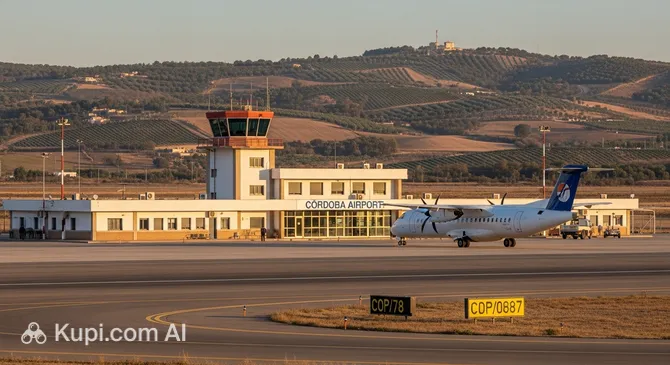
Cordoba Airport. Source: Kupi.com Binoculars

Cordoba Airport is a compact and welcoming aerial gateway, providing quick access to the heart of Andalusia and its architectural treasures. Located just a few minutes' drive from the historic centre, it offers travellers a unique atmosphere of tranquillity, completely unlike congested international hubs. Although regular commercial connections are limited here, the airport plays a key role for private aviation, seasonal charters, and summer tourism programmes. It is the ideal arrival point for those who value their time and wish to find themselves at the walls of the famous Mezquita almost immediately after landing.

IATA Code ODB
ICAO Code LEBA
City Cordoba
Distance to centre 6 km
Status Regional / Civil
Passengers per year ~5,300 (predominantly private aviation)
Schedule Charter and seasonal flights

Features and Advantages of the Airport

The main advantage of the airport is its phenomenal proximity to the city. The distance to the centre is only 6 kilometres, allowing you to reach your hotel or landmarks in literally 15–20 minutes by taxi. Thanks to the small size of the terminal and the absence of heavy traffic, all pre-flight procedures — from check-in to boarding — pass at lightning speed, sparing passengers from tiresome queues.

Following a major reconstruction of the runway, the airport gained the capacity to receive larger aircraft, which increased its appeal for seasonal tourist groups and business aviation. A calm environment prevails here, and the staff pays attention to every guest, making arrival or departure as comfortable and stress-free as possible.

Contact Information

  • Official Website: Current information on flights, services, and regulations of Cordoba Airport can be found on the official portal of Spanish airports, Aena: www.aena.es/es/cordoba.html.
  • Information Service Phone: For inquiries, you can call the unified Aena network number: (+34) 91 321 10 00.
  • Airport Address: Ctra. N-437, km 5.8, 14005, Cordoba, Spain.
  • Email: To contact the administration, it is recommended to use the feedback form available on the official Aena website in the contacts section.
  • Social Media: The airport is part of the Aena network. You can follow general news and updates on the official Aena social media accounts (e.g., Twitter @aena).
  • Lost Luggage Information: If you have lost luggage during your flight, you should first contact your airline's representative office. For items left within the airport premises, please contact the Lost and Found service (Objetos perdidos).
  • Passenger Support Contacts: General questions can be directed to the information service phone line. Passengers with reduced mobility are provided with special assistance (Servicio Sin Barreras), which must be booked in advance through the airline or the Aena website.

Getting to the Airport

Cordoba Airport (ODB) is located approximately 6 kilometres southwest of the city centre, and it can be reached via several convenient methods. The choice of the optimal option depends on your budget, time, and amount of luggage.

The most economical way is public transport. A special bus route O-2 (Aeropuerto - Estación de Autobuses - RENFE - Centro) directly connects the airport with key points in the city, including the main railway station and the bus terminal. The journey takes about 30 minutes, and the ticket price is very reasonable. It is important to note that there is no direct train or metro connection to the airport, so the bus is the only public transport option.

For those who value comfort and speed, a taxi or a pre-booked transfer is the ideal choice. A taxi ride from the city centre to the terminal will take just 15–20 minutes, depending on traffic conditions. The cost of such a trip will be approximately 15–25 euros. Booking a private transfer is particularly convenient if you are travelling with a large amount of luggage or with family and wish to be assured of a fixed price.

If you plan to actively travel around Andalusia and other regions of Spain, it is worth considering car rental. There are counters for several rental companies at the airport, allowing you to select a car immediately upon arrival. For those arriving at the airport in their own or rented vehicle, convenient parking is provided in front of the terminal building, suitable for both short-term and long-term stays.

Terminals and Map

Cordoba Airport (ODB) is a small and compact aviation hub in the south of Spain, making navigation extremely simple. There is only one passenger terminal here, which serves both domestic and seasonal international flights. Thanks to its modest size, you will not have to worry about long walks or the risk of getting lost.

The entire airport infrastructure is located on a single floor, which is very convenient for passengers. The terminal layout is intuitive: upon entering the building, you will immediately see the check-in area with several counters. After completing check-in and dropping off your luggage, you proceed to the security checkpoint, behind which lies a small departure lounge. The arrival area is also located on this same level and includes a baggage claim belt and an exit to the main hall where you can meet arriving passengers.

Due to the small size of the airport, completing all pre-flight formalities usually takes minimal time. Registration and security screening procedures proceed quite quickly. Nevertheless, it is recommended to arrive at the airport as standard — 1.5-2 hours before departure, to drop off luggage and pass security control without haste.

The main advice for navigation is simple: follow the signs. All important information is displayed on screens, and staff are always ready to assist. Since all services — from airline counters to car rental offices and a small café — are located in one hall, you will easily find everything you need. You will not have to worry about how to get from one terminal to another, making travel through Cordoba Airport maximally comfortable and fast.

Airport History

The history of Cordoba Airport (ODB) dates back to the late 1930s. Initially, it was used as a military airfield and belonged to the Air Force of Spain. An important turning point occurred on 25 May 1958, when the airport was officially opened to domestic civil air traffic. Shortly thereafter, the airline Aviaco launched the first regular flights connecting Cordoba with Madrid, marking the beginning of its new, civil chapter.

With the growth of passenger traffic, the need arose to improve infrastructure. In 1965, a passenger terminal building was constructed, becoming the hub for traveller services. The next important step was the modernization of the runway. In 1980, it was widened, and in 1995, extension works were completed. However, even after these improvements, its length remained insufficient to accommodate many medium-haul aircraft, which held back the airport's development.

A truly new era for Cordoba Airport began in the 21st century. After years of planning, a large-scale project to extend the runway was launched. The works, which began in 2007, included complex engineering solutions, including rerouting a nearby road. This ambitious project was completed in 2018, when the updated runway was put into operation. Its length increased to 2,285 metres, which finally allowed the airport to receive popular aircraft, such as the Airbus A320 and Boeing 737, without load restrictions.

Interesting fact: for decades, Cordoba Airport was considered one of the most limited in Andalusia due to its short runway. Its history is, in essence, a story of a long struggle for modernization. Today, after the latest reconstruction, the airport is fully ready to serve tourist flows, contributing to the development of this beautiful historic city. It has gone from a modest military airfield to a modern aerial gateway connecting Cordoba with the rest of the world.

Services and Amenities

Cordoba Airport (ODB) is a compact regional airport that nevertheless offers all the basic amenities for a comfortable wait for your flight. Although the range of services here is not as extensive as in major international hubs, passengers will find everything necessary before departure or upon arrival.

You can have a snack or drink coffee in the cafeteria located in the public zone of the terminal. A shop also operates here, where you can buy press, books, souvenirs, and essential items. Please note that the selection of dining venues and shops is limited, so for full-scale shopping or dining, it is better to allocate time in the city.

Free Wi-Fi is available throughout the airport via the AENA network. Special power outlets and USB ports are provided in the waiting lounges for charging electronic devices. Regarding premium facilities, there are no VIP lounges available for general passengers at Cordoba Airport.

For financial transactions, an ATM is installed in the terminal. There is no currency exchange bureau at the airport, so it is recommended to arrange currency exchange in advance at one of the city's banks. In case of necessity, there is a first aid point at the airport.

For passengers with special needs, the free "Sin Barreras" support service is provided. This is a standard for airports in Spain, ensuring escort and assistance at all stages — from check-in to boarding the aircraft. It is recommended to book the service at least 48 hours before departure. For travellers with small children, nursing rooms with changing tables are equipped.

There are no hotels directly on the airport grounds, however, many accommodation options can be found in Cordoba itself, which is easily accessible by taxi or bus. Specialized conference rooms or business centres are also absent at the airport, which is typical for small regional air terminals.

Dining Options

Cordoba Airport (ODB) is a regional airport, so the choice of establishments here is not as large as in major hubs, but quite sufficient for a snack before departure. The main food points are concentrated in the main terminal building and offer options for every taste and budget.

In the public area (landside), before passing security control, a cafeteria usually operates. This is an excellent place for those seeing off passengers or arriving at the airport early. Here you can drink coffee with fresh pastries, order a sandwich, or enjoy light snacks. Prices here are generally moderate.

The main part of the establishments is located in the secure area (airside), after screening. Here, travellers can find spots for a quick bite as well as cafés for a more substantial lunch. The assortment includes traditional snacks for Spain such as tapas, sandwiches (bocadillos) with cured meats or cheese, salads, and hot dishes. We recommend trying something from Andalusian cuisine if the opportunity arises. The opening hours of most establishments are tied to the flight schedule — they open early in the morning and close after the departure of the last aircraft.

For passengers with special dietary needs, for example, vegetarians or those adhering to a gluten-free diet, the café menu usually has several suitable options, such as salads or vegetable sandwiches. Nevertheless, there are no specialized restaurants here, so it is better to clarify the ingredients of dishes with the staff. If you need a quick snack, grab a packaged sandwich and a drink, but if you have time, you can sit quietly in the main café in the departure zone and enjoy a full lunch.

Travel Tips

To ensure your journey through the airport of Cordoba goes as smoothly as possible, take advantage of our tips. Planning is the key to a calm start and finish to your trip, especially if you are flying from Spain for the first time.

Arrival Time and Check-in: It is recommended to arrive at the airport at least 2 hours before international flights and 1.5 hours before domestic ones. To avoid queues, use online check-in, which most airlines open 24 hours before departure. This will allow you to head straight to baggage drop or, if you are travelling light, to the security screening area.

Security Control and Hand Luggage: Prepare for security screening in advance. Liquids (in containers up to 100 ml) must be packed in a transparent bag. Laptops, tablets, and other large gadgets must be removed from your bag into a separate tray. It is strictly forbidden to carry sharp objects, weapons, and flammable substances in hand luggage. Power banks, conversely, should only be taken into the cabin.

Seat Selection and Savings: When choosing a seat on the plane, consider your preferences: a window seat offers beautiful views during takeoff and landing, while an aisle seat allows you to stand up and stretch your legs freely. To save money, bring an empty water bottle with you and fill it after passing security. Prices for food and beverages at the airport are traditionally higher, so a light snack brought with you will not be amiss. It is also more cost-effective to book a taxi in advance or study the public transport schedule than to resolve this issue upon arrival.

Transfers and Customs: If you have a connecting flight, clarify at check-in whether you will need to collect and re-check your luggage at the intermediate airport. Arriving from a country outside the Schengen area, you will have to pass customs control. Follow the "Green Channel" if you have nothing to declare, or the "Red Channel" if you are carrying goods subject to declaration.

In Case of Flight Delay: If your flight is delayed, first contact your airline representative for information. Remember your rights: for flights departing from the EU, regulation EU261 applies, which, depending on the length of the delay, may provide for beverages, meals, and in some cases, hotel accommodation. Remain calm and keep all documents close at hand.

Reached the end of the page?

That means the route is fully explored