Support

Badajoz Airport

About the Airport

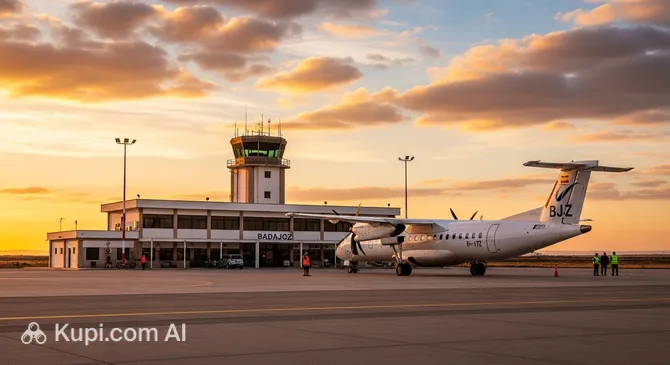
Badajoz Airport. Source: Kupi.com Binoculars

Badajoz Airport (BJZ), also known as Talavera la Real, is a compact and modern aerial gateway to the picturesque Extremadura region in western Spain. Located on the border with Portugal, it serves as an important transport hub not only for the city of Badajoz but also for historic Mérida, the regional capital, located just 45 km away. The airport shares its runway with a military airbase, giving it a unique status. Despite its modest size, it plays a key role in connecting Extremadura with the country's major cities, such as Madrid and Barcelona, offering passengers a quick and comfortable start to their journey.

IATA Code BJZ
ICAO Code LEBZ
City Badajoz
Distance to centre approx. 14 km
Status Domestic
Annual passengers approx. 80,200 (2023)
Popular Airlines Iberia, Binter Canarias
Schedule Badajoz Airport online board

The main advantage of Badajoz Airport is its compactness and convenience. The small terminal allows passengers to complete all pre-flight formalities without unnecessary bustle or long queues, which is especially appreciated by those who prefer calm travel. The airport is connected to the cities of Badajoz and Mérida by the modern A-5 motorway, and taxi and car rental services are available for the convenience of travellers. A pleasant feature is the free parking provided by Aena, making trips by private car even more cost-effective. Free Wi-Fi is available throughout the terminal, allowing you to stay connected while waiting for your flight.

Contact Information

For your convenience, we have compiled the main contact information for Badajoz Airport (BJZ).

  • Official website: You can always find the most up-to-date information on flights, services, and airport regulations on the official website of the Spanish airport operator Aena: www.aena.es/es/badajoz.html
  • Information desk phone: For information about flights, services, and airport operations, you can call the unified Aena number: (+34) 91 321 10 00.
  • Address: Carretera Nacional N-V, km. 182, 06195, Badajoz, Spain.
  • Email: A direct email address for general inquiries is not provided. It is recommended to use the contact form on the official airport website to communicate with services.
  • Social media: Follow news and updates from Aena (the airport operator) on official accounts, for example, on Twitter/X (@aena).
  • Lost luggage information: If your luggage was lost during the flight, you should first contact your airline's representative at the airport. For items left within the terminal (not on the plane), contact the Lost and Found service (Objetos perdidos) via the special section on the Aena website.
  • Passenger support contacts: For all questions, you can contact the general information phone (+34) 91 321 10 00 or use the online services on the operator's official website.

How to Get to the Airport

Badajoz Airport (BJZ) is located approximately 14 kilometres east of the city centre of Badajoz, in a picturesque region in western Spain. You can reach it in several ways, the choice of which depends on your budget, time, and preferences.

Public transport to the airport is poorly developed. There is no direct and regular bus service to the city centre, which should be taken into account when planning your trip. Seasonal or special routes may occasionally be launched, so it is recommended to check the current schedule on the local bus company's website before travelling. There is no direct rail or metro connection to the airport.

The most convenient and predictable way to get to the airport is by taxi or pre-booked transfer. The trip from the centre of Badajoz will take about 15–20 minutes depending on traffic conditions. The cost of a taxi ride is usually 20–25 euros. Booking a private transfer can be a cost-effective solution for groups or travellers with a lot of luggage, as the price will be fixed.

For those who value independence and plan to travel around the Extremadura region, car rental is an excellent option. Several rental agencies operate at the airport and in the city. The road from the city centre to the airport is simple and runs mainly along the A-5 motorway, so you are unlikely to get lost.

If you are driving to the airport in your own or a rented car, you can use the official parking. Parking lot P1 is located directly opposite the terminal building, which is very convenient. Spaces are usually available, as the airport is not overcrowded. This is a good option for both short-term and long-term parking.

Terminals and Map

Badajoz Airport (BJZ) is a small and modern regional airport distinguished by its compactness and convenience for passengers. All its infrastructure is concentrated in a single passenger terminal, which serves both domestic and international flights. Thanks to this, navigating here is very easy, even if you are visiting for the first time.

The terminal layout is extremely simple. The building is single-storey, and all key zones are located within walking distance of each other. Upon entering the terminal, you immediately find yourself in the public area, where airline check-in counters and a small waiting hall are located. Since there is only one terminal, the issue of transfers between them is irrelevant — all processes take place in one building.

Departure and arrival zones are clearly separated. After checking in for a flight, passengers proceed to the security screening area, which leads to a small but comfortable departure hall. There are several boarding gates here. The arrival zone is located in another part of the building and includes a baggage claim belt and an exit to the public area, where you can meet arriving passengers or take a taxi.

Check-in and security procedures at Badajoz Airport usually pass very quickly due to low passenger traffic. As a rule, it takes no more than 20-30 minutes. Nevertheless, it is recommended to arrive at the airport 1.5-2 hours before departure to check in luggage and complete all formalities without rushing, especially during the peak tourist season.

To navigate the terminal, simply follow the signs, which are clearly visible and intuitive. Given the small size of the airport, it is practically impossible to get lost here. Everything you need — from information desks to cafes and boarding gates — is within a few minutes' walk, making travel through Badajoz Airport as comfortable and carefree as possible.

Airport History

The history of Badajoz Airport (BJZ) is inextricably linked with the military aviation of Spain. Its origins go back to 1953, when the Talavera la Real Air Base (Base Aérea de Talavera la Real) was founded, intended for training jet pilots. From the very beginning, the airfield had a dual purpose, and already in the early years, it received occasional civil flights, although full-fledged infrastructure for passengers did not yet exist.

The official start for civil aviation in Badajoz is considered to be July 14, 1976. On this day, the airport was opened for regular domestic passenger traffic. This was preceded by an important modernization: the runway was extended to 2,850 metres and equipped with a lighting system, which allowed commercial liners to be received at any time of day. Soon after, the first permanent route was launched, connecting the airport with the capital — Madrid.

The airport began to acquire its modern look in 1990 with the construction of a passenger terminal. However, the most significant transformation occurred between 2007 and 2010. During a large-scale reconstruction, the terminal area was more than doubled, the apron for aircraft parking was expanded, and a new car park was built. These improvements significantly increased capacity and raised the level of comfort for travellers.

One of the most interesting facts about Badajoz Airport is its continued joint use by military and civil services. The runway and control tower are shared with the Talavera la Real Air Base, where the 23rd Wing of the Spain Air Force is based today, engaged in fighter pilot training. Thus, passengers flying from Badajoz may witness training flights of military aircraft, adding uniqueness to this important transport hub of the Extremadura region.

Services and Amenities

Badajoz Airport (BJZ) is a compact regional airport offering all necessary services for a comfortable wait for your flight. Despite its small size, the terminal is well-organized and convenient for passengers.

For a snack or a full meal, there is a café-restaurant in the airport where you can order drinks, snacks, and hot dishes. There is also a small multi-purpose shop selling souvenirs, press, travel goods, and local delicacies. There are no specialized VIP lounges at the airport, but the general waiting area is spacious and comfortable enough.

Free Wi-Fi from the operator Aena is available throughout the terminal. Special stands and power outlets are provided in the waiting hall for charging gadgets. There are no bank branches or currency exchange offices at the airport, but there are ATMs for withdrawing cash. It is recommended to exchange currency in advance.

The airport is fully equipped for passengers with reduced mobility. A free assistance service is provided, which should be requested at least 48 hours before departure. For travellers with small children, there are changing tables in the restrooms. In case of need, you can contact the first aid station. There are no hotels on the airport territory, but many accommodation options are located in the city of Badajoz itself, which can be quickly reached by taxi or rental car. Conference rooms and business centres are absent in the terminal.

Dining

Badajoz Airport (BJZ) is a small regional airport, so the choice of dining establishments here is quite compact. Passengers should not expect a large variety of restaurants and fast-food chains found in major international hubs. The main opportunities for a snack and a full lunch are concentrated in one main café-restaurant.

This establishment is located in the public zone (landside), before security control, which is convenient for both departing passengers and those meeting them. The menu usually features classic options for Spain: coffee, soft drinks, pastries, as well as famous Spanish sandwiches — bocadillos. For a more substantial meal, you can order platos combinados — combo plates, for example, with meat, french fries, and salad. After passing security control (airside), the choice is usually limited to vending machines with drinks and snacks.

Since the airport is located in the Extremadura region, known for its meat delicacies, be sure to try a bocadillo with Iberian ham (jamón ibérico) or local cheese. This is a great opportunity to explore the region's gastronomy right before departure. Regarding special dietary requests (vegan, gluten-free, or halal dishes), their availability is unlikely. Travellers with strict dietary restrictions are recommended to carry their own suitable snacks.

Prices in the airport café are slightly higher than in the city, which is standard practice for such facilities. The opening hours of the establishment are directly tied to the flight schedule: it opens a few hours before the first departure and closes after the last one departs. Thus, if you have a flight, you will definitely have time to drink coffee or have a snack.

Travel Tips

To ensure your journey through Badajoz Airport goes smoothly, use these helpful tips. Badajoz Airport (BJZ) is a small regional hub, making it quite easy to navigate. It is recommended to arrive at the airport at least 1.5-2 hours before the departure of a domestic or Schengen flight. This time is enough to check in and pass security control without rushing. To save time, complete online check-in and print your boarding pass or save it on your mobile device.

When choosing a seat on the plane, consider your preferences: a window seat will give you picturesque views of the vastness of Extremadura during takeoff and landing, while an aisle seat will allow you to stand up and stretch your legs freely. When preparing for security, remember the rules for carrying hand luggage: all liquids (shampoos, creams, perfumes) must be in containers of no more than 100 ml and packed in one transparent bag with a volume of up to 1 litre. Electronic devices, such as laptops and tablets, will need to be removed from the bag and placed in a separate tray.

Since the airport mainly serves flights within Spain and the Schengen area, customs control for most passengers is very fast or non-existent. If you are flying from a non-Schengen country, follow the signs "Green Channel" (if you have nothing to declare) or "Red Channel" (if you have goods subject to declaration). Transfers at this airport are rare, but if you have a connecting flight, ensure there is enough time between flights to pass security control again if required.

To save money, consider bringing an empty reusable water bottle with you — it can be filled at drinking fountains after the security zone. Also, a pre-booked transfer or taxi from the airport may turn out to be cheaper than finding a car on the spot. Keep an eye on the tariffs and services offered by your airline: sometimes it is more profitable to pay for luggage online in advance than at the airport.

In case of a flight delay, remain calm. First, find the information board to get updated information. Then contact your airline representative at the counter in the airport — they are obliged to provide you with details about the reason for the delay and the estimated departure time. Depending on the duration of the wait, the airline may be required to provide you with drinks, meals, or even hotel accommodation. Keep all receipts for unforeseen expenses to request compensation later.

Reached the end of the page?

That means the route is fully explored