Support

Damascus Citadel

About

Towering over the ancient quarters, the Citadel of Damascus is one of the most impressive examples of medieval fortification architecture in the Middle East. This powerful fortress, located in the northwestern corner of the Old City, served for many centuries not only as a reliable defense but also as the main residence of the rulers for which Damascus was famous.
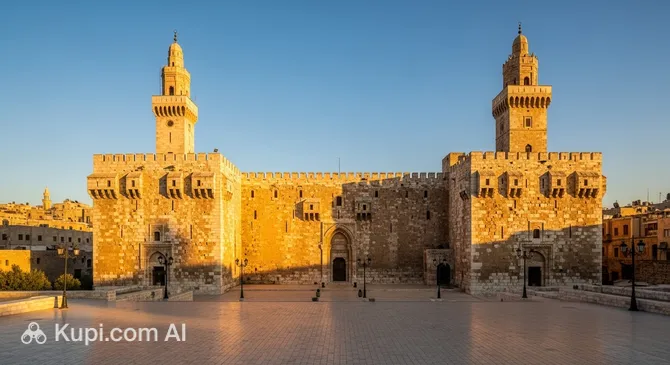
Damascus Citadel
Damascus Citadel. Иллюстрация. Источник: Kupi.com AI

As an important historical monument protected by Syria, the citadel has preserved a layout reminiscent of a Roman castrum camp. Its modern appearance was mainly formed in the 11th century under the Seljuks. The fortress survived many sieges, destructions, and reconstructions, which turned its walls into a real stone chronicle, where each layer of masonry tells of different eras — from the Crusades to Ottoman rule.

Today, it is a unique architectural ensemble included in the UNESCO World Heritage list. Travelers are attracted by the opportunity to see massive towers, skillfully decorated gates, and the remains of palace interiors that were once the center of political life in the region.

Contacts

For current information before your visit, you can use the official contact details. It is also recommended to check the website of the Directorate-General of Antiquities and Museums.

How to contactContact
AddressG862+JF6, Дамаск, Сирия
Phone+963 930 517 426
Websitewww.dgam.gov.sy

What to Do

The main reason to visit the citadel is the opportunity to touch thousands of years of history embodied in stone. Visitors can explore the massive defensive walls and towers, each demonstrating unique construction techniques from different periods. Be sure to climb to the upper levels: from there, an impressive panoramic view of the Old City rooftops and mosque minarets opens up.

Inside the fortress walls, the ruins of historical structures have been preserved, among which the remains of the "House of Roses" residence, dating back to the Seljuk period, deserve special attention. Walking through the inner courtyards, you can imagine how palace chambers and garrisons of warriors were once located here.

A visit to the citadel will be an excellent starting point for a grand journey through the historical center. Right outside its gates begins the famous Al-Hamidiyah Souq, leading to the legendary Umayyad Mosque. This place is perfect for feeling the spirit of one of the oldest continuously inhabited cities in the world.

Getting There

The majestic Citadel of Damascus is located in the northwestern part of the Old City. The exact address is G862+JF6, Damascus, Syria. It is easy to find, as it is one of the most prominent landmarks of the historical center, surrounded by ancient walls.

The most atmospheric way to reach the fortress is to walk through the main gates of the Old City. The path goes through the famous covered market, Al-Hamidiyah Souq, which leads directly to the historical complex. This is an ideal route for those who want to immediately immerse themselves in the flavor of an oriental city.

If you are in another part of the capital, it is most convenient to take a taxi. Simply tell the driver the name of the attraction, and you will be taken to the entrance of the Old City. Local microbuses (servis) also run towards the center, but for tourists, a taxi remains a more comfortable and simpler option.

Ближайший город: Damascus

History & Facts

The history of this defensive structure began in ancient times. It is believed that the first fortifications on this site were laid by the Roman Emperor Diocletian at the end of the 3rd century. Later, during the Seljuk period, the ruler Tutush I implemented a large-scale project in 1076–1078 to build a new fortress, giving it the features of a classic Roman castrum with four gates.

Over the centuries, the citadel witnessed dramatic events and was rebuilt several times. In 1260, during the Mongol invasion, the western wall was almost destroyed by heavy catapults, and the internal palaces suffered from fires. However, each time the fortress rose from the ruins: under the Mamluk Sultan Qutuz and his successors, the fortifications were strengthened and expanded.

One of the most unusual facts is the siege of the fortress by Tamerlane in 1401. It is said that the invaders used fire and vinegar to break down the masonry of the walls. Nevertheless, by 1405, the outer defensive belt was restored, emphasizing the strategic importance of this site for the rulers of Damascus.

With the arrival of the Ottoman Empire in 1516, the military importance of the citadel gradually began to decline. By the 17th century, it housed Janissary barracks, and in the 19th century, the deep moat surrounding the walls was filled in. The fortress was last used for defensive purposes in 1925, remaining today a silent monument to the region's centuries-old history.

Time Needed

To take a leisurely look at the massive walls, towers, and inner spaces of the citadel, it usually takes about 2–3 hours. This is enough time to study the architectural details and take memorable photos.

However, if you plan to combine a visit to the fortress with a walk through Al-Hamidiyah Souq and a visit to the Umayyad Mosque, we recommend allocating at least 4–6 hours for this route. The Old City invites long walks and a thoughtful study of history.

Working Hours

The citadel hospitably welcomes visitors throughout the week. From Monday to Thursday, as well as on Sunday and Saturday, the fortress is open from 08:00 to 00:00 (midnight). This allows you to see the ancient walls not only in daylight but also in the rays of evening illumination.

A special schedule applies on Friday: on this day, the site is open 24 hours a day. Nevertheless, before your visit, it is recommended to check the information on the official website or with local guides, as the schedule may change during holidays.

DayWorking hours
понедельник08:00–00:00
вторник08:00–00:00
среда08:00–00:00
четверг08:00–00:00
пятницаКруглосуточно
суббота08:00–00:00
воскресенье08:00–00:00

Nearby

Exploring the surroundings of the fortress will allow you to get a complete picture of life in the ancient capital. The Old City of Damascus is literally filled with architectural monuments, cozy cafes, and traditional markets, all within walking distance of each other.

A walk through the narrow streets near the citadel will open the doors to ancient hammams and mosques, each keeping its own secrets. Here is a list of the most interesting sites located nearby:

NameDistance
Bakdash0.2 km
Al-Hamidiyah Souq0.2 km
Azem Palace0.5 km
Sayyidah Ruqayya Shrine0.6 km
Abu Abdou1.3 km
Sibki Park1.4 km
Abbasid Square2.1 km

Reached the end of the page?

That means the route is fully explored