Support

Chinatown

About

Chinatown in Bangkok is not just a district, but an entire world pulsing with life in the historical heart of Thailand's capital. It is rightfully considered one of the largest and most colorful Chinatowns outside of China. Here, the ethnic Chinese community carefully preserves its centuries-old traditions, language, and culture, creating a unique atmosphere that transports visitors to another reality.

A walk through Chinatown is a true adventure for all the senses. The narrow, eternally busy streets are filled with the hum of voices, the aromas of exotic dishes, and the bright colors of Chinese signs and lanterns. The district is famous for its intense and noisy atmosphere, where new discoveries await around every corner: from traditional shops and markets to ancient temples hidden in the alleys.
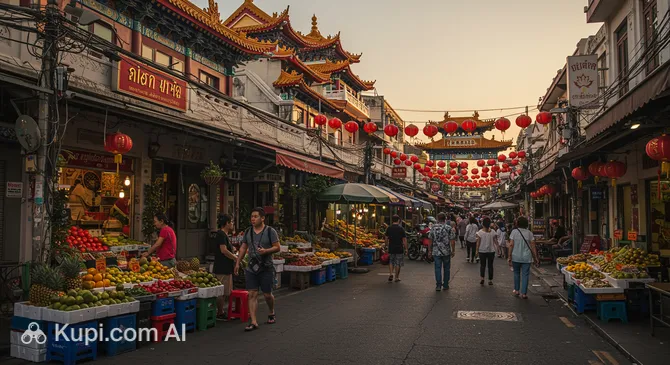
Chinatown. Illustration.
Source: Kupi.com AI

Traveler photos:

The heart of the quarter is Yaowarat Road, which undergoes a special transformation in the evening, becoming a massive open-air restaurant. This is the place to try authentic Chinese cuisine, purchase gold in numerous jewelry shops, find rare medicinal herbs, or simply buy unusual souvenirs to remember your trip. Visiting this district is an opportunity to take a cultural and gastronomic journey without leaving the Thai capital.

Contacts

Bangkok's Chinatown is a vast historical district rather than a single site with a central administration, so it doesn't have a general inquiry phone number or website. The heart of the quarter lies along Yaowarat Road, which serves as the primary landmark for visitors.

There are several ways to reach Chinatown. One of the most convenient is to take the underground metro (MRT) to the recently opened Wat Mangkon station, located right in the center of the district. You can also travel to Hua Lamphong station and take a 5–10 minute walk. Another scenic option is to take a river boat along the Chao Phraya River and get off at Ratchawong Pier, which is just a stone's throw from the main street.

How to contactContact
AddressPGR5+4W6, Yaowarat Rd, Khwaeng Samphanthawong, Khet Samphanthawong, Krung Thep Maha Nakhon 10100, Thailand
Websiteen.wikipedia.org

What to Do

The main reason people flock to Chinatown is, of course, the food. This district offers a chance to embark on a true gastronomic tour: from the famous street food, which reaches its peak at nightfall, to restaurants serving authentic Cantonese, Szechuan, and other regional Chinese cuisines. The streets, filled with vendors and foodies, turn into one big open-air feast where you can try everything from exotic seafood and shark fin soup to traditional noodles and dim sum.

Beyond gastronomy, Chinatown is a paradise for shopping lovers. In its colorful markets like Sampeng, you can find anything: rare spices, elite varieties of Chinese tea, exotic fruits, souvenirs, and, of course, the famous gold jewelry. A stroll through the market stalls is an exciting adventure in itself, where you can haggle and find unique items, including traditional Chinese medicine products.

For those interested in culture and history, Chinatown also has plenty to offer. Be sure to visit the majestic Chinese temples, most notably the Temple of the Golden Buddha (Wat Traimit), which houses the famous solid gold statue. It's also worth seeing the memorial arch built in honor of the King and stopping by the local museum dedicated to the district's history. And if your trip coincides with the Chinese New Year, you will witness an unforgettable spectacle of colorful parades and festive processions.

Getting There

Thanks to Chinatown's central location on Yaowarat Road, there are many ways to get there. The fastest and most convenient is to take the Blue Line of the underground metro (MRT) and get off at Wat Mangkon station. It is located right in the heart of this colorful district, allowing you to immediately dive into its lively atmosphere. An alternative and very scenic route is a journey along the Chao Phraya River. You need to board one of the boats and disembark at Ratchawong Pier (No. 5), from which the main street is just a few minutes' walk away.

For those who prefer ground transport, there are numerous bus routes. Buses No. 1, 4, 7, 8, 21, 25, 37, 40, 49, and 75 all go to Chinatown. To avoid getting lost in the routes and to track transport in real-time, you can use the ViaBus mobile app. This will help you plan your trip better and save time.

Taking a taxi or using services like Grab is also possible, but this option isn't always the best. Chinatown is known for its narrow streets and very heavy traffic, especially during peak hours and in the evenings. Due to frequent traffic jams, a car journey can take significantly longer than public transport. Therefore, if you value your time, it's better to opt for the metro or the river boat.

Nearest city: Bangkok

History & Facts

The history of Chinatown is inextricably linked to the founding of Bangkok itself as the capital. Its story began in 1782, when King Rama I, the founder of the ruling Chakri dynasty, moved the capital. At that time, the Chinese community was forced to leave their land on Rattanakosin Island to make way for the construction of the new Grand Palace. It was then that they resettled in the area known today as Sampeng, laying the foundation for the future Chinatown.

The district's true flourishment began in the mid-19th century. A key event was the signing of the Bowring Treaty in 1855, which liberalized international trade in Thailand. This gave a powerful boost to Chinatown's economic development: piers for merchant ships and warehouses for goods were actively built, and new roads were laid. As a result, the area quickly transformed into one of the city's most important commercial centers, attracting traders and entrepreneurs.

By the late 19th and early 20th centuries, Chinatown gained fame as one of the capital's most bustling and controversial places. On one hand, cultural life thrived here with theaters and nightclubs. On the other, the district was known for its gambling houses and even opium dens. This duality created a unique and bubbling atmosphere that can still be felt today in its labyrinth of streets, which hold the memory of a rich and rather ambiguous past.

Time Needed

To fully experience the unique and vibrant atmosphere of Chinatown in Bangkok, it is recommended to set aside at least 3–4 hours for your visit. This will be enough time to leisurely stroll along the main Yaowarat Road, peek into the lively side streets, visit local markets and temples, and, of course, sample the famous street food. Some guided tours are designed for about 3.5 hours. If you plan to dive deep into shopping at Sampeng Market or visit several temple complexes, it’s worth budgeting about half a day in your plan.

Your schedule will depend on your personal interests. Shopping enthusiasts can easily spend a couple of hours just at Sampeng Market, exploring countless rows of clothing, souvenirs, and jewelry. Culture fans should dedicate about an hour to exploring iconic sites like the Temple of the Golden Buddha (Wat Traimit) or the largest Chinese Buddhist temple, Wat Mangkon Kamalawat. However, for many, the key part of the visit is the gastronomic experience.

Particularly vivid impressions of Chinatown can be gained in the evening. It is with the onset of dusk that the district truly comes alive: neon signs light up, and the streets transform into one massive open-air restaurant. If your main goal is to try authentic and exotic Chinese dishes, plan your visit for the afternoon, starting around 17:00. It's also interesting during the day, but it is the evening Chinatown that offers those unforgettable and colorful experiences that tourists from all over the world come for.

Working Hours

Chinatown in Bangkok is a vast urban area rather than a single attraction, so it is open to visitors 24 hours a day, all year round. No tickets or reservations are needed to walk through its colorful streets. However, it's important to remember that individual establishments—temples, markets, and shops—operate on their own schedules. Most retail shops and markets are open to visitors from early morning until late evening.

The special atmosphere of Chinatown reveals itself at dusk, when the area transforms into a giant open-air food court. It is in the evening and at night that street food becomes the main magnet for tourists and locals alike. If your plans include visiting a specific temple, such as the Temple of the Golden Buddha, or a particular restaurant, it is recommended to check their opening hours in advance on official websites or in local travel guides to avoid any unpleasant surprises.

Open 24 hours

Nearby

A visit to Chinatown is an immersion into a unique and vibrant world, but exploring its surroundings can make your journey through Bangkok even more rewarding and multifaceted. Many iconic sites, from ancient temples to modern shopping malls, are within walking distance of the colorful streets of the Chinese quarter, making it easy to combine several experiences in one day.

Exploring nearby attractions will help you better understand the contrasting character of Thailand's capital, where history and modernity are closely intertwined. Just a few kilometers from bustling Chinatown, the kingdom's main shrines and picturesque markets await you, each possessing its own unique atmosphere. Below is a list of interesting places located nearby.

NameDistance
ICONSIAM1.5 km
The Grand Palace2.2 km
Rajadamnern Stadium2.3 km
Wongwian Yai2.4 km
Mahanakhon Tower2.7 km
Mahanakhon Bar2.7 km
Bangkok Ocean World2.8 km

Have you reached the end of the page?

So the route has been studied inside and out