Imagine a massive engineering structure that has saved an entire region from thirst for centuries. The Aghlabid Basins are an outstanding monument of early Islamic architecture and engineering, located in the ancient city of Kairouan. This site represents a system of open-air reservoirs created back in the Middle Ages in the country of Tunisia.
Traveler photos:
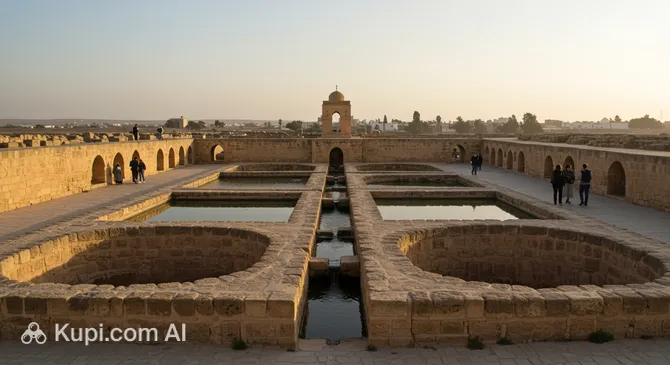
Tourist attention is usually centered on two interconnected basins. While they appear perfectly circular from a distance, they are actually complex 17-sided polygons. The smaller one served as a filter for settling sand and silt, while the larger one, with a diameter of about 130 meters and a depth of almost 5 meters, was intended for storing clean water.
These cisterns are a true triumph of hydraulic engineering from the 9th century. They not only impress with their size but also demonstrate how deep the knowledge of ancient builders was regarding pressure distribution and water filtration in an arid climate.