Support

Tunis Science City

About

Tunis Science City is a grand scientific and educational complex that has become a landmark of modern Tunis. This center was created to make science accessible and exciting for everyone. Interactive museums, a high-tech planetarium, and research laboratories are gathered under one roof on the complex's vast territory.
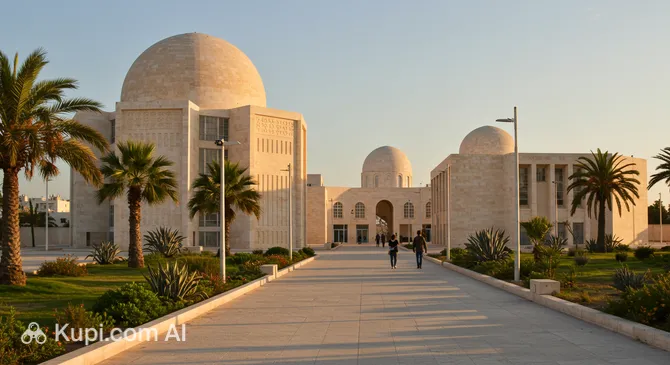
Tunis Science City
Tunis Science City. Иллюстрация. Источник: Kupi.com AI

Visitors can explore exhibitions dedicated to a wide variety of fields of knowledge: from ancient astronomy to modern genetics and robotics. This is not just a classic museum, but a living space for experiments where every exhibit can and should be touched. A special place in the complex is occupied by the planetarium, which offers breathtaking sessions about the mysteries of space.

Walking through the halls in Tunisia, you will encounter hundreds of installations demonstrating the laws of physics, biological diversity, and the environmental challenges of our time. The center carries out an important mission of popularizing STEM disciplines, annually attracting thousands of tourists and students who want to see science in action.

Contacts

For information regarding special events or group tours, you can use the official communication channels:

How to contactContact
AddressRue La Cité des Sciences à Tunis, Tunis 1082, Тунис
Phone+216 71 766 000
Websitewww.cst.rnu.tn

What to Do

Forget about boring lectures — here, science turns into an exciting game. In the complex's halls, you can independently conduct physics experiments, study light refraction, or watch real lightning being created. For nature lovers, there is an aquarium featuring local aquatic life, and in the biology zones, you can literally peek inside a human cell.

Be sure to plan a visit to the planetarium. Modern equipment projects the starry sky with striking clarity, allowing you to take a virtual flight to distant galaxies. In addition, there is a 3D cinema and flight simulators on the territory, which will help you feel like a pilot or an explorer of the deep sea.

Young guests will surely enjoy the special interactive attractions where they can launch a model rocket or try their hand at programming robots. Temporary exhibitions are often dedicated to the most current topics — from artificial intelligence to global warming — so every visit to the Science City can bring new discoveries.

Getting There

Finding this science complex is easy: it is located in the northern part of the capital, in the El Guerjoula district. The fastest and most comfortable way to get there is by taxi from the center of Tunis. The trip will take about 30 minutes, and the cost will be approximately 10–15 Tunisian dinars. For convenience, you can use mobile taxi booking services.

If you prefer public transport, use bus lines No. 20 or No. 35, which depart from the Tunis Ville central railway station. You should get off at the Cité des Sciences stop. You can also take the light metro to Ariana station and then transfer to a local bus or taxi for the short final stretch.

For travelers with rental cars, there is ample free parking on the complex's grounds. It is recommended to plan your trip for the morning hours to avoid the heavy peak-hour traffic typical of the metropolis.

Ближайший город: Tunis

History & Facts

The creation of such a large-scale facility was an important step in the country's drive to modernize education. The initiative to build the Science City belonged to the government, which aimed to popularize STEM disciplines among young people. The project drew on the experience of the best European science museums and was created with the support of international experts.

The official opening of the complex took place in 2006. The El Guerjoula area, which previously had industrial significance, was chosen for its construction. Transforming this zone into a modern research and educational hub became a symbol of the country's technological progress at the beginning of the 21st century.

Since its opening, the complex has continuously evolved. New pavilions were gradually put into operation, planetarium equipment was updated, and the collection of interactive exhibits was expanded. Today, it is considered one of the leading science centers not only in Tunisia but in all of North Africa.

Despite its modern architecture, Science City continues Tunis's centuries-old tradition as an important center of knowledge and culture. Just as the city's ancient universities were once centers of philosophical thought, this complex today opens the doors to the world of high technology for new generations.

Time Needed

To fully appreciate all the complex has to offer, it usually takes 4 to 6 hours. This is enough time to leisurely explore the permanent exhibitions, watch an exciting show at the planetarium, and visit the aquarium.

If you plan to participate in interactive workshops, visit temporary themed exhibitions, or are arriving with a large family, it's better to set aside a full day for the visit. There are rest areas on-site, allowing for a break between experiments and research.

Working Hours

You can visit the science center from Tuesday to Saturday, when the doors are open from 09:00 to 16:30. On Sunday, the complex operates on a reduced schedule — from 09:00 to 13:30.

Please note that Monday is a day off. It is recommended to check the official website before your trip, as working hours may change on holidays or during major conferences.

DayWorking hours
понедельникЗакрыто
вторник09:00–16:30
среда09:00–16:30
четверг09:00–16:30
пятница09:00–16:30
суббота09:00–16:30
воскресенье09:00–13:30

Nearby

The area around the science center offers several interesting locations for those who want to vary their day with active recreation or walks. Its proximity to amusement parks makes this an excellent starting point for a family itinerary.

Below are some interesting attractions located nearby:

NameDistance
Sultan Ahmet3 km
La Vinothèque3.1 km
Go! Sushi3.1 km
Japanese Garden of Tunis3.3 km
Carthage Land3.7 km
City of Culture4.3 km
Tunis Clock Tower5.5 km

Reached the end of the page?

That means the route is fully explored