Support

Hacı Bayram Veli Tomb

About

The Hacı Bayram Veli Mausoleum is a significant historical landmark located in the heart of the Ulus district in Ankara, the capital of Turkey. This mausoleum is situated right next to the Hacı Bayram Mosque of the same name, built in 1427-1428, and is dedicated to the prominent Turkish poet and Sufi sheikh Hacı Bayram Veli, the founder of the influential Bayramiyya tariqa.
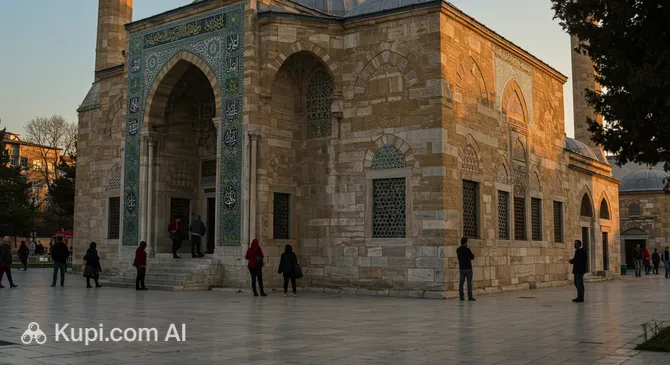
Hacı Bayram Veli Tomb. Illustration.
Source: Kupi.com AI

Traveler photos:

Considered one of the finest examples of 15th-century funerary architecture in the city, the Hacı Bayram Veli Mausoleum draws attention with its main facade, skillfully crafted from marble. Together with the mosque, it forms an important religious and cultural complex that has served for centuries as a center for followers of the Bayramiyya Sufi order, founded by Hacı Bayram himself.

The historical value of this site is enhanced by its multilayered nature. The mosque and mausoleum were built on the ruins of an ancient Byzantine church. Furthermore, archaeological studies indicate that even earlier, the famous Temple of Augustus and Roma was located on this same spot. Thus, visiting the Hacı Bayram Veli Mausoleum offers a unique opportunity to touch different eras of Ankara's history.

Contacts

Hacı Bayram Veli Mausoleum is a significant historical site and part of a major religious complex in Ankara. As it is a historical site, direct contact phone numbers may not be available. Generally, up-to-date information regarding opening hours and access conditions for such attractions can be found on the official tourism portals of Ankara or Turkey, as well as at local tourist information centers.

The mausoleum is located in the Ulus district, next to the Hacı Bayram Mosque, and can be reached by public transport or taxi by heading toward this well-known complex.

How to contactContact
AddressHacı Bayram, Şht. Keskin Sk. No:7, 06050 Altındağ/Ankara, Türkiye
Phone number+90 312 309 09 42
Websitewww.kulturportali.gov.tr

What to Do

A visit to the Hacı Bayram Veli Mausoleum offers tourists a unique opportunity to immerse themselves in the history and culture of Ankara. First and foremost, pay attention to the architecture of the mausoleum itself. Although it was built in the 15th century, its appearance shows features characteristic of the 16th century. The marble facade is particularly impressive, serving as a striking example of Islamic art from that period. It is a wonderful place for architecture and history enthusiasts, where one can examine the skillful work of past masters in detail.

Located next to the mausoleum is the Hacı Bayram Mosque, which is a significant architectural monument of Ankara in its own right. Exploring the mosque will complement your impressions of this historical complex. You will be able to appreciate its interior and feel the atmosphere of this important religious center. For many visitors, this complex is not only a tourist attraction but also a place of pilgrimage, as Hacı Bayram Veli was a prominent figure in the history of Sufism and the founder of his own religious order.

Another advantage of the mausoleum's location is its proximity to the Temple of Augustus. This allows tourists to see several major historical monuments from different eras and cultures in a single visit. A walk through this district will give you the chance to trace the centuries-old history of the city, from antiquity to the Ottoman period. Thus, visiting the Hacı Bayram Veli Mausoleum is not just about seeing one landmark, but a whole journey through time.

Getting There

Getting to the Hacı Bayram Veli Mausoleum is quite simple, as it is located in the central historical district of Ulus in Ankara, the capital of Turkey. This landmark is situated next to the equally famous Temple of Augustus, making it an easy point to find on the city map.

The most convenient way to reach the mausoleum is by using Ankara's public transport. You can reach the Ulus district by numerous city buses that pass through the center, or by metro. The nearest metro station is aptly named "Ulus". From the metro exit, it’s just a few minutes' pleasant walk through historical streets to reach the mausoleum.

If you prefer a more comfortable way to travel or are carrying luggage, you can always use a taxi. Taxis in Ankara are widely available, and a trip from any part of the city to the Ulus district doesn't take much time, depending on traffic. Simply tell the driver Hacı Bayram Mausoleum or Hacı Bayram Mosque, and you will be taken to this important cultural complex.

Nearest city: Ankara

History & Facts

The history of the Hacı Bayram Veli Mausoleum is inseparable from the life of Hacı Bayram himself (full name Numan-bin-Ahmed, also known by the name Hacı Bayram-ı Veli), one of the key figures in the spiritual life of 15th-century Turkey. He initially gained fame as a talented poet but later dedicated himself entirely to Sufism—a mystical branch of Islam. Hacı Bayram founded his own Sufi order, known as "Bayramiyya." His teachings were characterized by simplicity, accessibility, and a special focus on personal righteousness, love for one's neighbor, and active assistance to those in need, which earned the order widespread popularity and recognition among various social classes.

The construction of the Hacı Bayram Mosque and tomb dates back to approximately 1427-1428, although precise documentary evidence of the initial construction phase has unfortunately not survived. It is particularly noteworthy that this landmark complex was built on a site with a rich and multilayered history. Before the Islamic shrine, the ancient Temple of Augustus and a Byzantine church were successively located here. Choosing this historically significant site to establish the center of the Bayramiyya order can be interpreted as a symbol of spiritual continuity and the establishment of a new teaching on land that had been revered for many centuries.

The mausoleum itself is an outstanding example of 15th-century Islamic funerary architecture and is rightfully considered one of the most beautiful in Ankara, largely thanks to its exquisite marble facade. At the same time, the adjacent Hacı Bayram Mosque exhibits architectural features more characteristic of the 16th century. This stylistic difference is likely due to later reconstructions and expansions. Such changes could have been driven by the growing influence of the Bayramiyya order and its increasing number of followers, as well as a desire to reflect the evolving architectural tastes of the era while carefully preserving the historical core of the entire complex.

Time Needed

For a typical visitor, seeing the Hacı Bayram Veli Mausoleum itself usually takes relatively little time—typically from 30 minutes to 1 hour. This is enough to appreciate the architecture of the mausoleum, its marble facade, see the interior if access is open, and soak in the atmosphere of this historical site. The size of the mausoleum itself is not very large, so a detailed inspection will not take long.

However, it is worth noting that the Hacı Bayram Veli Mausoleum is part of a larger complex that includes the mosque of the same name. If you also plan to visit the Hacı Bayram Mosque, which is highly recommended for a complete experience, the total duration of your stay may increase to 1-2 hours. Additionally, the Temple of Augustus, another important Ankara landmark, is located in the immediate vicinity. If your visit includes an inspection of these sites as well, you can easily allocate half a day to this entire historical zone.

Working Hours

The Hacı Bayram Veli Mausoleum, like the adjacent mosque, is an active religious site, so visiting hours may vary and generally coincide with the mosque's opening times. Usually, access for tourists is open throughout the day, except during prayer times. To get the most accurate and up-to-date information on opening hours, it is recommended to check official Ankara tourism websites or inquire directly on-site, as details may change.

As a rule, visiting the mausoleum does not require prior ticket booking or registration; entrance is free. However, if you plan to visit the complex as part of a large tour group, it is better to check this in advance. The Hacı Bayram Veli Mausoleum is open to visitors year-round, serving as an important cultural and religious center in Ankara.

8:00 – 18:00

Nearby

Visiting the Hacı Bayram Veli Mausoleum is undoubtedly a significant event for any traveler interested in the history and culture of Ankara. However, to make your immersion into the atmosphere of this ancient city even more complete and memorable, it is worth paying attention to the attractions located in the immediate vicinity. Exploring the surroundings will allow you to better understand the historical context of the mausoleum and see how different eras intertwine on the streets of the Turkish capital.

The Ulus district, where the mausoleum is located, is a true treasure trove in itself. Here, literally just a few steps from each other, many of Ankara's key monuments are concentrated. Below is a list of some interesting places you can visit not far from the Hacı Bayram Veli Mausoleum, with approximate distances.

This table will help you plan your route and make the most efficient use of your time to discover the rich heritage of Ankara. Each of these places is unique in its own way and will complement your impressions of visiting the Hacı Bayram Veli Mausoleum.

NameDistance
Economic Independence Museum0.3 km
Museum of the War of Independence0.4 km
Atatürk Monument0.4 km
Republic Museum (Second Grand National Assembly Building)0.6 km
Museum of Anatolian Civilizations0.8 km
Ankara Castle0.9 km
Ulucanlar Prison Museum1.5 km

Have you reached the end of the page?

So the route has been studied inside and out