Support

Hunat Madrasa

About

Located in the very heart of Kayseri, this building is a magnificent monument of Seljuk architecture. The Hunat Medrese, built in 1238, is not just an educational institution, but part of a monumental religious complex that has become a true symbol of Turkey during the Middle Ages.

This architectural ensemble was commissioned by Mahperi Hunat Hatun, the wife of the Seljuk Sultan Alaeddin Keykubad. The complex brings together a mosque, a medrese (religious school), a mausoleum, and a hammam under one roof. The main feature of the building is its incredible portals, decorated with the finest stone carving, which is considered some of the best of its kind.
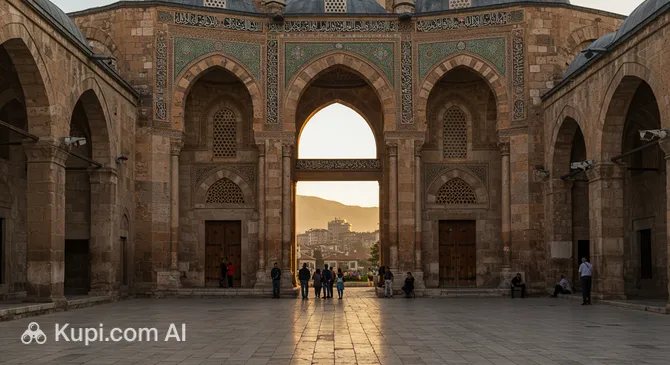
Hunat Madrasa
Hunat Madrasa. Иллюстрация. Источник: Kupi.com AI

Today, the medrese continues to thrive as an important cultural and historical site. It impresses visitors with its integrity and the austerity of form characteristic of the Seljuk style, allowing tourists to literally touch the history of the great 13th-century Islamic civilization.

Contacts

To check the latest information before your visit, it is recommended to visit official resources or use navigation services.

How to contactContact
AddressHunat, Seyyid Burhanettin Blv. No:1, 38030 Melikgazi/Kayseri, Türkiye
Websitewww.kayseri.gov.tr

What to Do

When visiting the complex, the first thing to notice is the main portal. Its stone carving is a virtual textbook of Seljuk ornamentation. The delicate geometric and floral patterns create a play of light and shadow that is definitely worth capturing on camera.

Inside the complex, be sure to visit the tomb (türbe) of Mahperi Hatun, located in the inner courtyard. It is also decorated with exquisite carvings and serves as the resting place of the founder. The peace and tranquility of the courtyard allow you to escape the city's hustle and bustle and feel the atmosphere of medieval enlightenment.

You can conclude your tour by visiting the complex's active mosque. The interior has preserved elements that reflect the architectural traditions of that era. Thanks to its proximity to the Kayseri Castle, a visit to the medrese fits perfectly into a walking route through the historical city center.

Getting There

Finding this attraction is easy, as it is located in the very heart of the city. The complex is situated at: Hunat, Seyyid Burhanettin Blv. No:1, Melikgazi. A key landmark for tourists is the massive Kayseri Castle (Kayseri Kalesi), located in the immediate vicinity.

The medrese can be easily reached by public transport — numerous bus routes and a tram line pass through the city center. If you prefer more comfort, you can use a taxi, which is relatively inexpensive in the city. For those staying in central hotels, a walk on foot is an excellent way to experience the local atmosphere.

Ближайший город: Kayseri

History & Facts

The history of this place is inextricably linked with the name of Mahperi Hunat Hatun, the widow of the famous Seljuk Sultan Alaeddin Keykubad. Built in 1238, the complex was the first of twelve buildings constructed on her initiative. After converting to Islam following her husband's death, Hunat Hatun dedicated herself to charity and education, leaving behind this architectural treasure.

Interestingly, the construction took place during a challenging period for Anatolia. After the defeat at the Battle of Kösedağ in 1243, when Mongol troops threatened the city, the founder of the complex was forced to seek protection in a castle. Despite political upheavals, the medrese stood firm and has preserved its original appearance as a symbol of the greatness of Islamic civilization during the Seljuk era.

At the center of the complex lies the tomb (türbe) of Hunat Hatun herself. The fact that she commissioned the construction of a mausoleum for herself as part of an educational and religious center highlights her high status and significant influence on the cultural life of that time. This structure stands as a silent witness to the "golden age" of Kayseri as an economic and spiritual hub of the region.

Time Needed

To leisurely explore the main parts of the complex, including the mosque and the medrese courtyard, most travelers will need 30 to 60 minutes. This is enough time to appreciate the skill of the stone carvers and take some memorable photos.

If you are a connoisseur of architectural details or interested in the history of the Seljuk period, you might spend a bit more than an hour here, studying the ornaments on the portals and visiting the mausoleum of Mahperi Hatun.

Working Hours

The exact opening hours of the Hunat Medrese may vary depending on the season and religious activities held in the complex's mosque. Traditionally, such historical sites are open to visitors during daylight hours.

Since the building also functions as a religious center, it is recommended to plan your visit between prayer times. For the most up-to-date access information, we suggest checking the official website of the Kayseri province.

Nearby

Thanks to the central location of the medrese, you can continue exploring the city's rich heritage with a simple stroll through the neighborhood. A short walk will lead you to other iconic architectural and cultural monuments.

NameDistance
Hunat Bath0 km
Tomb of Zeynel Abidin0.1 km
Kayseri Castle0.2 km
Ataturk House Museum0.2 km
Kayseri Archaeological Museum0.2 km
Kayseri Clock Tower0.3 km
Kayseri Republic Square0.3 km

Reached the end of the page?

That means the route is fully explored