Support

Amasya Bayezid II Complex

About

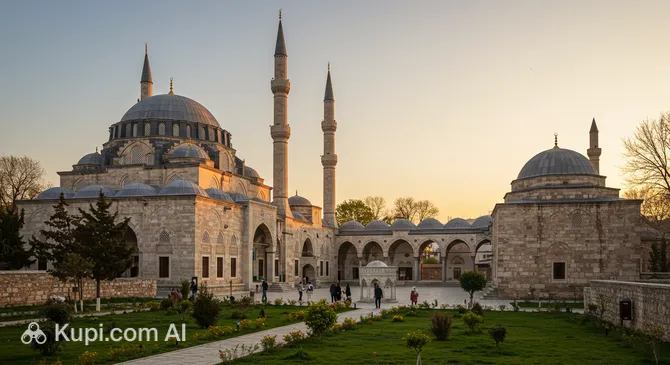
A visit to the city of Amasya is unthinkable without discovering a majestic monument of Ottoman architecture — the Sultan Bayezid II Complex. Built between 1485 and 1486, this architectural ensemble is a striking example of the early Ottoman Bursa style. It was commissioned by Shehzade Ahmed, the son of Sultan Bayezid II, and is one of the most significant imperial mosques in Turkey.
\n\n
Beyazid II Complex (Amasya)
Beyazid II Complex (Amasya). Иллюстрация. Источник: Kupi.com AI
\n\n

The complex was designed as a complete social and religious hub, featuring not only a mosque with a massive dome but also a madrasah (educational school), a charity kitchen (imaret), and a tranquil courtyard with a fountain. The buildings are constructed from hewn stone with minimalist yet exquisite decor: alternating colored stones can be seen around the windows and arches, lending a unique aesthetic to the austere forms.

\n\n

The site's architecture reflects a unique transition period from early traditions to the classical Ottoman style. The interior of the mosque impresses with its symmetry and simplicity, while the high dome creates a sense of extraordinary spaciousness. This location is ideal for those wanting to feel the atmosphere of antiquity and see how imperial patronage shaped the appearance of Anatolian cities.

Contacts

For planning your visit to the Sultan Bayezid II Complex, it is helpful to check the official details. Although the site does not have a direct information telephone number, it is an active cultural and religious center open to the general public.

How to contactContact
AddressHacı İlyas, Sultan II. Bayezit Cami No:47, 05100 Amasya Merkez/Amasya, Türkiye
Websiteamasya.ktb.gov.tr

What to Do

Start your discovery of the complex with a walk through its spacious courtyard. Here, you can admire the elegant ablution fountain and the arcades, which provide pleasant shade even on a hot day. Be sure to step inside the mosque (keeping prayer times in mind) to appreciate the grandeur of the main dome and the calm dignity of the interior, which is free of excessive luxury yet filled with light.

History and architecture buffs will find it interesting to study the layout of the madrasah and the imaret. By examining the masonry of the walls and the shape of the vaults, you can spot unique details of early Ottoman craftsmanship. This location is also an excellent spot for photography: the complex’s massive stone walls set against the backdrop of Amasya’s picturesque mountains make for truly impressive shots.

Spend some time in the quiet beneath the vaults of these ancient buildings, reflecting on the site's role as a center for education and charity in the past. After touring the mosque, you can continue your route to the nearby rock tombs, making your walk through the historical center as rich and interesting as possible for the whole family.

Getting There

The landmark is located in the very heart of Amasya, at Hacı İlyas, Sultan II. Bayezit Cami No:47. If you are staying in the historical center, you can reach the mosque on foot in just 10–15 minutes from major tourist spots, including the famous rock tombs.

For those arriving from other regions via Amasya Merzifon Airport (located 20 km away), it is most convenient to take a taxi or a shuttle bus; the trip to the center takes about 30–40 minutes. From the city’s main bus station, local minibuses (dolmuş) run regularly to the complex, taking no more than 10 minutes. Taxis within the city are also an affordable and fast way to get around.

Amasya is very compact and pedestrian-friendly. You can plan your route along the scenic Yeşilırmak River, enjoying views of old Ottoman mansions before turning toward the square where the majestic complex is situated. Entry to the grounds is free, and there are parking spaces available nearby.

Ближайший город: Amasya

History & Facts

This architectural masterpiece was erected in 1485–1486 by order of Shehzade Ahmed, the son of Sultan Bayezid II. Its construction coincided with an era of rapid development in Ottoman architecture, when Sultan Bayezid II sought to transform the empire's cities into educational and cultural centers. The complex in Amasya was the last major structure built in the "Bursa style" before Ottoman architecture transitioned to classical canons.

Architects of that time designed not just individual buildings, but integrated külliye (social complexes). The ensemble included a mosque, a madrasah (theological school), an imaret (charity kitchen), and a primary school. Such a layout reflected the Ottoman rulers' commitment to urban development and supporting those in need. Notably, a similar complex was being built in Edirne at the same time, highlighting the unity of the imperial style of that era.

For centuries, the Sultan Bayezid II Complex remained a benchmark of early Ottoman aesthetics in Anatolia. Its strict symmetry, the use of alternating colored stones in the decoration of arches and windows, and its powerful domes demonstrate the skill of transition-period builders. Today, the complex is recognized as one of the most important monuments for tracing the evolution of Turkish architecture from regional styles to grand imperial scale.

Time Needed

To fully appreciate the Sultan Bayezid II Complex, one typically needs 1 to 2 hours. This allows enough time to leisurely explore the interior of the main mosque, stroll through the courtyard with its ancient fountain, and examine the external facades of the madrasah and imaret.

If you are an architecture enthusiast or enjoy detailed photography, set aside a bit more time — the play of light on the stone arches and the view of the mosque against the backdrop of the rugged mountains are well worth the attention. For those visiting the complex as part of a quick introductory walk through the city, 40 minutes will suffice to appreciate the scale and grandeur of this historical ensemble.

Working Hours

While the exact opening hours of the Sultan Bayezid II Complex are not officially regulated, like most active religious sites, it is open to visitors daily from dawn to dusk. Visitors should take into account the times of the five daily prayers, during which tourist access to the main prayer hall may be restricted.

It is recommended to plan your visit during daylight hours to fully appreciate the architectural details and the beauty of the courtyard. To get the most up-to-date information before your trip, it is advisable to check the official website of the Amasya Department of Culture and Tourism or clarify details with local guides upon arrival.

Nearby

Exploring the area around the Sultan Bayezid II Complex allows tourists to delve deeper into the region's history and see how different eras intertwine in the city's architecture. The neighboring streets hide many interesting sites — from old Turkish baths to the ruins of ancient structures.

Thanks to the compactness of Amasya's historical center, most significant attractions are within walking distance. You can easily combine a visit to the mosque with a walk to the rock tombs or an exploration of the unique wooden houses along the riverfront.

NameDistance
Amasya Miniature Museum0.1 km
Amasya Archaeology Museum0.2 km
Şehzadeler Promenade Route0.2 km
Teşup Mansion Hotel0.3 km
Ziyagil Mansion0.3 km
Amasya Riverside Houses0.4 km
Museum of the Ottoman Princes0.4 km

Reached the end of the page?

That means the route is fully explored