Support

Gök Medrese

About

The majestic Gök Medrese is a true gem of 13th-century Islamic architecture, located in the historic center of Sivas. Officially known as the Sahibiye Medrese, it earned its popular name, which translates as the "Celestial Madrasa", due to the stunning turquoise tiles decorating its facade. This structure in Turkey is considered one of the most significant monuments of the Seljuk period.
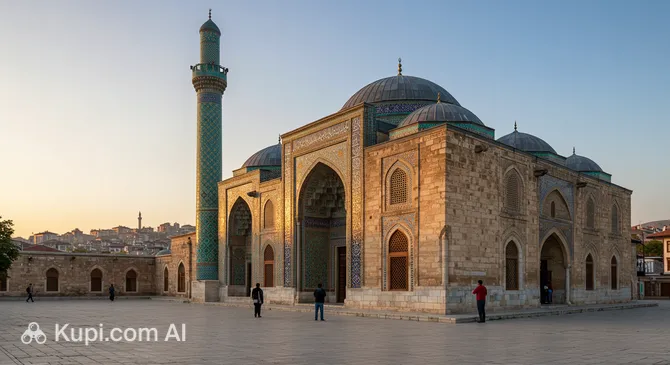
Gök Medrese
Gök Medrese. Иллюстрация. Источник: Kupi.com AI

The building's architectural appearance is striking for its monumentality: the main entrance features a massive marble portal with intricate filigree carving, flanked by two slender 25-meter minarets. The internal layout follows the classical canons of the time—here you will find an open courtyard surrounded by two-story galleries and iwans, where philosophical and religious discussions were once held.

Today, Gök Medrese serves not only as a pilgrimage site for art connoisseurs but also as an important symbol of the city. Its facade is a kind of "stone chronicle," where intricate patterns and the play of light create a unique sense of connection with the ancient history of Anatolia.

Contacts

For your convenience, we have collected the current contact information for the Gök Medrese. You can clarify visiting details via the official phone number or on the national culture portal.

How to contactContact
AddressGökmedrese, Gökmedrese Cd., 58070 Merkez/Sivas Merkez/Sivas, Türkiye
Phone+90 346 225 00 66
Websitewww.kulturportali.gov.tr

What to Do

A visit to the Gök Medrese is, first and foremost, a visual delight. The first thing worth doing is a detailed study of the main portal. The carved patterns on the marble are so delicate that they create a unique play of shadows under different lighting. This is an ideal spot for architectural photography, especially against the backdrop of the tall brick minarets with their characteristic mosaics.

Inside the building, visitors can take a leisurely stroll through the open courtyard, feeling the atmosphere of a medieval educational institution. It is worth paying attention to the layout of the iwans and the remains of the original tiles that gave the entire complex its name. The sense of coolness and peace inside the stone walls allows for a temporary escape from the bustle of the modern city.

Since 1926, a museum exhibition has been housed within the walls of the medrese. Here you can see artifacts that tell the story of the region and the daily life of people during the Seljuk era. It is a wonderful opportunity to see authentic antiquities within interiors that are themselves a priceless exhibit.

Getting There

The landmark is located in the heart of the historic center, so getting there is quite easy. If you are staying in the central part of Sivas, a walk to the medrese will be a pleasant addition to your route—the building is located on Gökmedrese Caddesi and is visible from afar thanks to its tall minarets.

For those arriving from other districts or cities, it is convenient to use a taxi or city transport. Sivas railway station and the bus terminal are within reach, from where you can quickly reach the site by public bus or car. If you are traveling by your own car, there are parking spaces for tourists in the vicinity of the complex.

Ближайший город: Sivas

History & Facts

The history of the Gök Medrese dates back to the heyday of Seljuk power. It was erected in 1271–1272 by order of Sahip Ata Fahreddin Ali, the Grand Vizier of the Sultanate of Rum. This man went down in history as an outstanding patron of the arts, and the medrese in Sivas became one of his most ambitious projects.

For centuries, the building functioned as a prestigious Islamic educational institution. However, with the passage of time and the change of eras, its role changed. In 1926, the government decided to turn the empty building into a museum, which helped protect the fragile decorative elements from destruction and preserve the unique appearance of the monument for posterity.

Despite the fact that some elements, such as the eastern iwan, suffered over time and were restored later (including in wood), the main structure of the facade and the famous turquoise tiles have reached us almost in their original form. This allows modern researchers to study the 13th-century decorative carving and majolica techniques in detail.

Time Needed

For a thoughtful inspection of the Gök Medrese, including studying the carved details of the facade and a walk through the courtyard, 30–60 minutes is usually sufficient. It is a compact yet detail-rich structure that does not require many hours of stay unless you plan to engage in detailed architectural photography or scientific study.

This timing makes it easy to include a visit to the medrese in a general tour of the city center, combining it with an inspection of neighboring Seljuk-era monuments. If you decide to look into the museum exhibition, aim for the upper limit of this time frame.

Working Hours

When planning a visit to the Gök Medrese, please note the opening hours. The museum complex welcomes guests from Tuesday to Sunday, while Monday is the official day off.

On other days, the doors are open from 9:00 to 18:00, providing ample time to enjoy the architecture both in the morning hours and in the rays of the pre-sunset sun, when the facade looks particularly spectacular.

DayWorking hours
ПонедельникЗакрыто
Вторник9:00 – 18:00
Среда9:00 – 18:00
Четверг9:00 – 18:00
Пятница9:00 – 18:00
Суббота9:00 – 18:00
Воскресенье9:00 – 18:00

Nearby

A stroll around the Gök Medrese will allow you to dive deeper into the atmosphere of ancient Sivas. Most of the significant historical monuments and recreation areas are within walking distance, creating a unified cultural ensemble in the city center.

NameDistance
Grand Mosque of Sivas0.3 km
Double Minaret Madrasa0.5 km
Sifaiye Madrasa0.5 km
Tozlu Raflar Gift Shop0.5 km
Sivas State Theatre0.5 km
Taşhan Caravanserai0.6 km
Buruciye Madrasa0.6 km

Reached the end of the page?

That means the route is fully explored