Support

Tokat Castle

About

Towering over the Yeşilırmak River valley, Tokat Castle (Tokat Kalesi) stands as a silent witness to a thousand-year history preserved by the ancient city of Tokat. This powerful fortification, located on a steep rocky hill in Turkey, served for centuries as a key defensive point controlling strategic trade routes.

The castle is a unique architectural ensemble where traces of the Pontic, Byzantine, Seljuk, and Ottoman eras intertwine. Its crenelated walls offer breathtaking panoramic views of modern city blocks and picturesque natural landscapes. According to one version, the name "Tokat" comes from the phrase "Tok-Kat," which literally translates as "a fortress surrounded by walls."
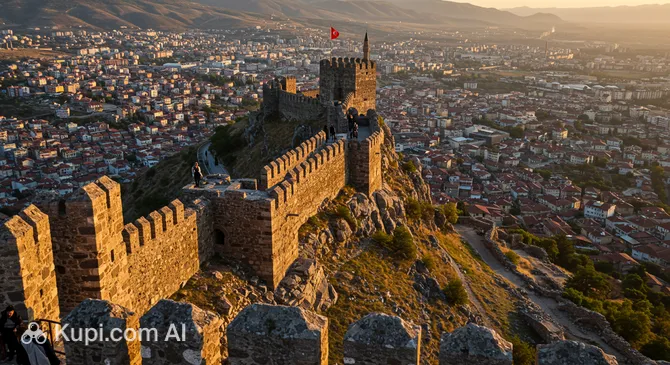
Tokat Castle
Tokat Castle. Иллюстрация. Источник: Kupi.com AI

Today, this site is recognized as a significant historical landmark and a popular tourist attraction. Although the interior of the fortress has transformed into a rocky plateau over time, it continues to draw researchers and travelers with its majestic atmosphere and the legends hidden behind its massive stonework.

Contacts

When planning a visit to this historical site in Tokat, it is helpful to have the exact coordinates on hand. Please note that the site may currently have visiting restrictions.

How to contactContact
AddressSemerkant, 60100 Tokat Merkez/Tokat, Türkiye

What to Do

The main reason to make the climb to Tokat Castle is for the incredible panoramic views. From a bird's-eye perspective, the city of Tokat and the winding course of the Yeşilırmak River appear in the palm of your hand, providing ideal conditions for artistic photography.

History buffs can spend time exploring the ancient ruins and the preserved battlements. The dungeons discovered here are of particular interest. One of them is shrouded in mystical fame—it is believed to be the very place where the famous Wallachian prince Vlad the Impaler was held in custody. A walk through the fortress grounds allows you to appreciate firsthand the skill of ancient engineers who successfully integrated powerful fortifications into the challenging mountain landscape.

After touring the citadel, it is recommended to head down to the city's historical center to visit the old madrasas and bustling market squares. This combination of an active climb and a cultural promenade will allow you to fully experience the spirit of this unique region.

Getting There

Tokat Castle is located northwest of the city center, majestically overlooking Cumhuriyet Alanı (Republic Square). If you are already in the center, a walk to the foot of the hill will take about 10–15 minutes. The main landmark is Gazi Osman Paşa Boulevard, from which trails lead up to the defensive walls.

For travelers from other regions of Turkey, buses are the most convenient option. The journey from Ankara takes about 8 hours, from Istanbul 10 to 12 hours, and from neighboring Sivas, you can arrive in just 2 hours. Within the city, you can use taxis or local minibuses (dolmuş) that pass by the key architectural monuments.

If you are traveling by car, follow the D100 highway. You can leave your car in the parking area at the base of the cliff. Important tip: Be sure to wear comfortable athletic shoes for the climb to the fortress, as the terrain is quite steep and rocky.

Ближайший город: Tokat

History & Facts

The history of this site is striking for its longevity: the first settlements on the rocky hill emerged back in the Chalcolithic era, and some artifacts found here are over 5,000 years old. Over various eras, Tokat Castle was controlled by the Hittites, Phrygians, and Persians, and later became part of Alexander the Great's empire. In ancient times, it was closely linked to the religious center of Comana Pontica.

The citadel began to take on its current rugged appearance during the Pontic period. Later, its walls were reinforced by the Romans, Byzantines, Seljuks, and Ottomans. After the famous Battle of Manzikert in 1071, the fortress became a stronghold for the Danishmend dynasty, who transformed the region into a flourishing hub of science and culture. Later, the city voluntarily came under the rule of the Ottoman Sultan Bayezid I, and the fortress itself successfully withstood the siege of the Great Tamerlane.

One of the most somber and intriguing facts about the castle's history is its use as a prison for high-ranking individuals. It was here, in the deep dungeons, that the Wallachian prince Vlad III the Impaler, who became the prototype for the legendary Count Dracula, was held captive. This historical episode today attracts many fans of mystical legends to the city of Tokat.

By the 19th century, the citadel's defensive significance began to decline as the region's administrative center gradually shifted toward Sivas. Nevertheless, Tokat Castle has preserved its architectural integrity, remaining a vital monument of fortification art on the ancient Silk Road.

Time Needed

A full exploration of this historical site typically takes 1 to 2 hours. This is ample time to leisurely climb the hill, examine the surviving sections of the walls, and take commemorative photos.

The climb itself takes about 30–45 minutes depending on your physical fitness level. If you plan to study the ancient ruins in detail and linger at the viewpoints to enjoy the valley vistas, it is worth allotting a bit more time. A visit to the castle is best combined with a stroll through the historical quarter at its base.

Working Hours

Currently, Tokat Castle is listed as Closed Temporarily due to ongoing restoration work aimed at preserving the ancient walls and underground passages.

Visitors are strongly encouraged to check for up-to-date information on the city's official tourism portals or inquire at local information centers before beginning the ascent to the citadel.

Nearby

Exploring the area around the castle will allow you to delve deeper into the atmosphere of the old city. The Sulusokak district, located right at the foot of the hill, is considered a true open-air museum where every building is steeped in history.

A stroll through these streets will reveal magnificent examples of Ottoman and Seljuk architecture, from ancient educational institutions to richly decorated mansions.

NameDistance
Taşhan Caravanserai0.3 km
Yagbasan Madrasa0.3 km
Tokat Museum0.3 km
Ali Pasha Mosque and Tomb0.4 km
Latifoglu Mansion0.7 km
Mevlevi Lodge0.9 km
Tokat Clock Tower0.9 km

Reached the end of the page?

That means the route is fully explored