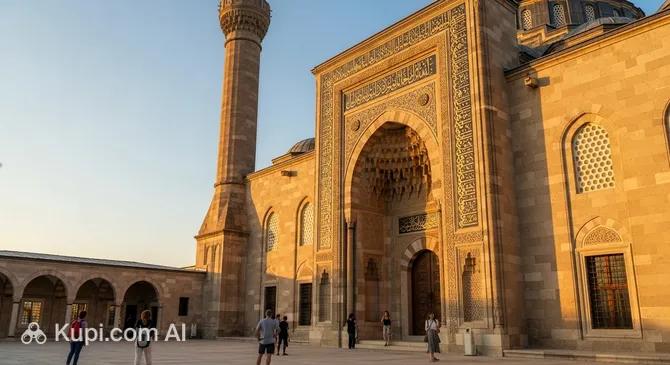
Strolling through the bustling streets of Kayseri, it is hard to miss the rugged yet elegant beauty of its ancient walls. The Hacı Kılıç Mosque (Hacı Kılıç Camii) is more than just a religious building; it is a true architectural gem that has come down to us from the 13th century. It is a unique complex that unites a mosque and a madrasa under one roof.
Hacı Kılıç Mosque. Illustration.
Source: Kupi.com AI
Traveler photos:
Built in 1275 during the peak of Seljuk architecture, this site is one of the most significant historical monuments Turkey takes pride in. The complex is distinguished by its strict geometric forms and a magnificent stone portal, considered a classic example of the style of that era. The rectangular prayer hall and the adjoining school rooms create an atmosphere of peace and historical continuity.
Today, this place attracts not only worshippers but also many history and art enthusiasts. Its high rating among travelers confirms that the Hacı Kılıç Mosque remains an important cultural beacon, allowing modern tourists a glimpse into the glorious past of Central Anatolia.
Contacts
For those planning to visit this historic site, the basic contact information is provided below:
Once here, the first thing to note is the monumental portal. Its exquisite stone carvings are a veritable textbook of Seljuk decorative art. Photographers will find plenty of interesting angles here, especially in sunny weather when the play of shadows emphasizes the complexity of the ornaments and ancient inscriptions.
Inside the complex, you can feel the coolness and serenity characteristic of ancient mosques. Take a walk through the interior rooms that once served as classrooms for madrasa students. This is a great opportunity to imagine how educational and spiritual life was organized in Kayseri many centuries ago.
A visit to the mosque fits perfectly into an itinerary through the old center. After touring Hacı Kılıç, be sure to walk toward the old bazaar or the citadel to see how ancient architecture is harmoniously integrated into the modern rhythm of the Turkish city. Don’t forget to spend some time on the exterior details made of dark volcanic stone, which gives the building a special, majestic look.
Getting There
The attraction is located in the heart of the Kocasinan district. If you are already walking through the central part of the city, the stroll from the Kayseri Citadel or Republic Square will take only about 10–15 minutes. The route passes through lively streets, allowing you to better soak in the local atmosphere.
For those who prefer public transport, buses and dolmuş (shuttle taxis) running along İstasyon Cd. are excellent options — stops are located in the immediate vicinity of the complex. If you are coming from Kayseri Airport (ASR), a taxi ride will take about 20–30 minutes, and you can also use the Havaş shuttle buses that run to the city center.
When using a navigator, look for the address Gevhernesibe, İstasyon Cd. No:49. For travelers arriving by car, parking zones are available in the surrounding blocks, although the historic center is best explored on foot.
Nearest city: Kayseri
History & Facts
The construction of this majestic complex dates back to 1275, placing it in the era of the Sultanate of Rum. This was a time of Seljuk architectural flourishing in Anatolia, when the city was actively expanding beyond its old Byzantine walls. Some sources mention earlier construction stages starting in 1249, initiated by influential Seljuk rulers.
One of the key historical features of the Hacı Kılıç Mosque is its multi-functionality. Combining a mosque and a madrasa (religious school) into a single architectural ensemble was characteristic of the period, turning the complex into a center for both spiritual and intellectual life. The buildings were constructed using local volcanic stone, which ensured their durability and unique aesthetic appearance.
Over the centuries, the complex has survived many events, including the earthquakes common to the region, yet it has managed to preserve the authentic features of the Seljuk style. Today, it serves as an important testament to the medieval Islamic heritage of Central Anatolia and is one of the oldest surviving structures in modern-day Kayseri.
Time Needed
Exploring the architectural complex itself, including the mosque interiors and the courtyard of the former madrasa, usually takes about 30–45 minutes. This is ample time to leisurely examine the carved details on the portals and enjoy the tranquility inside the building.
If you plan to combine your visit with a stroll through the neighboring streets of the old town and a tour of nearby monuments, you should set aside about 1–1.5 hours. The mosque is very conveniently located for those who enjoy discovery-filled walks through historical centers.
Working Hours
Like most active religious sites, the Hacı Kılıç Mosque is open to the public daily. However, it is important to remember that access for tourists may be limited during the five daily prayers. During these times, it is recommended to remain quiet and not disturb the worshippers.
Since the official schedule may change, visitors are advised to check information on-site or look for local announcements. The best time for sightseeing is the first half of the day, between the morning and midday prayers.
Nearby
Thanks to its central location, a visit to the mosque can be easily combined with exploring other iconic city spots. Discovering the surroundings will allow you to dive deeper into the rich history of the region, where different eras and cultures intertwine.