Support

English Heritage - Weeting Castle

About

Imagine the secluded ruins of a medieval manor house holding eight centuries of English aristocratic history. This is Weeting Castle—a rare example of a luxurious 12th-century stone house. Located near the town of Brandon, this site in Great Britain is officially designated as a "scheduled ancient monument" and is managed by English Heritage.
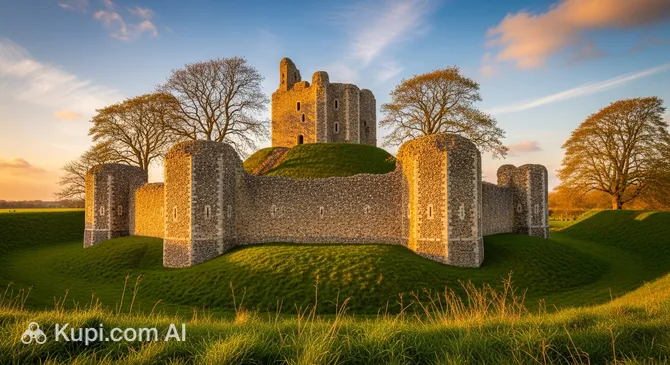
Weeting Castle
Weeting Castle. Иллюстрация. Источник: Kupi.com AI

Despite its name, this structure was never a castle in the traditional military sense. Built around 1180 by the Norman lord Hugh de Plais, it was intended as a grand country residence. The architectural ensemble included a three-story tower, a spacious main hall, and a separate kitchen block, while the surrounding ten-meter moat served more as a symbol of the owner's high status than as a real defense against enemies.

Today, visitors can see the surviving foundations and wall fragments in the Romanesque style, constructed from flint and stonework. Of particular interest is the fact that the castle stands on the site of an even older Saxon settlement that existed here from the 7th century, making this location a unique crossroads of different eras in English history.

Contacts

To check for up-to-date information before visiting Weeting Castle, you can use the official contact details.

How to contactContact
AddressCastle Cl, Weeting, Brandon IP27 0RQ, Великобритания
Phone+44 370 333 1181
Websitewww.english-heritage.org.uk

What to Do

A stroll through the castle grounds is a chance to touch the daily life of the medieval nobility. You can freely explore the remains of the main hall, where guests were once received, and try to spot fragments of former grandeur in the masonry details: carved columns and decorative elements. Be sure to notice the foundations of the service buildings and the kitchen, which was purposely built as a separate structure to protect the main part of the house from the fires frequent in those times.

History buffs interested in unusual details should look for the ice house, located to the left of the entrance. It appeared here much later than the castle itself and was used by the owners of the neighboring estate to store ice harvested directly from the moat during the winter months. The surrounding landscape, with its quiet moat and old trees, provides an ideal backdrop for historical-style photoshoots.

For a deeper dive into the context, it is recommended to study the information boards installed on the grounds. They vividly illustrate what the manor looked like during its heyday and tell the story of the transition from a simple Saxon dwelling to a monumental Norman house. This place is perfect for a quiet, contemplative break away from the hustle and bustle of the city.

Getting There

Getting to this historical location is quite simple if you are traveling through the eastern part of the country. Weeting Castle is located just 750 meters north of the village of the same name. If you are traveling by car, follow the A1065 or B1106 roads leading from the town of Brandon. There is visitor parking provided near the ruins.

For those who prefer public transport, the nearest arrival point is the Brandon (East Midlands Railway) railway station. From the station to the castle ruins, it is about 3 kilometers, which can be covered by taxi or a pleasant walk taking about 30–40 minutes. Also, buses run to the village of Weeting itself, from where the attraction is no more than a 15–20 minute walk.

It is worth considering the terrain: access to the ruins is via an earth causeway. In winter or after heavy rains, the moat surrounding the castle may partially flood, which gives the place a special charm but requires suitable footwear for walking in the countryside.

Ближайший город: Brandon

History & Facts

The history of this site is rooted deep in the past. Archaeological excavations have confirmed that the area where the castle stands today was inhabited as early as the 7th century. A Saxon settlement was located here, traces of which—in the form of ditches and pottery—were discovered by researchers. By the 10th century, a full-fledged Anglo-Saxon manor had formed on this site.

The castle took on the stone form whose ruins we see today around 1180. Its builder was Hugh de Plais, a Norman lord and vassal of the Earl of Surrey. Interestingly, Hugh largely copied the architecture of his lord's house at Castle Acre. It was a high-status building in the Romanesque style, known as a domus defensabilis—a fortified manor house that emphasized the owner's wealth rather than serving as a fortress for warfare.

In the mid-13th century, the manor acquired a wide rectangular moat. This was done not so much for defense as for prestige and the ability to raise fish. During the same period, the kitchen block and stables were added. However, prosperity did not last forever: at the end of the 14th century, the male line of the de Plais family ended, and the estate passed to the Howard family, after which Weeting Castle was gradually abandoned.

In the 18th century, the ruins became part of the landscaped park of the now-destroyed Weeting Hall estate. At this time, an ice house was even built here to store ice harvested from the moat. In 1926, the monument came under state care, and today it is managed by English Heritage, preserving a piece of Norfolk's medieval grandeur for us.

Time Needed

To leisurely explore the monument grounds, study the information stands, and take atmospheric photos, 1 hour is usually sufficient. The site is quite compact, and all its main parts are within easy walking distance of each other.

If you are interested in architectural details or plan to have a small picnic in the picturesque surroundings of the ancient walls, you can extend your stay to an hour and a half. A visit to the ruins is often combined with a walk through nearby Brandon, which together can take up half a day.

Working Hours

Weeting Castle is usually open to visitors daily, from Monday to Sunday. Standard access hours to the grounds are from 09:00 to 17:00.

Since the monument is outdoors and managed by English Heritage, the schedule may change depending on the season or maintenance work. Before your trip, it is recommended to check the official website to ensure the ruins are accessible on your chosen day.

09:00–17:00

Nearby

A visit to the ruins of a medieval manor can be complemented by a walk through the surrounding area, which boasts many interesting sites and establishments reflecting the spirit of this part of England. Exploring the attractions around the town of Brandon will allow you to delve deeper into local history and enjoy the region's hospitality.

NameDistance
Valentino's Restaurant & No.30 Coffee Lounge2.6 km
Brandon Tandoori2.7 km
Brandon Country Park3.9 km

Reached the end of the page?

That means the route is fully explored